Novelhalla
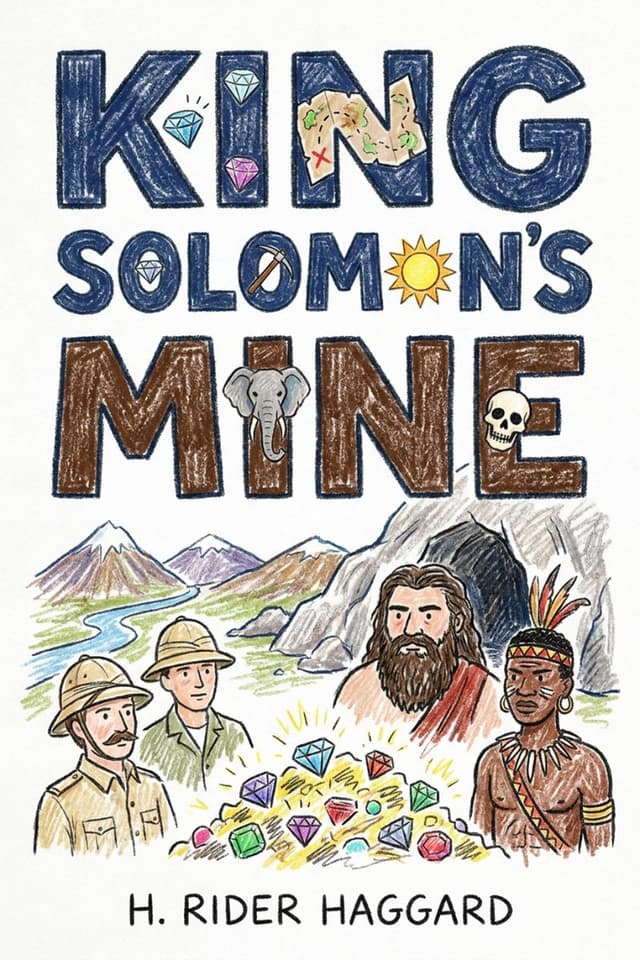
King Solomon's Mines
Read King Solomon's Mines by H. Rider Haggard for free on Novelhalla, and try out our easy-to-read modern edition of this classic book. You can also download the EPUB and read it on any device if you prefer!
The Plot
Allan Quatermain is getting too old for this. A professional elephant hunter based in Durban, South Africa, he has survived longer than most men in his dangerous trade, but he knows his luck cannot hold forever. He has a son, Harry, studying medicine in England, and the boy's future weighs on his mind. So when two Englishmen approach him with a proposition that sounds like certain death, Quatermain listens anyway.
Sir Henry Curtis is a towering Danish-English aristocrat, blond and powerfully built, with the bearing of a Viking and the determination to match. His companion is Captain John Good, a retired Royal Navy officer notable for his fastidious appearance, his monocle, and his remarkably white legs. Sir Henry's younger brother George quarreled with him years ago over their inheritance, took the name Neville, and vanished into the African interior searching for the legendary diamond mines of King Solomon. Sir Henry wants to find him.
Quatermain possesses something relevant: an old map, stained brown with the blood of the Portuguese explorer who drew it three centuries earlier. Jose da Silvestra claimed to have found King Solomon's Mines, only to die of cold and starvation on the mountain pass leading back to civilization. His descendant gave the map to Quatermain years ago, but Quatermain never took it seriously. The route it describes leads through hundreds of miles of desert and over mountains no European has ever crossed. It is, by any reasonable assessment, a death sentence.
But Sir Henry offers terms Quatermain cannot refuse: a share of any treasure found, or if Quatermain dies on the journey, a stipend that will see Harry through his medical studies. Quatermain agrees. He assembles a small party of bearers, including a Hottentot tracker named Ventvogel and a tall, proud Zulu who calls himself Umbopa. There is something strange about Umbopa, a dignity that seems out of place in a servant, but Quatermain cannot put his finger on it.
The journey begins badly and gets worse. They cross the desert by the route marked on da Silvestra's map, nearly dying of thirst before finding the brackish pool the old explorer recorded. They climb into the mountains, where they discover the frozen corpse of da Silvestra himself, still sitting where he died centuries ago. And finally, they cross the peaks into a hidden land that no white man has ever seen.
Kukuanaland is a fertile country of perhaps a million souls, isolated from the world by the desert and the mountains. The Kukuanas are a warlike people, organized into regiments like the Zulus, ruled by a king and advised by an ancient witch named Gagool who claims to be centuries old. The current king is Twala, a one-eyed giant who came to power through murder and treachery. His son Scragga is even crueler than his father. The people live in fear.
The white men's arrival causes a sensation. Infadoos, a grizzled old warrior who commands one of the regiments, becomes their guide. He believes they may be supernatural beings. The strange Captain Good, with his monocle, his false teeth, and his half-shaved face, seems particularly magical. When Good accidentally reveals his remarkably white legs, the Kukuanas are convinced these visitors are not entirely human.
Twala receives them with suspicion. Gagool, ancient and wizened as a dried monkey, regards them with undisguised hatred. She seems to sense something, some threat to the established order. At the king's command, the white men witness a "witch hunt," a ceremony in which Gagool and her acolytes dance through the assembled warriors and point out those accused of disloyalty. The accused are immediately executed. It is slaughter dressed as ritual, a tool of political terror.
Then Gagool turns toward Umbopa and points. But before the execution can be carried out, Quatermain and his companions intervene with a display of firepower that checks even Twala's cruelty. That night, in the safety of their hut, Umbopa finally reveals his secret: he is not a servant at all, but Ignosi, the rightful king of the Kukuanas. As a child, he was driven into exile when Twala murdered his father and seized the throne. He has returned to claim what is his.
The snake tattoo around his waist proves his royal blood. Infadoos, who remembers the old king, is convinced. He begins gathering support among the chiefs who chafe under Twala's tyranny. But the chiefs demand proof of Ignosi's divine right to rule. They need a sign.
Captain Good, consulting his almanac, notices that a lunar eclipse is due the following night. Quatermain seizes the opportunity. He announces to the assembled chiefs that if Ignosi is the true king, the white men will demonstrate their power by darkening the moon itself. When the eclipse occurs on schedule, the effect is electric. The chiefs rally to Ignosi's cause. Civil war is now inevitable.
What follows is a campaign of restoration: gathering forces, planning strategy, and finally a pitched battle between Ignosi's rebels and Twala's loyalists. The white men fight alongside their friend, armed with rifles against spears, and the outcome hangs in the balance until the very end. Beyond the battle lies the question of King Solomon's Mines themselves, the legendary treasure that drew them all to this hidden land, and the ancient witch Gagool, who knows the secret of their location.
About the Author
Henry Rider Haggard was born on June 22, 1856, at Bradenham in Norfolk, England, the eighth of ten children. His father, a barrister, considered young Henry something of a disappointment compared to his more accomplished brothers. While the older boys went to university, Henry was sent off to South Africa at nineteen to serve as an unpaid assistant to the Lieutenant-Governor of Natal. His father apparently hoped the colonial experience would make something of him.
It did, though not in the way anyone expected. Haggard arrived in Africa in 1875 and spent the next six years immersed in a world of frontier conflict, colonial politics, and encounters with peoples and landscapes that would fuel his imagination for the rest of his life. He witnessed the British annexation of the Transvaal in 1877, personally raising the Union Jack and reading the proclamation when the designated official lost his voice. He served as Master of the High Court in the Transvaal and as an adjutant of the Pretoria Horse. He experienced both the Anglo-Zulu War and the First Boer War.
During this time, Haggard developed a deep fascination with the Zulu people, their military organization, their customs, and their history. He also became familiar with the legends of ancient lost civilizations, the mysterious ruins of Great Zimbabwe, and the persistent rumors of King Solomon's mines somewhere in the African interior. These experiences would provide the raw material for his fiction.
Haggard fell in love with a woman named Mary Elizabeth Jackson, but his father forbade the marriage until Henry had established himself. By the time he returned to England in 1881, she had married someone else. He never entirely recovered from the loss. Instead, he married Marianna Louisa Margitson, a friend of his sister's, and the couple had four children: a son, Jack, who died of measles at age ten, and three daughters.
Back in England, Haggard studied law and was called to the bar in 1884, but his heart was not in it. He had begun writing, producing a nonfiction account of Zulu politics and two unsuccessful novels. Then, according to legend, he made a bet with his brother that he could write a better adventure story than Robert Louis Stevenson's Treasure Island. Between January and April 1885, he produced King Solomon's Mines. The novel was rejected by several publishers before Cassell and Company accepted it and launched a massive publicity campaign, with billboards across London proclaiming "The Most Amazing Book Ever Written." The gamble paid off. The book became an immediate bestseller.
Haggard followed it with a torrent of adventure fiction, including the sequel Allan Quatermain (1887) and the enormously popular She (1887), which sold an estimated 83 million copies. He wrote some sixty novels in all, mostly adventure stories set in exotic locations, though he also produced serious works on agriculture and land reform that reflected his experiences as a gentleman farmer in Norfolk.
In later life, Haggard became increasingly involved in public service. He ran unsuccessfully for Parliament as a Conservative, served on numerous government commissions concerning agriculture and land use, and traveled extensively throughout the British Empire investigating questions of rural development. He was knighted in 1912 and made a Knight Commander of the Order of the British Empire in 1919.
Haggard's only son had died in 1891 while the family was abroad, a loss that haunted him for the rest of his life. He died on May 14, 1925, in London, at the age of sixty-eight. His ashes were buried at St. Mary's Church in Ditchingham, Norfolk.
Fun Facts
-
The novel was written on a bet. Haggard's brother challenged him to write something as good as Treasure Island. Haggard completed King Solomon's Mines in about six weeks, though some accounts say as little as sixteen days.
-
Allan Quatermain was based on a real person. The character drew heavily on Frederick Courteney Selous, a famous British hunter and explorer in Africa. Selous's adventures, published in books and magazines, provided Haggard with both inspiration and practical details.
-
Haggard stole the eclipse trick. The scene where the white men predict an eclipse to awe the natives was lifted almost directly from the explorer Joseph Thomson's book Through Masai Land (1885), where Thomson described using his false teeth to convince Kenyan warriors he was a magician. Thomson was furious and even wrote his own novel in response, which nobody read.
-
The first edition got the eclipse wrong. Haggard originally described a solar eclipse, but later realized his description didn't match how solar eclipses actually work. He changed it to a lunar eclipse in subsequent editions.
-
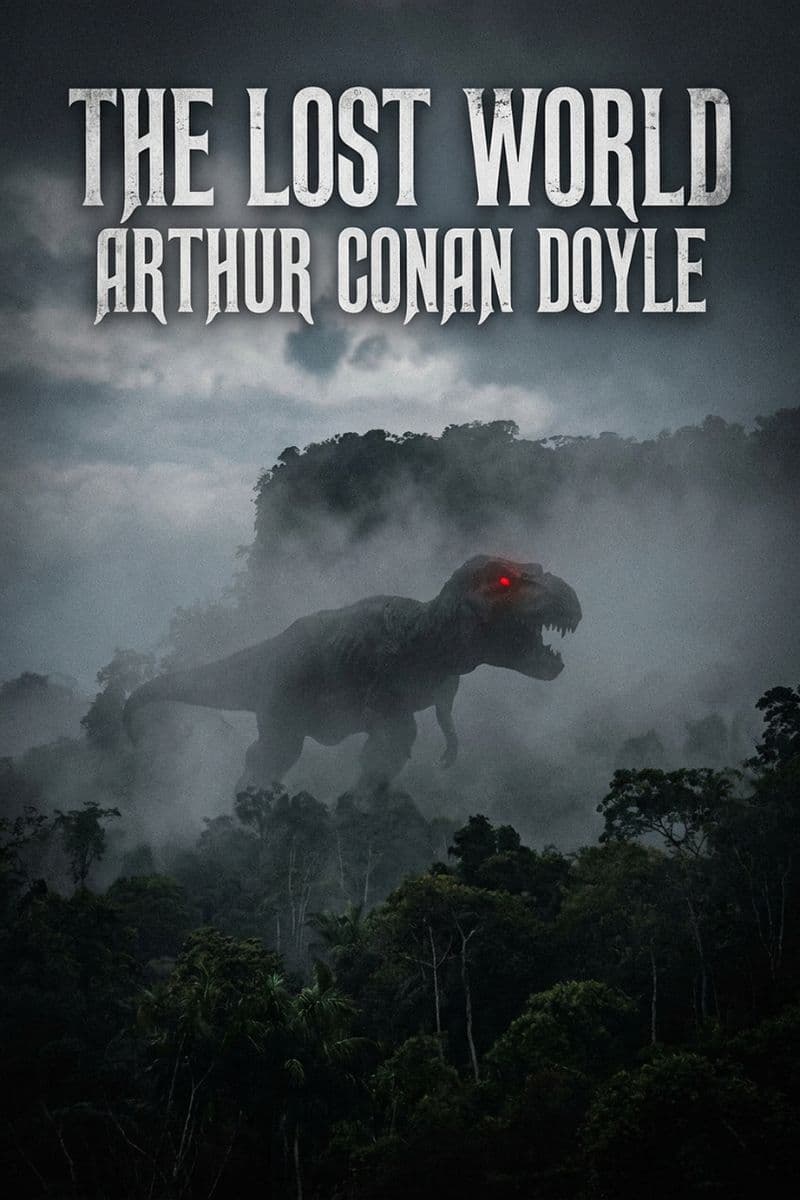
It spawned an entire genre. King Solomon's Mines is widely credited as the origin of the "lost world" literary genre. Its influence can be traced through Arthur Conan Doyle's The Lost World, Edgar Rice Burroughs's Tarzan novels, H.P. Lovecraft's At the Mountains of Madness, and countless others.
-
Haggard personally raised the British flag over the Transvaal. When the British annexed the Boer Republic in 1877, the official designated to read the proclamation lost his voice. The twenty-year-old Haggard stepped in, raised the Union Jack, and read much of the announcement himself.
-
The book has been filmed at least seven times. Major adaptations appeared in 1937, 1950 (starring Stewart Granger), 1985 (with Richard Chamberlain in an Indiana Jones-style adventure), and 2004 (a TV miniseries with Patrick Swayze). The 1919 silent version is now lost.
-
Quatermain explicitly refuses to use racial slurs. In the novel, Quatermain states that he refuses to use the word "nigger" and argues that many Africans are more deserving of the title "gentleman" than the Europeans who settle in their country. This was unusual for adventure fiction of the era.
-
The interracial romance was controversial. Haggard included a subplot in which the Kukuana woman Foulata falls in love with Captain Good. Though Quatermain disapproves on practical grounds, the novel treats Foulata with sympathy and dignity, which was progressive for 1885.
-
Haggard wrote fourteen more Quatermain stories. The hunter appeared in novels spanning fifty years of his fictional life, from his youth in the 1830s to his death in the sequel Allan Quatermain (1887). Haggard didn't write them in chronological order and occasionally contradicted himself.
-
Indiana Jones owes him a debt. George Lucas and Steven Spielberg have acknowledged that the adventure serials that inspired Raiders of the Lost Ark were themselves influenced by Haggard's novels. The 1985 film adaptation of King Solomon's Mines tried to reverse the influence by directly copying Indiana Jones, complete with John Rhys-Davies from the Indy films.
Themes
The Lure of the Unknown. At the heart of the novel is the irresistible pull of unexplored territory, the blank spaces on the map that promise both danger and wonder. Quatermain knows the expedition will probably kill him, but he goes anyway, partly for money, partly for his son, but also because the mystery itself demands an answer. The lost mines of King Solomon represent everything that Victorian explorers sought in Africa: ancient secrets, fabulous wealth, and the thrill of being first.
Civilization and Savagery. The novel constantly plays with questions of who is truly civilized. The Kukuanas have a sophisticated society with laws, military organization, and cultural traditions, but also practice human sacrifice and rule by terror. The British visitors are appalled by Twala's witch hunts, yet they come from a society that has its own forms of institutionalized cruelty. Quatermain himself is a professional killer of elephants who acknowledges that his trade is destroying the wild places he loves.
Legitimacy and Usurpation. The political drama at the novel's center concerns rightful kingship: Ignosi, the true heir, returns to overthrow Twala, the usurper. This theme resonated with Victorian readers familiar with debates about legitimate succession, colonial authority, and the right to rule. The novel suggests that tyranny eventually produces its own opposition, that cruelty breeds rebellion.
Friendship Across Boundaries. The bond between Quatermain, Curtis, Good, and Ignosi transcends the racial hierarchies of the era. They fight together, risk their lives for each other, and part as equals. The novel does not entirely escape the prejudices of its time, but it repeatedly insists on the humanity and dignity of its African characters in ways that were unusual for adventure fiction.
The Cost of Adventure. For all its excitement, King Solomon's Mines never lets readers forget that adventure has a price. Men die on the expedition. The desert nearly kills them all. The battle claims thousands of lives. Even the treasure proves less accessible than hoped. Quatermain's world-weary narration constantly undercuts the glamour of exploration with reminders of its real human cost.
The Book's Legacy
King Solomon's Mines was a sensation from the moment it appeared. Published in September 1885 with an aggressive marketing campaign, it became one of the bestselling novels of the Victorian era and made Haggard famous overnight. Reviewers praised its imagination and pace, and readers devoured it. The novel went through multiple printings in its first year alone.
More importantly, the book essentially invented a genre. Before King Solomon's Mines, adventure novels existed, but the specific formula Haggard created, involving explorers penetrating unknown territory to discover hidden civilizations, ancient treasures, and exotic dangers, became a template that writers would follow for the next century. Arthur Conan Doyle's The Lost World (1912), with its hidden plateau of dinosaurs, is unimaginable without Haggard's precedent. Edgar Rice Burroughs's Tarzan novels, beginning in 1912, transplanted the lost world formula to the jungle. H.P. Lovecraft's At the Mountains of Madness (1936) applied it to Antarctica. The genre Haggard pioneered remained vital through the pulp era and beyond.
The novel's influence on cinema has been equally profound. Hollywood recognized the story's potential early, producing a silent adaptation in 1919 (now lost). The 1950 version, starring Stewart Granger and Deborah Kerr, won Academy Awards for cinematography and editing and established the visual vocabulary of the African adventure film. When George Lucas and Steven Spielberg created Indiana Jones in the early 1980s, they were drawing on adventure serials that were themselves drawing on Haggard. The lineage from Allan Quatermain to Indiana Jones is direct and acknowledged.
This created a peculiar situation in 1985, when Cannon Films produced a new King Solomon's Mines starring Richard Chamberlain. The film was so obviously modeled on Raiders of the Lost Ark that it seemed like a ripoff, even though the source material predated Indiana Jones by nearly a century. John Rhys-Davies, who played Sallah in the Indiana Jones films, appeared in essentially the same role. The film was not well received, but it demonstrated how completely Haggard's creation had been absorbed into popular culture.
Modern readers encounter King Solomon's Mines with complicated feelings. The novel is undeniably a product of the British Empire at its height, written from a colonialist perspective that takes European superiority largely for granted. At the same time, Haggard's treatment of African characters is notably more respectful than much adventure fiction of the era. Quatermain's explicit refusal to use racial slurs, his acknowledgment that many Africans are more gentlemanly than many Europeans, and the genuine dignity accorded to characters like Ignosi and Foulata set the novel apart from cruder examples of the genre.
The book remains in print, studied in universities as both a literary landmark and a document of imperial attitudes, and read for pleasure by those who can appreciate its considerable narrative energy while recognizing its historical limitations. Allan Quatermain endures as one of the great adventure heroes, the template from which so many others were made.