Novelhalla
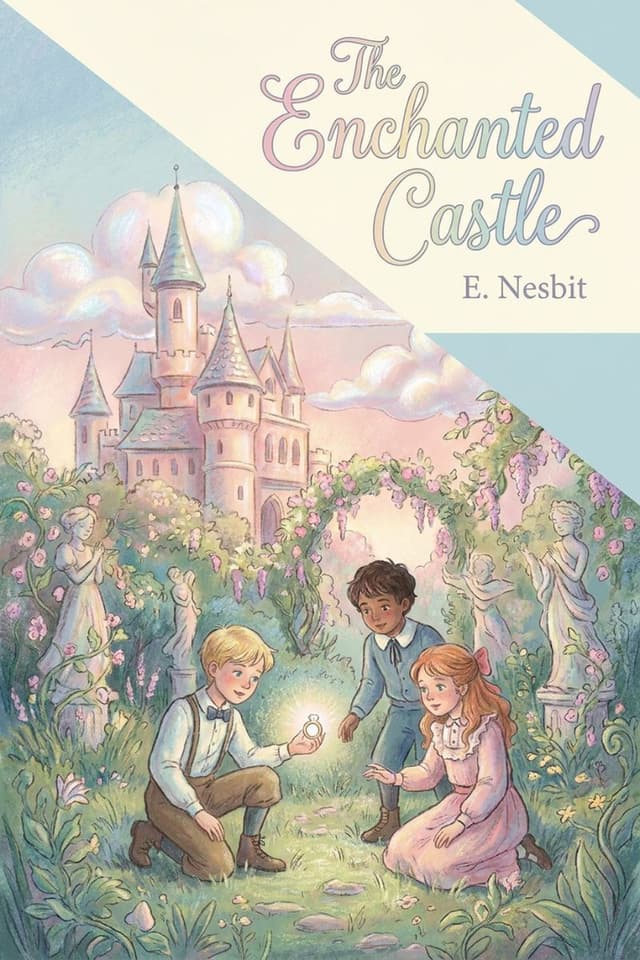
The Enchanted Castle
Read The Enchanted Castle by E. Nesbit for free on Novelhalla, and try out our easy-to-read modern edition of this classic book. You can also download the EPUB and read it on any device if you prefer!
The Plot
The Castle in the Garden
It's the school holidays, and Gerald, Jimmy, and Kathleen are stuck. Their cousin has measles, so they can't go home. Instead, they're marooned at Kathleen's boarding school with only the young French governess, Mademoiselle, for supervision. Gerald, who has a gift for charming adults, talks her into giving them the run of the countryside. They buy penny horns, pack ginger beer, and set off looking for adventure.
They find one.
Down a lane, through a tunnel choked with damp leaves, they emerge into sunlight and discover something extraordinary: a country estate with marble terraces, a shimmering lake, groves of ancient trees, and white towers rising in the distance. It looks like a fairy tale. It feels like a fairy tale. And when they navigate the maze in the rose garden and find a princess asleep on a stone bench, dressed in faded pink and gold brocade with jewelled rings on every finger, they're almost ready to believe it is one.
The Ring
The princess wakes. She tells them the castle is enchanted. She leads them through secret passages to a hidden treasure room filled with gold and glittering gems. Among the treasures is a plain ring, which she says is a ring of invisibility.
She puts it on. She vanishes.
There is a long, panicked silence. Then the invisible girl admits the truth. She's not a princess. She's Mabel, the housekeeper's niece, and she was only playing pretend. The castle is real enough, a grand estate called Yalding Towers, but the fairy-tale story was make-believe.
The ring, however, is not.
The Rules Keep Changing
The four children quickly learn that the ring doesn't follow the neat rules of storybook magic. It grants wishes, yes, but unpredictably. It makes people invisible, but on its own schedule. You can't simply take it off and go back to normal. The magic lasts until it decides to stop.
And the ring keeps revealing new powers, each more unsettling than the last. Gerald turns invisible and gets tangled up with a real burglary. Kathleen is turned to stone. Jimmy is aged into a bewildered old man who finds himself doing business in London, unable to explain who he is or why he can't remember his own address. Each adventure is funny at first and then increasingly alarming, because the children can never quite predict what the ring will do next or how they'll undo what it's done.
The Ugly-Wuglies
Then comes the worst of it.
The children decide to put on a play. They need an audience, but there's nobody around, so they do what imaginative children do: they build spectators. They stuff old clothes with cushions, prop them up with umbrellas and hockey sticks, and paint crude faces on paper bags. They call them the Ugly-Wuglies.
The ring brings them to life.
What climbs out of those chairs is not charming. The Ugly-Wuglies are hollow things wearing human faces, wrong in ways that are hard to articulate. They walk. They talk. They have opinions. One of them speaks and behaves like a respectable middle-aged businessman, which is almost the most disturbing thing about him. They are polite and insistent and absolutely not supposed to exist.
Getting rid of them becomes the children's most urgent and terrifying problem. These aren't fairy-tale creatures. They're something closer to a nightmare dressed in cast-off clothes.
The Statues
But the ring has gentler moods, too. On moonlit nights, something happens in the grounds of Yalding Towers that is the opposite of the Ugly-Wuglies. The marble statues come to life. The Greek gods step down from their pedestals. A faun slips out of the woods. Dinosaurs stir by the lake. Phoebus Apollo plays his lyre, and the children are invited to a banquet of nectar and ambrosia on the island in the middle of the water, surrounded by laughing immortals.
Anyone looking out of the castle windows would see nothing but empty lawns and still white statues in the moonlight. You have to be wearing the ring. You have to believe.
The Heart of the Enchantment
Beneath all the adventures, something quieter is happening. Lord Yalding, the owner of the castle, doesn't know any of this magic exists. And Mademoiselle, the children's French governess, turns out to be connected to the castle's story in ways none of them expected.
The children begin to realize that the ring isn't just a toy. It's the key to something larger, something that binds together the castle, its owner, the statues, and even Mademoiselle. The enchantment has a purpose. But the magic that makes childhood so glorious may not be compatible with the thing it's trying to accomplish. Something may need to be given up so that something else can finally begin.
About the Author: E. Nesbit
Early Life
Edith Nesbit was born in 1858 in Kennington, South London. Her father, an agricultural chemist, died before she was four. Her older sister's poor health sent the family travelling across Europe for years, living in France, Spain, and Germany. Edith attended boarding schools she mostly hated and moved constantly. The rootlessness of her childhood, the freedom and the loneliness of it, would become the emotional bedrock of her fiction.
A Radical Life
At nineteen, Nesbit met Hubert Bland, a journalist who shared her socialist ideals. She married him in 1880, already seven months pregnant. The marriage was turbulent from the start. Bland was a serial philanderer who fathered children with other women, including the household's live-in housekeeper. Nesbit raised two of his illegitimate children as her own. She coped through her own intense friendships and by throwing herself into political activism.
In 1884, Nesbit and Bland helped found the Fabian Society, the socialist organisation that would eventually help give rise to the Labour Party. Their early meetings included George Bernard Shaw, H.G. Wells, Beatrice and Sidney Webb, and Eleanor Marx. Nesbit was a prolific lecturer and pamphleteer for the cause throughout the 1880s.
The Children's Author
In 1899, at age forty, Nesbit published The Story of the Treasure Seekers and discovered her true voice. She went on to write over sixty books for children, including Five Children and It, The Phoenix and the Carpet, The Story of the Amulet, The Railway Children, and The Enchanted Castle. She was among the first writers to portray children as real, complicated, bickering, scheming, brave little people rather than saintly miniatures of adults. She was also among the first to bring magic into the everyday modern world rather than whisking children off to a separate fantasy realm.
Her influence runs through nearly every major children's fantasy writer who followed: C.S. Lewis, Edward Eager, Diana Wynne Jones, J.K. Rowling. She didn't just write the genre. She invented most of its rules.
Later Years
Nesbit's son Fabian died at fifteen after a botched tonsil operation, a loss that haunted her for the rest of her life. Her husband died in 1914. In 1917, she married Thomas Tucker, a ship's engineer whose warmth and kindness gave her, by many accounts, more happiness than her first marriage ever had. A lifelong heavy smoker, Nesbit died of lung cancer in 1924, aged sixty-five. She was buried in the churchyard of St Mary in the Marsh, in the Romney Marsh countryside of Kent.
Fun Facts About the Book
The Ugly-Wuglies Haunted Everyone
The Ugly-Wuglies are consistently cited as one of the most genuinely frightening things in children's literature. Historian Antonia Fraser recalled being "chilled" by the scene as a child and finding it "still chilling today." The genius of the horror is in the details: the Ugly-Wuglies don't behave like monsters. They behave like people. One of them is indistinguishable from a real middle-aged businessman. Nesbit understood that the uncanny is far more disturbing than the obviously monstrous.
Written for Two Audiences
Nesbit explicitly wrote The Enchanted Castle for both children and adults. The children's adventures are vivid and funny and sometimes terrifying, but there's a deeper romantic and philosophical layer running underneath. The subplot about Mademoiselle and Lord Yalding, and the novel's final meditation on what must be given up when childhood ends, are aimed squarely at grown-up readers.
The Castle Was Real (Sort Of)
Nesbit based Yalding Towers loosely on several English country estates she knew, blending them into a single dreamlike setting. The grounds, with their classical statuary, Italian gardens, and hidden grottos, reflect the kind of grand Edwardian estate that would have been familiar to her readers but mysterious to the children who stumble upon it.
The Inventor of Modern Children's Fantasy
Before Nesbit, children's fantasy typically transported children to a separate magical world. Nesbit reversed this. She brought magic crashing into the ordinary modern world, where children had to deal with its consequences while also hiding it from grown-ups, catching trains, and explaining why their clothes were ruined. This formula, magic disrupting everyday life, became the template for nearly everything that followed, from Mary Poppins to Harry Potter.
A Socialist in Fairy-Tale Country
Nesbit's Fabian Society politics occasionally surface in The Enchanted Castle through sharp little observations about class and wealth. The satire of the Ugly-Wuglies, whose hollow respectability makes them indistinguishable from actual members of the upper-middle class, is pure Nesbit: a children's author who co-founded one of the most important political movements in British history, slipping social commentary into a story about a magic ring.
The BBC Adaptation
In 1979, the BBC adapted The Enchanted Castle into a television miniseries. It remains the only major screen adaptation of the novel, though the book's influence on later fantasy films and series is impossible to overstate.
Themes
The Danger of Getting What You Wish For
The ring grants wishes, but never cleanly. Every magical intervention creates new problems. Invisibility sounds thrilling until you can't turn it off and nobody can hear you and you're trapped outside at night. The novel teaches its lesson not through moralizing but through the sheer comic and terrifying momentum of wishes gone wrong.
The Line Between Play and Reality
The children start by pretending. They pretend the castle is enchanted. They pretend Mabel is a princess. They pretend stuffed dummies are real people. And then the pretending becomes real, and they can't stuff it back into the box. Nesbit captures something true about childhood imagination: it is powerful, and power always has consequences.
The Uncanny
The Ugly-Wuglies tap into a deep and ancient fear: the thing that looks human but isn't. Nesbit was exploring this territory decades before the term "uncanny valley" existed. Her instinct that the most frightening thing isn't a dragon or a ghost but a pillow in a coat with a painted face that walks and talks and wants to shake your hand is psychologically precise and genuinely unsettling.
The Cost of Growing Up
The novel's ending turns on a bittersweet truth: the enchantment that makes the castle magical, that brings statues to life and lets children see gods, belongs to childhood. It cannot coexist with the adult world of love and responsibility. Something must be sacrificed. Nesbit doesn't flinch from this, and the final pages carry a weight that lifts the book far above a simple children's adventure.
Belief
The magic in The Enchanted Castle doesn't work for everyone. It works for children because they are willing to believe. The statues come alive only for those who can see them. The ring responds to those who take it seriously. Nesbit suggests that enchantment isn't something that happens to you. It's something you have to be open to. And the tragedy of adulthood is that most people close that door and never find the key again.
The Book's Legacy
The Enchanted Castle is less famous than The Railway Children or Five Children and It, but many readers and writers consider it Nesbit's richest and most imaginative work. Julia Donaldson has called it "her most imaginative book." It combines the humor and domestic realism of her earlier work with moments of genuine terror and startling beauty that nothing else in her catalogue quite matches.
The Ugly-Wuglies alone have earned the novel a permanent place in the history of children's literature as one of the most memorably frightening creations in the genre. But the scene with the living statues, the banquet of the gods under moonlight, is equally unforgettable and perhaps more important. Nesbit could do wonder and she could do dread, and in this book she does both, sometimes on the same page.
Her influence on the writers who followed is enormous. C.S. Lewis's Narnia, with its fauns and talking statues and children stumbling into enchantment, owes a clear debt. Edward Eager acknowledged her directly. Diana Wynne Jones and J.K. Rowling both inherited her central insight: that magic is most interesting not in a faraway kingdom but in a world where you still have to eat breakfast and explain yourself to adults.
The Enchanted Castle is the book where Nesbit proved that a children's story could be funny, frightening, beautiful, and philosophically serious all at once. It still is.