Novelhalla
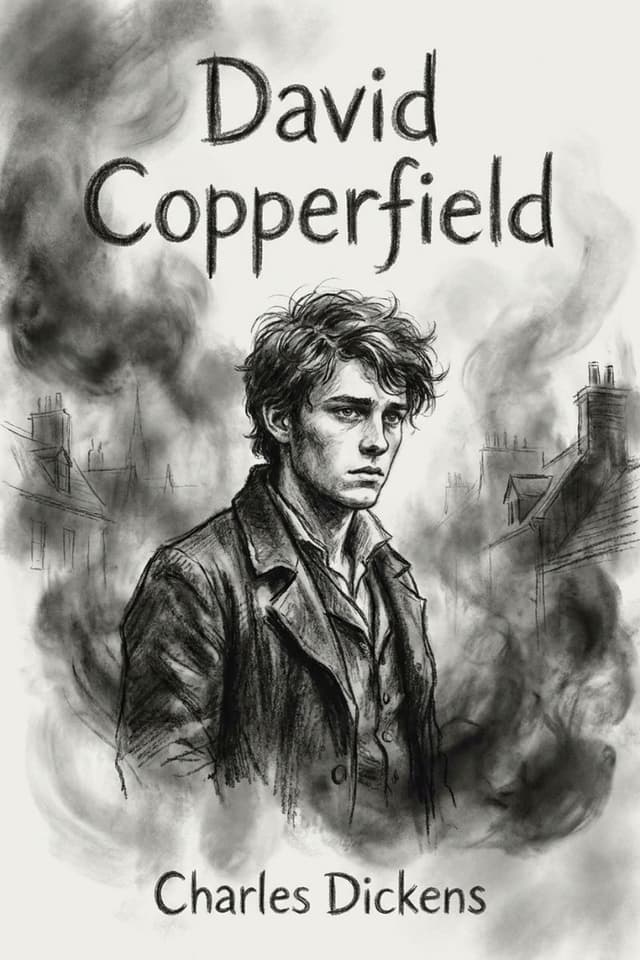
David Copperfield
Read David Copperfield by Charles Dickens for free on Novelhalla, and try out our easy-to-read modern edition of this classic book. You can also download the EPUB and read it on any device if you prefer!
The Plot
A Boy Without a Father
David Copperfield is born six months after his father's death, into a small house in Suffolk with only two people who love him: his young, pretty, slightly helpless mother, Clara, and the family's fiercely loyal housekeeper, Peggotty. For a few years, life is good. Simple and warm and safe.
Then Mr. Murdstone arrives.
He's charming at first, attentive to Clara, patient with her boy. But the moment the wedding ring is on, the mask drops. Murdstone is cold, controlling, and cruel, and he brings his equally grim sister to help run the household. Together, the Murdstones systematically crush Clara's spirit and make David's home unrecognizable. When David fights back against a beating, biting Murdstone's hand, he's shipped off to Salem House, a miserable boarding school run by a man whose primary teaching method involves a cane.
School isn't all bad, though. David befriends the kind, awkward Tommy Traddles, and falls under the spell of James Steerforth, an older student who is handsome, wealthy, confident, and everything David wishes he could be. Steerforth takes David under his wing. It feels like protection. Whether it actually is remains to be seen.
Alone in London
David's mother dies. He's ten years old. And instead of sending him back to school, Murdstone puts him to work in a London warehouse, washing and labeling wine bottles in a rat-infested building for pennies a day. A child, alone in the city, doing grown men's labor.
His one comfort is the Micawber family, with whom he boards. Mr. Micawber is a man of grand speeches, elaborate plans, and absolutely no money. He's perpetually on the verge of financial ruin, perpetually cheerful about it, and perpetually convinced that something will "turn up." He's ridiculous and lovable and completely useless as a guardian. When the Micawbers leave London to escape creditors, David has no one left.
So he runs. With no money and barely any belongings, he walks all the way to Dover to find the only relative he has left: his great-aunt Betsey Trotwood, a woman he's never met, who reportedly stormed out of the house the night he was born because he wasn't a girl.
A Second Chance
Aunt Betsey is eccentric, opinionated, and terrified of donkeys on her lawn. She is also, beneath the bluster, deeply kind. She takes David in, along with the help of her gentle, slightly scattered lodger Mr. Dick, and gives the boy something he hasn't had in years: a real home.
She sends him to a good school in Canterbury, where he boards with Mr. Wickfield, a respectable lawyer, and his daughter Agnes. Agnes is calm, wise, and good in a way that David instinctively trusts. She becomes his closest friend, the person whose judgment he values above anyone else's. He thinks of her like a sister.
Also living in the Wickfield household is Uriah Heep, a clerk with clammy hands, a writhing manner, and a constant insistence on how very "umble" he is. Everything about Heep makes David's skin crawl, but he can't quite put his finger on why. Heep is always watching. Always ingratiating himself. Always moving closer to power.
Love, Ambition, and Bad Judgment
David finishes school, reconnects with Steerforth, and begins training as a lawyer at the firm of Spenlow and Jorkins. At his employer's home, he meets Dora Spenlow, and falls instantly, hopelessly, dizzyingly in love. Dora is beautiful, sweet, and about as practical as a kitten. David doesn't care. He's besotted.
Meanwhile, threads are tangling in dangerous directions. Steerforth has been spending time in Yarmouth, charming the Peggotty family, paying particular attention to Little Em'ly, the fisherman's niece who is engaged to her cousin Ham. David introduced them. He didn't think anything of it.
He should have.
Uriah Heep is tightening his grip on Mr. Wickfield, exploiting the older man's weaknesses, maneuvering himself into a partnership. Agnes sees it happening but can't stop it. Aunt Betsey's finances are suddenly, mysteriously in trouble. And David is so wrapped up in his infatuation with Dora that he's barely paying attention to the disasters building around him.
The Storm Gathers
Everything David has tried to hold together begins pulling apart. Em'ly vanishes. Mr. Peggotty, devastated, sets out to search for her, vowing to walk the earth until he finds her. Heep's influence grows bolder and more openly sinister. David's romantic life and his financial life collide in ways that force him to grow up fast.
And through it all, Agnes is there, steady and patient, pointing David toward what matters. He keeps calling her his good angel. He keeps not understanding what that means.
The novel barrels toward a series of confrontations, revelations, and reckonings. Schemes are exposed. Loyalties are tested. A great storm is coming, both literally and figuratively, and not everyone will survive it.
Whether David can untangle the mess his heart has made, whether justice catches up with those who deserve it, whether love gets a second chance or just a first honest look, that's the rest of this enormous, messy, deeply human story. Dickens called it his favorite child. You'll understand why.
About the Author: Charles Dickens
Early Life
Charles Dickens was born in 1812 in Portsmouth, the second of eight children. His father, John, was a naval clerk with a talent for living beyond his means and a gift for cheerful optimism in the face of mounting debt. (Sound like anyone from the novel? Mr. Micawber is essentially a love letter to, and gentle roast of, John Dickens.)
The family moved frequently, and young Charles's happiest years were spent in Chatham, where he devoured books and dreamed of a genteel life. That dream shattered when he was twelve. His father was arrested for debt and sent to the Marshalsea debtors' prison. The family moved into the prison with him. Charles, however, was sent to work at Warren's Blacking Factory, pasting labels on bottles of shoe polish ten hours a day, six days a week, for six shillings.
It lasted about a year. It scarred him for life.
The Rise
Dickens never forgot the factory, but he channeled that rage into ambition. He taught himself shorthand, became a court reporter, then a parliamentary journalist, then a fiction writer. His first novel, The Pickwick Papers, published in monthly installments in 1836, became a sensation. He was twenty-four.
What followed was one of the most extraordinary literary careers in history. Oliver Twist, Nicholas Nickleby, A Christmas Carol, Dombey and Son. Dickens wrote with furious energy, edited magazines, gave public readings that were theatrical events, campaigned for social reform, and became the most famous writer in the English-speaking world. He married Catherine Hogarth in 1836, and they had ten children.
The Personal Cost
Dickens's public life was triumphant. His private life was more complicated. His marriage to Catherine deteriorated over the years, and in 1858 they separated. Dickens had fallen in love with a young actress named Ellen Ternan, and while the full nature of their relationship remains debated, the separation was messy and public. Dickens wrote a defensive public statement. Friends took sides. It was not his finest hour.
He continued writing through all of it. A Tale of Two Cities, Great Expectations, Our Mutual Friend. And he continued his grueling schedule of public readings, which drew enormous crowds but destroyed his health. He suffered a stroke during a reading tour and died in June 1870 at age fifty-eight, leaving his final novel, The Mystery of Edwin Drood, unfinished.
Legacy
Dickens is one of those writers whose influence is so vast it's almost invisible. He shaped how English speakers think about Christmas, poverty, childhood, justice, and storytelling itself. His characters have become cultural shorthand. His name is literally an adjective. He has never been out of print, never been out of fashion, and never stopped making people laugh and cry, often on the same page.
Fun Facts About the Book
Dickens's "Favourite Child"
In a preface to the 1867 edition, Dickens wrote: "Like many fond parents, I have in my heart of hearts a favourite child. And his name is David Copperfield." Of all fifteen novels, this was the one he loved most. Given that the book is essentially Dickens rewriting his own life with the rough edges smoothed and the endings improved, that makes a certain kind of sense.
The Initials
When Dickens's friend and biographer John Forster pointed out that David Copperfield's initials are Charles Dickens's initials reversed, Dickens claimed he hadn't noticed. He said it must be fate. Whether you believe him is entirely up to you.
The Blacking Factory Connection
The warehouse where young David is sent to wash bottles is drawn directly from Dickens's own childhood trauma at Warren's Blacking Factory. Dickens kept that experience secret his entire life. It wasn't until Forster published his biography after Dickens's death that readers learned the novel's most painful scenes were essentially memoir.
Dora Was Real (Sort Of)
David's infatuation with the lovely, impractical Dora Spenlow mirrors Dickens's own youthful obsession with Maria Beadnell, a banker's daughter who ultimately rejected him. Dickens was so affected by the experience that decades later, when he met the now middle-aged Maria again, he was reportedly devastated by the change. He promptly put a version of the older Maria into Little Dorrit. The man weaponized his heartbreaks.
A Daughter Named Dora
In August 1850, while still writing the novel, Dickens's wife Catherine gave birth to a daughter. They named her Dora Annie Dickens, after the character. Tragically, the baby died in infancy the following year.
No Master Plan
Unlike some of his other novels, Dickens wrote David Copperfield without a detailed overall plan. He often wrote the chapter summaries after finishing the chapters. Several major character names, including Steerforth, Traddles, and Creakle, were chosen at the last minute. Dora's fate wasn't decided until well past the halfway point of serialization. He was building the plane while flying it.
The Title Marathon
Dickens agonized over the title. His working notes contain seventeen different options, including "The Copperfield Survey of the World as it Rolled" and just plain "Charles Copperfield." He eventually went with the full mouthful: "The Personal History, Adventures, Experience, and Observation of David Copperfield the Younger." Most people just call it David Copperfield.
Virginia Woolf Was a Fan
Woolf called it "the most perfect of all the Dickens novels." Sigmund Freud was also a devoted reader of the book, drawn to its exploration of memory, childhood trauma, and psychological development. It's the rare novel that satisfies both literary critics and psychoanalysts.
Themes
Memory and the Stories We Tell Ourselves
The novel is narrated by the adult David looking back on his life, and Dickens is deeply interested in how memory works. David doesn't just report events. He shapes them, lingers on some, rushes past others, and openly admits that his recollections may be colored by emotion. It's a novel about how we construct the story of who we are.
The Undisciplined Heart
This is the phrase David uses to describe his own greatest flaw: his tendency to love unwisely, to be dazzled by charm over substance, to follow his feelings without examining them. It applies to his romantic life, certainly, but also to his hero worship of Steerforth and his blindness to danger in people he admires. Growing up, for David, means learning to see clearly.
Class, Merit, and the Self-Made Life
David moves through nearly every layer of Victorian society, from comfortable childhood to grinding poverty to professional respectability. The novel celebrates hard work and perseverance while showing how easily class can trap people. The Murdstones use their social position as a weapon. The Micawbers are imprisoned by debt. Uriah Heep uses the language of humility to disguise ruthless ambition.
The Vulnerable Child
No one writes about endangered children like Dickens, and this novel is his most personal take on the subject. David's suffering at the hands of the Murdstones and in the London warehouse isn't just plot. It's an argument. Children are not small adults. They can be broken by cruelty and neglect. And the adults who fail them bear the responsibility.
True Friends and False Idols
The novel is populated by people who appear to be one thing and turn out to be another. Steerforth seems noble but isn't. Heep seems humble but isn't. The Micawbers seem hopeless but prove loyal when it counts. Agnes seems ordinary but is the truest person David knows. Learning to tell the difference is basically the entire education of David Copperfield.
The Book's Legacy
David Copperfield helped establish the coming-of-age novel as one of literature's great forms. Its influence runs through everything from Great Expectations (Dickens essentially reworking some of the same themes a decade later) to the novels of Charlotte Bronte to modern memoirs and autobiographical fiction. Every story about a sensitive kid surviving a rough childhood and finding their way in the world owes something to this book.
The novel has been adapted for screen dozens of times, starting with silent films in 1911. The 1935 Hollywood version, starring Freddie Bartholomew as young David and W.C. Fields as the unforgettable Mr. Micawber, was a massive hit and is still considered one of the finest Dickens adaptations ever made. The 1999 BBC miniseries featured a young Daniel Radcliffe as David, a role that helped launch his career before a certain boy wizard came calling. Most recently, Armando Iannucci's 2019 film with Dev Patel brought a fresh, diverse, and warmly comic energy to the story.
Characters from the novel have become permanent fixtures in the cultural vocabulary. "Uriah Heep" is shorthand for slimy false humility. "Micawber" means an eternal optimist waiting for something to turn up. Even people who have never read the book know these names, which is perhaps the most Dickensian legacy of all.
Dickens called David Copperfield his favorite. Virginia Woolf called it his most perfect novel. Readers for nearly two centuries have called it one of the most human stories ever written. It's long, it's sprawling, it's stuffed with more characters than some entire novel series. And every single one of them breathes.