Novelhalla
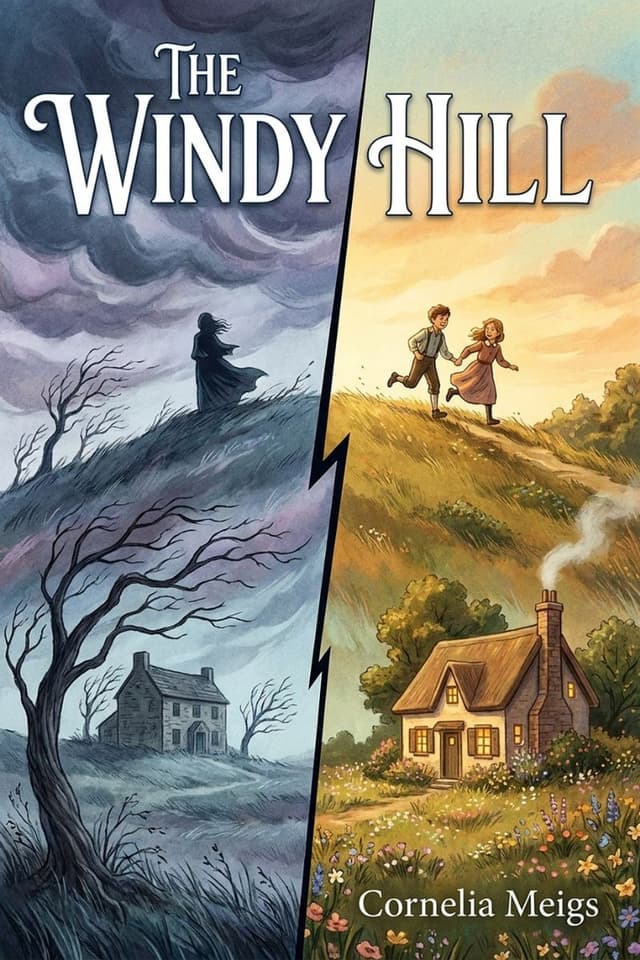
The Windy Hill
Read The Windy Hill by Cornelia Meigs for free on Novelhalla, and try out our easy-to-read modern edition of this classic book. You can also download the EPUB and read it on any device if you prefer!
The Plot
A Summer That Starts Going Wrong on Day One
Oliver Peyton is fifteen, his sister Janet is thirteen, and they've been shipped off for their first visit anywhere without their mother. The destination sounds like a dream: Cousin Jasper's enormous new house on a hill above Medford Valley, with a butler, a garden, a chauffeur, and a car that almost never gets used.
The reality is stranger. Cousin Jasper used to be the family's favorite relative, the one with what their mother called the fairy godfather gift, always turning up with something delightful. Now he's thin, gray, jumpy, and hollowed out. He forgets they're in the house. He sits alone in his study long after everyone else has gone to bed. The servants tiptoe. Even the housekeeper and the butler have started comparing notes with each other, because something is clearly wrong and nobody will say what.
Janet loves the place anyway. Oliver, bored and increasingly angry, decides on the third day that he's leaving. He walks out the gate toward the railway station with enough money in his pocket to get home, telling himself the whole way that he isn't running away from anything.
The Man on the Hill
He never makes the train. Halfway across the valley he climbs a wall into an abandoned orchard, follows a lane up a bare round hill toward a tumbledown cottage, and gets caught in the act by a man in worn overalls and a girl in a faded pink apron who need an extra pair of hands to hive a swarm of bees.
They feed him. They call him a friend in need. And then the Beeman, who has a slow drawling voice and a laugh you can't help joining, tells a story, because his daughter Polly always gets a story when the bees are done.
Oliver goes back up that hill the next day, and the day after. It takes him an embarrassingly long time to notice two things. The Beeman has never told him his name. And the Beeman knows a great deal about the Peyton family, the Peyton land, and the drainage of the Medford Valley, for a poor beekeeper living in a shack.
The Cousin Nobody Mentions
There's another relative in this valley, and he arrives at the house in a rattling cart behind a knock-kneed white horse, timing his visits for maximum humiliation.
Anthony Crawford is roughly Jasper's age, nearly handsome, and entirely without friends by deliberate policy. He walks into Jasper's library uninvited, announces that family doesn't stand on ceremony, and makes his demand in front of the children: give me my share, or I'll take everything. When Jasper refuses, Crawford promises to drag the family name down into the mud where his own already lies, and he sounds like a man who has thought about how to do it.
Then he tells Oliver where to look for one of his cousin's meanest secrets. Over the back garden wall. The one that's built higher than any other wall on the property, thick with grapevines and trained pear trees, hiding whatever is on the other side.
Oliver knows he's being manipulated. He climbs it anyway, at sunrise, and what he sees explains nothing and makes everything worse.
Stories That Turn Out Not To Be Stories
The Beeman's tales come one at a time, and they're not what a kid expects from a beekeeper killing an afternoon.
There's Nashola, an Indian boy centuries ago who loved the sea his people were taught to fear, and Secotan, the medicine man whose whole authority rested on a claim he couldn't defend. There's Cicely Hallowell in 1813, thirteen years old in a merchant countinghouse, listening to her father and his cousin tear their partnership apart over a privateer called the Huntress and what she should be allowed to do before the peace is signed. There's a fiddler in Apple Tree Lane and a young man named Felix who went west with everyone else in 1849.
Every one of them happens within sight of that same hill and that same oak tree. And when Janet, on an afternoon that goes very sideways, ends up somewhere she absolutely should not be, she finds an old print of a ship with faded gold letters under it, and a small ivory portrait of a smiling girl with piled-up brown hair. She turns it over. The engraved name on the back is one she heard three days ago in a cottage on the Windy Hill.
So the stories are true. Which raises a much larger question, and Oliver and Janet are nowhere near ready for the answer: how does a man who mends beehives for a living know their family's history better than they do?
The River
Meanwhile, the thing nobody in the mansion is watching is the water.
Thirty years ago a Peyton drained the swampy floor of Medford Valley and built dikes to hold Medford River back, and the arrangement only works if one owner keeps the whole length of the bank in repair. Jasper still maintains his stretch. The land at the bend of the stream, the last farm at the top of the valley, has recently passed into other hands, and the tenant who works it has been begging his landlord to fix that section for a year. The landlord keeps saying he guesses it'll hold.
The river looks lazy and sleepy all summer. Everyone who's lived in the valley long enough will tell you what it turns into when the rain comes.
Cousin Jasper is running out of room to maneuver, Anthony Crawford is preparing his last ultimatum, and the earth bank above four hundred acres of farmland is soft and unpatched at exactly the place where the current hits hardest.
About the Author: Cornelia Meigs
An Engineer's Daughter on the Mississippi
Cornelia Lynde Meigs was born on December 6, 1884, in Rock Island, Illinois, the fifth of six daughters. Her father, Montgomery Meigs, was a civil engineer who ran navigation improvement projects on the Mississippi, and the family moved to Keokuk, Iowa, when Cornelia was a month old. She grew up on the bank of a big working river, watching a parent spend his career on the problem of what water does to land when nobody's paying attention. The family spent summers in New England with relatives, which is where the coastline and stone walls of her fiction come from.
The Teacher Who Talked Too Well
She graduated from Bryn Mawr in 1907 and went back to Iowa to teach at St. Katherine's School in Davenport. Her students got stories, and the stories got good enough that they turned into a book. The Kingdom of the Winding Road, a collection of fairy tales, was published by Macmillan in 1915. That same year, her play The Steadfast Princess won a Drama League prize.
She published steadily through her twenties and thirties, sometimes under the pen name Adair Aldon, building a catalog of adventure novels for young readers that included The Island of Appledore, Master Simon's Garden, and The Pool of Stars. This book arrived in August 1921, and the following spring it landed her a place in children's publishing history.
Awards and a Farm in Vermont
Meigs collected Newbery Honors for this book in 1922, for Clearing Weather in 1929, and for Swift Rivers in 1933. She cared for her ailing father until his death in 1932, then went back to Bryn Mawr as an instructor in English, eventually becoming a full professor.
In 1933 she published Invincible Louisa, a biography of Louisa May Alcott built on original material and interviews with Alcott's surviving family and friends. It won the Newbery Medal in 1934 and it's still the book most people know her for. It also sold well enough to buy her a small farm in Vermont called Green Pastures, where she spent her summers for the rest of her life.
The Historian of Her Own Field
Meigs stayed at Bryn Mawr until she retired in 1950, taking time out during the war to work as a civilian for the War Department. She kept writing into her eighties: novels, American history for young readers, a history of Bryn Mawr, a biography of Jane Addams in 1970. She also became one of the first serious scholars of children's literature in America, leading the team behind A Critical History of Children's Literature.
She died at her home in Havre de Grace, Maryland, on September 10, 1973, at eighty-eight.
Fun Facts About the Book
One of the First Five
The Newbery Medal didn't exist when this book was written. It was invented while the book was on shelves, and this was one of the first titles the new award ever recognized. In 1922 the winner was picked by popular vote of every librarian in the American Library Association, 212 ballots cast, with The Story of Mankind taking 163 of them. Every other book that got at least two votes was listed as a runner up, in order. Meigs made that list, which is why the book carries a Newbery Honor today.
The Illustrators Won a Medal of Their Own
The original edition was illustrated by Berta and Elmer Hader, a husband and wife team who worked on the same drawing at the same time, passing it back and forth until they were both happy with it. They went on to win the 1949 Caldecott Medal for The Big Snow, plus Caldecott Honors in 1940 and 1944. So the first edition of this novel is a Newbery Honor book drawn by future Caldecott winners.
She Wrote What She Grew Up Watching
The dikes on Medford River, the argument about who's responsible for maintaining them, and the difference between a bank that gets inspected every year and one that gets a shrug are not background scenery. Meigs's father spent his working life on river engineering, and she spent her childhood in a river town watching him do it. Very few children's novels of 1921 turn on the maintenance schedule of an earthwork.
A Novel With Four Novels Inside It
The book is built as a frame story. Every few chapters the plot stops and the Beeman tells a self contained tale set on the same hill in a different century: pre contact New England, the War of 1812, the California gold rush. They look like digressions. They aren't, and the moment you realize how they connect is the engine of the whole book.
The Title Is a Weather Report
The hill is bare, treeless except for one enormous oak, and it sits directly in line with a gap in the ridge that opens to the sea. The trees down by the river stand perfectly still while the oak at the top never stops moving. That's the whole explanation, and the wind runs through the book as steadily as it runs over the hill.
She Kept Coming Back to This Material
The historical interludes here, ordinary people building something in a young country and paying for it, became the spine of her later work. Clearing Weather and Swift Rivers, both of them Newbery Honor books, expand what this novel does in twenty page bursts into full length historical adventure.
The Antagonist Drives a Cart on Purpose
Anthony Crawford owns land, but he shows up at his rich cousin's front door behind a bony old horse in a wagon that sounds like it's coming apart. Oliver works out fairly early that the man doesn't have to travel that way. He does it because the contrast is a weapon.
Themes
What Hatred Does to Everything Around It
The Beeman keeps bees, and he understands that a hive dies from the inside when conditions turn against it. The book applies that logic to a family. Anthony Crawford's bitterness doesn't just damage Anthony Crawford. It hollows out Jasper, it runs a farm into the ground, it lets a child grow up in a house with cracked windows and a scarecrow rotting in the yard, and it puts an entire valley in danger. Nothing in the book stays contained.
Inheritance, and Not the Money Kind
Every character in this valley is carrying something handed down: a fortune, a grudge, a reputation, a temperament, a piece of unfinished business from three generations back. The historical tales exist to make that literal. The question the book asks is whether people are stuck with what they inherit or whether the current generation gets a vote.
Children Who Notice What Adults Are Hiding
Oliver puts it plainly and bitterly at one point. It's miserable to be old enough to see that something is badly wrong and too young for anyone to explain it to you. Both kids spend the summer being handled and managed, and both of them end up understanding the situation better than the adults protecting them from it.
Pride as a Trap
Jasper won't defend himself. A father in one of the inner tales won't bend far enough to keep his son. Characters here keep choosing dignity over the conversation that would fix things, and the book is unusually clear eyed about the cost. Being right is not the same as being effective.
Land, Labor, and Neglect
John Massey works hard on a farm that never quite succeeds, because his landlord takes rent and gives nothing back. The good land in the valley is good because someone drained it and keeps repairing it. The book has a practical, unromantic view of prosperity: it isn't a virtue that lands on you, it's maintenance that somebody either does or doesn't do.
The Difference Between Power and Nerve
The very first story the Beeman tells is about a man revered as a sorcerer and a boy with no standing at all, and which of them can actually do the thing that needs doing. That question keeps resurfacing in the present day plot, usually with a fifteen year old holding the answer.
The Book's Legacy
This is a genuine piece of American children's publishing history: one of the small handful of books recognized in the very first year of the Newbery, awarded by open vote of the country's librarians before anyone knew the prize would matter. A century later, the Newbery is the most influential award in American children's books, and this novel was in the room when it started.
Meigs's own reputation eventually rested on Invincible Louisa, the Alcott biography that took the Medal outright in 1934 and stayed in print for decades. But readers working their way through the Newbery list often report the same surprise about this earlier book: the descriptive writing is lovely, the embedded historical tales are the best thing in it, and the structure is far more ambitious than a 1921 children's mystery had any obligation to be.
It's also a book that quietly refuses the shape you expect. The mystery isn't a crime, it's a grudge. The villain isn't a stranger, he's family. The rescue that matters isn't a chase, it's a repair job on a riverbank. For a story published for young readers between the wars, it takes a remarkably adult view of how damage actually gets done and how it actually gets undone.
Modern readers come to it for the mystery and stay for the interludes, which is probably what Meigs intended. The Beeman's stories are the reason the book is still worth handing to someone.