Novelhalla
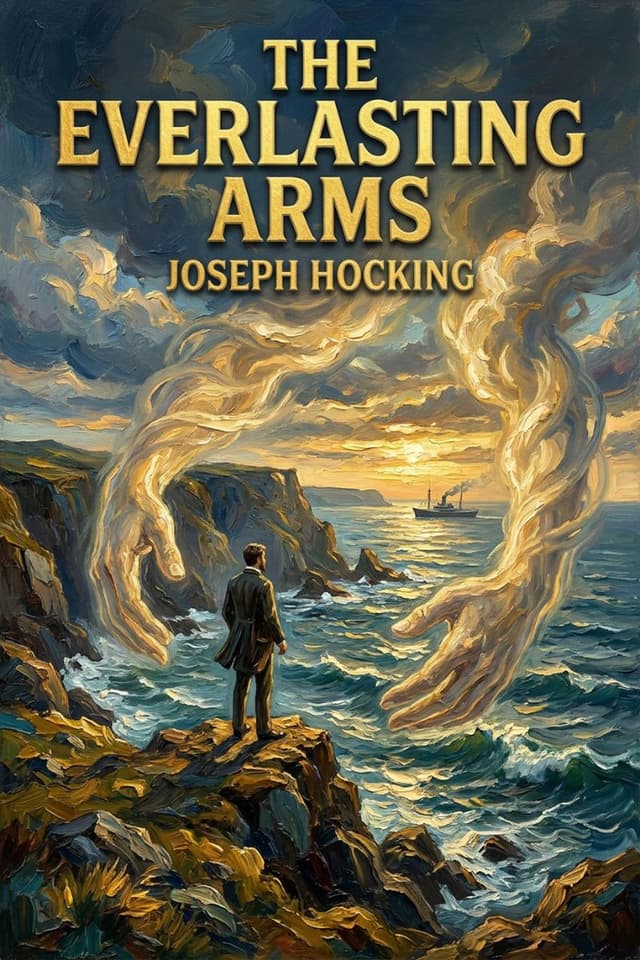
The Everlasting Arms
Read The Everlasting Arms by Joseph Hocking for free on Novelhalla, and try out our easy-to-read modern edition of this classic book. You can also download the EPUB and read it on any device if you prefer!
The Plot
An Argument in the Smoke-Room
A dozen men are sitting up late in the smoke-room of a liner bound for Australia, arguing about the Angels of Mons. Half of them think the soldiers really saw something. A clergyman named Bennett is certain of it, because his own son died at Mons and he swears the boy has been near him ever since.
Dick Faversham thinks it's all nonsense. He's twenty-seven, sharp, ambitious, broke, and heading to Australia because it's the only offer he's got. He argues hard against the whole business of guardian angels and personal devils, and he's enjoying himself.
The only man in the room who doesn't join in is Count Romanoff, who watches the argument with a small cold smile and finally says he'd shock them all if he told them what he actually believed. He's handsome, brilliant, widely travelled, and something about him makes people keep their distance without knowing why. Dick likes him enormously.
Then, through the haze of cigar smoke, Dick sees a woman standing near the door. Young, still, with the most extraordinary eyes he has ever seen, full of pity and a kind of desperate warning. There are no women in the smoke-room. The steward has been there all evening and saw nobody. The man sitting beside the door saw nobody.
Dick goes to bed sure of what he saw, and a knock comes almost immediately. A wireless message. His uncle Charles Faversham, a man he has never once met, is dead, and a very respectable firm of London solicitors urgently needs him home.
The Wreck
Somewhere in deep water, the ship hits something in the night.
Dick goes into the sea in the dark with a head wound, swims until his arms stop working, and feels something enormous and hostile closing over him. He has spent his whole life expecting nothing after death, and now, drowning, he finds he cannot bear the thought. He is going under when a light appears, and above the light, a face.
He wakes on a beach in the sun with Count Romanoff sitting beside him, offering fruit and a very sensible explanation of how he was pulled from the water. That night the woman comes to him again in a dream, and she is unambiguous. That man saved nothing. He is your enemy, the enemy of your soul, and everything that is about to happen to you is a trap. You will be tempted, and you must fight.
Then Romanoff's voice calls across the island. A ship has seen their signal.
The Inheritance
What waits for Dick in England is almost obscene good fortune.
Charles Faversham was a bachelor with a genius for money and no interest in people. He left everything to his sister's three children, with a clause saying that if they were dead it should go to his nearest surviving relative. All three are dead. Two in England, and the third, a wastrel named Anthony Riggleton, in a squalid brawl outside Melbourne, identified from the papers in his pockets and by two bank clerks who looked at a badly beaten face in a mortuary.
So Dick, who lands at Tilbury in borrowed clothes with twenty-four shillings, walks out of Lincoln's Inn Fields as one of the richest men in England. Shipping. Banking. Mines. Hundreds of London houses. And Wendover Park, a three-hundred-year-old Surrey mansion with parkland rolling away to the hills, which the old man bought out from under a ruined baronet and which the county has never quite forgiven him for.
On the road to his new house, Dick stops to fix a stalled two-seater for a dark, magnificent young woman who turns out to be Lady Blanche Huntingford, daughter of the proudest peer in Surrey. Within a fortnight he's half in love with her and fully in love with what she represents: the county, the doors, the future, the whole glittering machine.
Then he stands at the foot of his own front steps and sees the angel hovering over the entrance, trying to warn him about something she can't get words for.
And when he turns around, Count Romanoff is standing in his doorway with a suitcase, smiling, come to take him up on that promise about anything he ever wanted.
Three Temptations
The Count is a marvellous guest. He is also, quietly and patiently, a teacher, and what he teaches is that there is no right and no wrong, that this life is all there is, and that the only sane thing to do with it is to take everything you can reach.
Dick is a good man in the ordinary way. He's also poor for the first twenty-seven years of his life, and hungry, and just clever enough to want more than money: he wants a seat in Parliament, a great name, the daughter of a great house on his arm. Every one of those wants is a door, and the Count knows exactly where each one opens.
There will be three temptations, and Dick will not recognise any of them for what they are while it's happening. There's a fortune that rests entirely on two Melbourne bank clerks having been right about a face. There's a political movement with a crowd behind it and a midnight meeting in a room off a Soho café. There's a Russian woman named Olga Petrovic. And there's a quiet young girl called Beatrice Stanmore, who lives near the park with her grandfather and who nobody in Surrey would call a beauty next to Lady Blanche.
Somewhere behind all of it, a woman with unbearable eyes keeps appearing at doorways and windows, trying to tell him something, and getting fainter every time.
About the Author: Joseph Hocking
A Cornish Boyhood
Joseph Hocking was born in November 1860 in St Stephen-in-Brannel, a village a few miles west of St Austell in mid-Cornwall. His father James was part-owner of a tin mine. His mother Elizabeth was a Kitto, related to the biblical scholar John Kitto. There were seven children and every one of them got a name out of the Bible.
He earned his living as a land surveyor from 1878, tramping over Cornish ground with a chain and a theodolite, before deciding on the ministry instead.
The Preacher Who Wrote Novels
He trained in Manchester and was ordained a United Methodist Free Church minister in 1884. Three years later, while stationed in London, he wrote his first novel.
He never treated the fiction as a hobby that competed with the pulpit. He treated it as the pulpit, extended. He believed a novel could reach people a sermon never would, and he wrote them at a pace that suggests he meant it, holding down full church appointments the entire time. Ill health finally forced him out of the ministry in 1909. His last charge was the big United Free Church at Woodford in Essex, which he pushed to have rebuilt by the arts and crafts architect Charles Harrison Townsend.
Once he recovered he found himself in demand as a preacher all over Britain, and he travelled extensively in the Middle East.
A Family Business
The Hockings were a writing dynasty, and an odd one. His older brother Silas was also a Methodist minister and also a bestselling novelist, whose book "Her Benny" sold enormously. Their sister Salome wrote novels too. Between the three siblings they produced something over two hundred books, most of them aimed squarely at a Methodist readership, and Joseph's own bibliography runs to nearly a hundred.
Critics of the time and since have called it pulp. There's a scholarly study of the three of them actually titled "Pulp Methodism."
The War
Hocking wrote hard through the First World War, turning out novel after novel about it while it was still happening. His son Cuthbert was killed in action.
Later Years
He married Annie in 1887. Three of his four daughters became published novelists in their own right, and one of them, Anne Hocking, wrote more than forty crime novels between 1930 and 1962. He died in Cornwall in March 1937 at seventy-six, and his ashes were buried in the churchyard of the village where he was born.
Fun Facts About the Book
The Angels of Mons Were a Real Mass Delusion
The argument that opens the book was one people were genuinely having. In August 1914 the British Expeditionary Force fought at Mons and was forced into a brutal retreat. On 29 September the Welsh writer Arthur Machen published a short story in the London Evening News called "The Bowmen," in which a soldier calls on St George and the ghostly archers of Agincourt appear to destroy the German advance.
It was fiction. It ran without a label saying so, in a country starving for good news, written in flat reportorial prose. Within months it was being repeated in parish magazines and preached from pulpits as established fact, with new details attached, and soldiers were coming home saying they'd seen it themselves. Machen spent years insisting he'd made the whole thing up, and nobody listened. That's the exact cultural moment this book opens in.
A Methodist Minister Wrote a Novel With the Devil in a Dinner Jacket
Hocking spent his career arguing that fiction was a legitimate vehicle for Christian teaching. What he built here is essentially a supernatural thriller: a charming, cultured, physically magnetic villain who may be an emissary of hell, an apparition who cannot make herself heard, and a hero being played for his soul by someone who never once raises his voice.
The Title Comes From Deuteronomy
The phrase is from Moses's blessing in Deuteronomy 33, and it's the line whispered to Dick as he's going under. Hocking builds the whole book around a single verse and takes it perfectly literally: there really are arms underneath, and they really do hold.
He Named His Devil Romanoff
The Count claims kinship with the Russian imperial house while sneering at Russia as a heap of savagery and superstition. The book was written into a Britain reading daily about Bolshevik Russia, industrial unrest, and revolution, and it puts a plot about class war and a room behind a Soho café at the centre of its second act. A reader in 1919 or 1920 would have felt that name land.
Hocking Was a Full-Time Controversialist
Alongside the novels he wrote openly anti-Catholic polemics, including a pamphlet titled "Is Home Rule Rome Rule?" and another asking whether Rome would reconquer England. He was not a gentle ecumenical figure. He was a Nonconformist with a printing press and strong opinions about who was wrong.
Three Parts, Three Temptations
The book's own table of contents lays out the structure: a prologue, then Part One, Part Two, Part Three, each named for a temptation. The parallel to the temptation of Christ in the wilderness is not subtle and isn't meant to be. Hocking was writing a sermon shaped like a thriller, and he trusted his readers to spot the shape.
Hocking Ended Up in a Play
The Cornish playwright Alan M. Kent made Hocking one of the main characters of his 2009 play "Surfing Tommies."
Themes
Money as a Spiritual Problem
The book's most interesting move is that the temptation isn't a crime. Nobody asks Dick to murder anyone. He inherits a fortune legally, moves into a beautiful house, and is welcomed by decent neighbours, and Hocking's argument is that this is exactly how it works: what corrupts you is getting everything you wanted while it stays technically above board.
The Unseen World Cuts Both Ways
Written for readers who had just buried a generation, the novel insists that the dead are near and watching. But it takes the other half of that bargain seriously too. If there are guardian angels, there are also things that are not, and both of them are interested in you.
Ambition and the Two Women
Lady Blanche is health, beauty, ancestry, and everything Dick's ambition tells him to want. Beatrice Stanmore is quiet and nobody's idea of a prize. The book knows precisely what it's doing by putting them in the same county, and it uses the question of who a man actually loves as the truest measure of what he's become.
The Angel Who Cannot Speak
The most haunting device in the book is that the warning never arrives clearly. She appears, she opens her mouth, and the words don't come. Dick has to decide, over and over, with no proof and no instructions, whether to believe his own eyes. Hocking has essentially dramatised what faith feels like from the inside.
Class, Crowds, and Revolution
The second act moves out of the Surrey drawing rooms and into a political movement promising the country for the people. The novel is genuinely uneasy about it, and honest enough to let the case be made rather than simply mocked.
The Book's Legacy
Joseph Hocking was, for about thirty years, one of the most widely read novelists in the English-speaking world, and he is now almost entirely forgotten outside Cornwall and a handful of Christian publishers who keep reprinting him. That gap between how big he was and how invisible he is now is itself the interesting thing about him. He wrote for an enormous audience that essentially dissolved: the Nonconformist chapel-going public who wanted stories with a moral spine and bought them by the hundred thousand.
What survives well here is the machinery. Strip out the theology and you have a properly constructed supernatural thriller with one of the better literary devils, a man who never threatens, never bargains openly, and simply arranges for you to get exactly what you already wanted.
It's also a document of a very specific moment. This is a book written by a bereaved father in a country full of bereaved parents, in the few years when a large number of otherwise sensible British people genuinely believed that soldiers had seen angels over a battlefield in Belgium. Read it now and the plot is a supernatural potboiler. Read it as something published into that particular grief and it becomes a good deal stranger and sadder.