Novelhalla
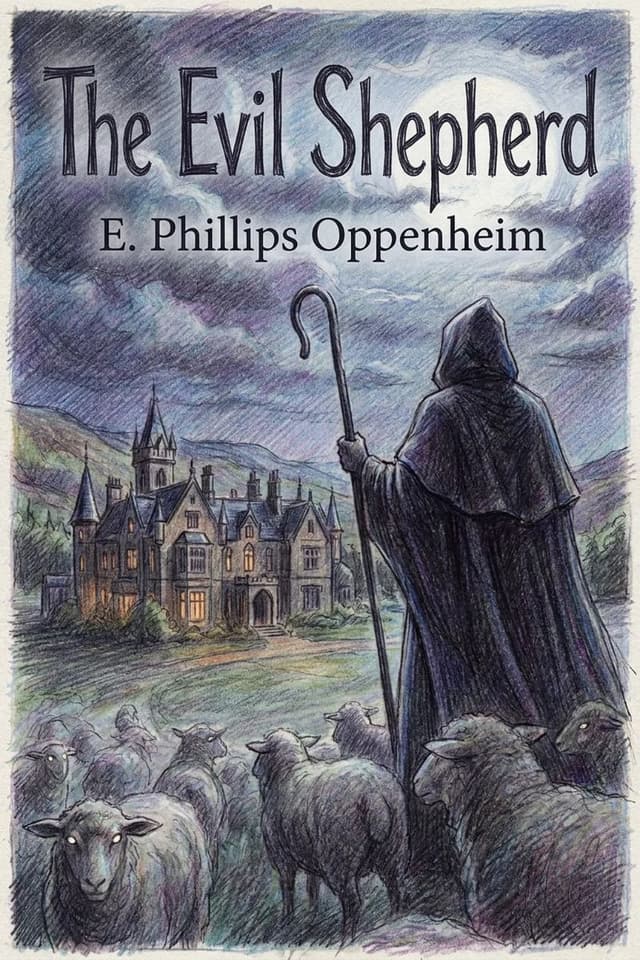
The Evil Shepherd
Read The Evil Shepherd by E. Phillips Oppenheim for free on Novelhalla, and try out our easy-to-read modern edition of this classic book. You can also download the EPUB and read it on any device if you prefer!
The Plot
A Victory That Turns Sour
Francis Ledsam is one of London's most brilliant criminal barristers, and he's just pulled off the kind of win that makes a career. A businessman is found stabbed through the heart, and the obvious suspect is his partner, Oliver Hilditch, a cold-eyed fellow with a paper-thin alibi. Hilditch seems destined for the gallows, but Ledsam uses every legal trick he knows to free his client. The book opens with Francis on the courthouse steps, very pleased with himself, the congratulations still ringing in his ears as he lights a cigarette.
Then a woman who followed him out of court stops him. She's Margaret Hilditch, the defendant's wife, and she's beautiful, pale, and strangely indifferent to everything around her. She informs him that her husband is guilty of crimes far more monstrous than murder. That evening Hilditch himself invites Francis home to dinner, where the newly freed man cheerfully walks his lawyer through exactly how the "impossible" crime was done.
Before the night is over, Francis is tangled up in events at that house that will follow him for the rest of the book. He also can't get Margaret's sad, guarded eyes out of his head.
A Lawyer Declares War
Shaken, Francis makes a decision. He won't defend the guilty anymore. He's going to go after them instead, and he says so out loud, over dinner, to his friend Wilmore. Unfortunately someone at the next table overhears.
That someone is Sir Timothy Brast, a man nobody can quite figure out. He's a millionaire, a power in the City, a generous supporter of hospitals, and a famous friend to animals who keeps a whole park of rescued, worn-out horses. He's also the subject of some very dark gossip. Sir Timothy leans over, needles Francis about his new crusade, and casually suggests that if Francis wants to be the world's great crime-fighter, he himself might make a fine arch-criminal. Then he predicts a murder.
It happens soon after. A young man named Victor Bidlake dies, and suddenly Francis has a mystery on his hands and a smiling millionaire who seems to know far more than he should.
Behind the Walls
Sir Timothy's country home is called The Walled House, a mansion by the river that's surrounded by rumors: wild parties, fixed boxing matches, rich young people with too much money and too little to do. Francis teams up with a Scotland Yard detective named Shopland to find out what really goes on behind those walls. The strange thing is that Sir Timothy doesn't seem to mind. He invites Francis to dinner, debates good and evil with him over excellent wine, and treats the whole investigation like a game he's sure he'll win.
To make things worse, the trail keeps leading back to Margaret Hilditch, who has her own connection to Sir Timothy. Francis wants to protect her, and he also wants to catch the man he's sure is pulling the strings. He's beginning to realize he may not get to do both. Is Sir Timothy a monster in evening dress, or the cleverest joker in London? And what is happening inside The Walled House on the nights the gates are locked?
About the Author: E. Phillips Oppenheim
Early Life and the Leather Trade
Edward Phillips Oppenheim was born 22 October 1866 in Tottenham, London, the son of Henrietta Susannah Temperley Budd and Edward John Oppenheim, a leather merchant. He grew up in Leicester, where "Oppy," as he was called when young, attended the Wyggeston grammar school. At sixteen he left school to help in his father's leather business, and he stayed there for more than twenty years. He wrote at night and in his spare time. His first book, Expiation, came out in 1887, and in 1898 he published The Mysterious Mr Sabin, which kicked off his long run of stories about the shadowy world of diplomacy.
Marriage and Success
On a business trip in 1892, he went to the United States and met his future wife, Elsie Clara Hopkins of Easthampton, Massachusetts. They had one daughter, Josephine. Once his writing paid well enough, he got out of the leather trade completely. When World War I began, he took a position with the Ministry of Information in London. The job took him to France with other journalists, and he fell in love with the country.
The Riviera Years
His books made him rich, and he lived like one of his own characters. He bought the Villa Deveron at Cagnes-sur-Mer, between Cannes and Nice, where he could play golf, gamble, and sail. He dictated his stories and novels to a secretary and sold most of them to American magazines before they came out as books. He spent his winters in France, often throwing parties for more than 250 guests, and was a well-known figure in high society. He was very fast, too. He sometimes wrote a novel in as little as three weeks and published as many as seven in a year.
Final Years
To avoid France's high death taxes, he sold the villa in 1934 and moved to Le Vauquiedor in the Channel Islands. World War II upended things: he lost access to that house when Germany occupied the Channel Islands, though he later got it back. He wrote about his life in an autobiography, The Pool of Memory. He died on 3 February 1946 in St. Peter Port, Guernsey.
Legacy
He called himself the "Prince of Storytellers," and the name stuck. He's generally seen as the earliest writer of spy fiction as we know it today, and his best-known work is The Great Impersonation (1920), which was filmed three times. Overall, more than 30 of his works were made into films.
Fun Facts About the Book
Two Publishers, Two Countries
The novel came out in 1922 from Hodder and Stoughton in Britain and Little, Brown in the US, and the first US edition had a cover by Ernest Fuhr.
A Spider on the Cover
One early American edition from the Review of Reviews Corporation was bound in olive green cloth with a gold spider-in-its-web illustration on the front cover. It's a pretty good hint about the kind of man Sir Timothy is supposed to be.
A Busy Year
Oppenheim was writing at full speed in 1922. The Great Prince Shan, a political thriller set in the future, came out the same year.
A Villain Who Loves Horses
Sir Timothy might be the book's most memorable character because he's so hard to pin down. One reader summed him up as patron of the SPCA, endower of hospitals, and apparent criminal mastermind. His collection of broken-down horses at The Walled House shows up in the novel as one more puzzling piece of the man.
Fists and Fancy Clothes
The thrills here aren't all gunfire and chases. As one reviewer put it, the thrills are provided by boxing matches, and matching wits. In one early scene, the very polished Sir Timothy flattens a rude carter with a single punch.
Translated Abroad
The novel has reached readers well beyond the English-speaking world, including an Arabic translation. One Arabic-language reviewer said Oppenheim's storytelling felt like watching a quiet, slightly mysterious film.
Themes
Law Versus Justice
Francis wins because he's good at his job, not because his client is innocent. The book keeps asking whether a lawyer can stay neutral when he knows the truth, and what happens when a man who's been on the side of the law decides to go after justice on his own.
Good and Evil at the Dinner Table
The best scenes are conversations. Francis and Sir Timothy like each other, distrust each other, and argue about morality over very good food. Good and evil become common topics of discussion over drinks and dinner. The book is less interested in a simple fight between hero and villain than in how blurry the line between them can get.
Boredom and the Idle Rich
Many of the characters have too much money and nothing to do with it. The book looks at what people with everything turn to for excitement, and how far they'll go once the usual pleasures stop working.
Love Against Conscience
Francis is falling for a woman whose life is caught up in the very things he's investigating. Ledsam finds himself trapped between his love for a beautiful woman and a powerful desire to do the right thing, no matter the cost.
Historical Context
The novel is set in London right after World War I, and the jumpy, pleasure-hungry mood of those years runs all through it. One reader praised how Post War England is well portrayed, with casual sex and a drug-fueled night life, orgies in country homes, wayward women, and wastrels of all classes. At one point Sir Timothy rants against the recent craze for drugs, which was a real worry in early-1920s London. Knowing a little about that world makes the nightclubs, cocktail bars, and secret parties feel even more alive.
The Book's Legacy
This isn't one of the Oppenheim books that got famous on screen, but it has kept a steady following among fans of Golden Age crime. MysteriousPress.com brought it back as part of its classics line, calling it a blockbuster novel from an early master of the thriller genre. LibriVox also released a free audiobook read by Richard Kilmer.
Modern readers sometimes find it more daring than they expected. One reviewer called it a tale of debauchery and crime-for-thrills amongst the English aristocracy, cocktails in hand! and said it pre-empts some of the themes beloved of Bret Easton Ellis and J.G. Ballard. That's high praise for a 1920s page-turner. Its mix of courtroom drama, high-society mystery, romance, and a villain you can't help liking makes it one of the most fun ways into the "Prince of Storytellers."