Novelhalla
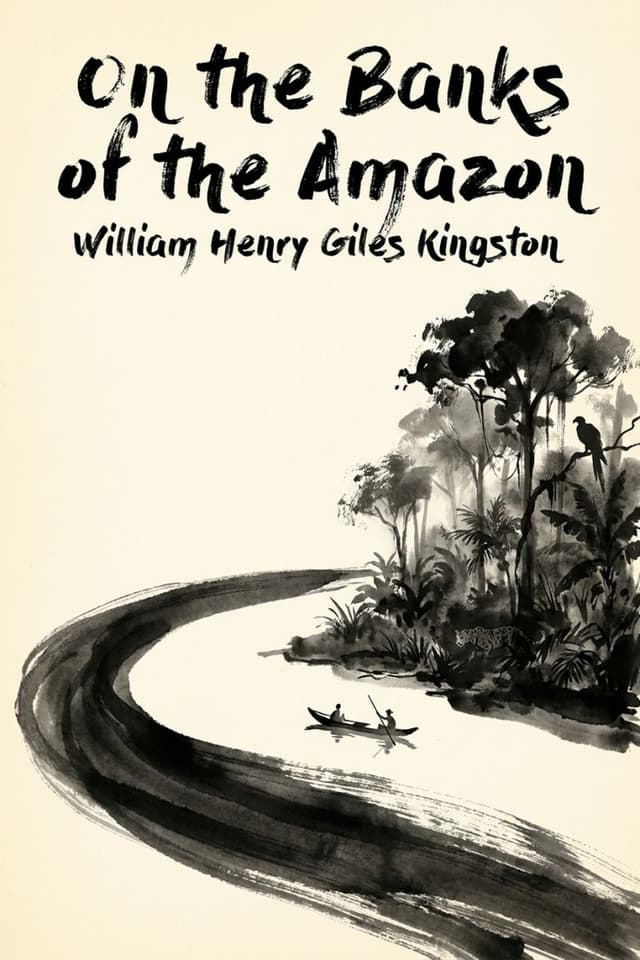
On the Banks of the Amazon
Read On the Banks of the Amazon by William Henry Giles Kingston for free on Novelhalla, and try out our easy-to-read modern edition of this classic book. You can also download the EPUB and read it on any device if you prefer!
The Plot
A Boy Born in the Clouds
Harry Faithful grows up in Quito, one of the highest cities on earth, in a house where the courtyard fountain trembles when the mountains decide to move. Pichincha smokes on the horizon. Chimborazo sits above everything like a white god. When Harry is small, an earthquake brings buildings down across the city in a matter of minutes, and his aunt carries him out into the open air without so much as flinching.
His family is a strange, interesting mixture. His father is a merchant with an English name and Spanish papers, descended on one side from the Incas and on the other from England, keeping his real religion quiet because the priests have already threatened to denounce him. His mother is English and insists the children be raised as Protestants, which is exactly why Harry gets shipped off across an ocean to be educated somewhere safer.
So he goes to school in England, where he makes the two friendships that will define his life. Tony Nyass is reckless, warm, and full of terrible ideas, and one of those ideas is that the two of them should run away, get to South America, and paddle up the Amazon in a canoe by themselves. Arthur Mallet is quieter, kinder, and carrying a private grief he doesn't talk about. There's also a bully named Houlston, who becomes something the boys never expected.
The Voyage Out
At sixteen, Harry gets the offer he's been waiting half his life for: sail home to Ecuador with his older brother John and his sister Ellen. His father needs help with the business. The mountains are waiting.
The crossing gives him a black cocker spaniel named True, a parting gift from Tony, who's headed to Brazil with a dog of his own. It also gives him a night he'll never forget. Somewhere in the black middle of the Atlantic, in a gale that's tearing the sails off the yards, the crew spots a ship going down ahead of them and a single boat full of people in water that shouldn't let anything live. Ropes go over the side. Hands grab at them. Some hold on. Some don't.
Bad News on a Mountain Road
They land at Guayaquil expecting their father to meet them. He isn't there, and nobody has heard from him for weeks. The country is unsettled, the way it's been unsettled ever since the Spanish provinces threw off Spain, with one faction seizing power just long enough for the next one to take it back.
A stranger appears the night before they leave: Don José, a Peruvian of pure Indian blood who offers, with no particular explanation, to guide them over the Andes. He's courteous, obviously educated, obviously important, and obviously not telling them who he really is. Harry and John decide he must be a relative on their grandmother's side. Their friends in Guayaquil know more than they'll say.
Two hundred miles of mule track later, high on a ledge with a river roaring several hundred feet below, a lone rider comes around the bend toward them. It's Domingos, the family's old servant, who has ridden hard for days to intercept them before they reach Quito. There's been a revolution. The house has been burned. The family has fled and is trying to get out of the country entirely. And there are government troops on this road, coming down the mountain right now, close enough that Harry can see the sun catching their weapons.
Into the Green
What follows is a scramble off the path, down a goat track, into the forest, and then into a continent. The only way to their family is east and down, off the roof of the world, through cloud forest and bark-cutters' camps and country nobody in the party has ever seen, toward the headwaters of a river that runs almost four thousand miles to the sea.
Harry has spent his whole boyhood dreaming of exactly this journey. He wanted the parrots and the palms and the jaguars, the alligators asleep on the mudbanks with their mouths open, the tapirs and the vultures and the trees so tall the sky disappears. He is going to get every bit of it. He's just going to get it with his sister beside him, soldiers behind him, no certainty that his parents are alive, and a guide whose real name nobody will say out loud.
About the Author: W.H.G. Kingston
A Boyhood Split Between Two Countries
William Henry Giles Kingston was born in London on 28 February 1814, but most of his youth was spent in Oporto, Portugal, where his father worked as a merchant. He grew up bilingual and half foreign, which is a useful thing for a boy who'd later spend his career writing about people far from home.
When he joined the family firm, he based himself in London and started writing newspaper articles about Portugal on the side. Those pieces got translated into Portuguese and helped smooth the way for the Anglo-Portuguese commercial treaty of 1842. Queen Maria II made him a Knight of the Military Order of Christ for it, and gave him a pension. He was twenty-eight.
The Accidental Novelist
His first book, The Circassian Chief, came out in 1844, followed by The Prime Minister and a travel book about Portugal. They did fine. Then in 1851 he published Peter the Whaler, his first story written specifically for boys, and it went off like a rocket in Britain and America both.
That was the end of the merchant career. Kingston walked away from business and spent the next thirty years writing adventure stories, more than 130 of them, set everywhere from the Arctic to Zululand to Florida to the Amazon basin. He also edited magazines, campaigned for better conditions for emigrants, and served as honorary secretary of a colonization society.
The Man Behind the Books
Kingston cared about sailors in a way that went well beyond fiction. He was instrumental in founding the Missions to Seamen in 1856 and spent years advocating for merchant seamen, travelling to Liverpool to build support there. He also translated a great many books from French, including Jules Verne, and his English versions stayed in print for generations.
He married in 1853 and took his wife on a wedding tour of North America, where the two of them met Henry Wadsworth Longfellow. Kingston, being Kingston, had brought along a copy of one of his own books to give to Longfellow's sons.
Final Years
In 1880 he launched a new boys' magazine called The Union Jack. Within four months his health had collapsed and he handed it over to a younger writer named G.A. Henty, who'd go on to become the biggest name in the genre Kingston helped invent. Kingston died on 25 August 1880 at sixty-six.
Three years later, the money The Union Jack had raised in his memory was given to the lifeboat service to pay for a boat. They named it the W.H.G. Kingston.
Fun Facts About the Book
The Full Title Is a Sales Pitch by Itself
The 1872 first edition from T. Nelson and Sons carried the subtitle "or, A Boy's Journal of His Adventures in the Tropical Wilds of South America." Victorian publishers didn't believe in subtlety, and honestly, they were right.
It's Enormous
The first edition ran to 512 pages with well over a hundred black and white engravings scattered through the text. This was a doorstop, sold as a school prize and a Christmas gift, and secondhand copies still turn up with prize plates and children's names written inside the front cover.
Kingston Never Went There
He'd sailed the Atlantic, lived in Portugal, and toured North America, but he never set foot on the Amazon. The book was built out of published travel accounts and natural history writing of the period, which was standard practice at the time and occasionally shows. Critics have noted for well over a century that his geography sometimes wanders.
It's Half Adventure Novel, Half Field Guide
Harry stops constantly to explain things. How a viper's fangs hinge and fold. How cacao pods are fermented under sand for four days before drying. How the bark collectors of the Andes send a specialist up the tallest tree to spot chinchona groves by the way the light bounces off their leaves. Readers either love this or skim it, and there's not much middle ground.
That Bark Is Quinine
One of the long digressions covers Peruvian bark, named chinchona after a viceroy's wife who was supposedly cured of a fever in 1638. It was called Jesuit's bark for a while, Protestants distrusted it on principle, and physicians argued it was dangerous. It was, of course, the only effective malaria treatment on earth, and a large part of why Europeans could go into the tropics at all.
He Wrote More Than 130 of These
Kingston's output was industrial. Over roughly thirty years he produced well over a hundred adventure novels, and many were serialized in weeklies and monthlies before appearing as books. This one sits among the best regarded of the lot, largely because the South American setting gave him more to work with than another sea story.
The Illustrations Changed Over Time
Different editions carried entirely different artwork. The 1872 Nelson printing used engravings by W.H. Freeman, J. Gauchard and W.H. Prior. Later editions were illustrated by W.H.C. Groome. If you've seen this book somewhere before, there's a decent chance the pictures in your memory don't match the ones in front of you now.
Themes
Curiosity as a Survival Skill
Harry's natural history obsession starts as a boyhood hobby: cages in his uncle's garden, a weasel, a hedgehog, three or four snakes, an aquarium of rock-pool creatures. It's played for charm early on. Then the family loses everything and the group has to move through country where knowing which animals are dangerous, which plants are edible, and how the forest actually works stops being a hobby and starts being the difference between competence and helplessness.
Family Is Worth Crossing a Continent For
The engine of the whole book is simple and it never lets up. Somewhere out there are a father, a mother, and a sister, and nobody knows where. Everything Harry does is in service of closing that distance.
Friendship, Made and Remade
Kingston is unusually interested in how friendships get built. Harry earns his place at school through a footrace. He earns Houlston's loyalty by tying him up in a woodshed, which sounds like a joke and isn't. The book keeps insisting that the boy who seems like an enemy might not stay one, and that the friend you thought you'd lost might turn up in the worst weather of your life.
Wonder and Threat in the Same Landscape
The Amazon basin in this book is a paradise and a gauntlet at once, often in the same paragraph. Orchids like snakes coiled round the branches, flowers the size of dinner plates, and then a precipice, a flood, a fever, a mouth in the water. Kingston doesn't separate the beauty from the danger, because to the people moving through it they aren't separate.
Providence
This is a Victorian book by a genuinely devout man, and faith runs all the way through it. Sam the cook, Ellen with her Bible open on a pitching table, Captain Byles saying he used to think God was fighting against him and now knows better. The characters read their survival as ordered rather than lucky, and the book is entirely sincere about it.
Historical Context
Reading It With Your Eyes Open
This was written in 1872 by an Englishman for English boys, and it carries the attitudes of that world. Indigenous peoples are ranked on a scale of civilization. Black characters speak in heavy phonetic dialect. Slavery appears in the household without comment. None of it is written with malice, which somehow makes it a clearer window into how ordinary and unquestioned those assumptions were.
It's worth knowing going in, partly so it doesn't blindside you, and partly because the book is more interesting when you can see both what Kingston noticed and what he couldn't. He was, for his moment, unusually attentive to the intelligence and dignity of his non-English characters. Don José and Domingos are the two most capable people in the party by a wide margin, and the book knows it.
The Book's Legacy
Kingston is the reason the boys' adventure novel became an industry. Peter the Whaler set the template in 1851, and by the time he handed The Union Jack to G.A. Henty in 1880, the genre he'd built had a successor ready and a readership of hundreds of thousands. Everything downstream of that, the jungle expedition stories, the survival serials, the whole tradition of teenagers thrown into wild country with a rifle and a knack for zoology, runs back through Kingston.
This one has aged better than most of his catalogue. The South American setting gave him scale, the family-in-danger plot gave him urgency, and the natural history gave him something real to say between the chases. Readers who come to it now tend to describe the same experience: the plot creaks in places, and then you find yourself genuinely absorbed in a three-page account of how a tapir moves through underbrush, or a description of the Organ Mountains at sunrise, and you understand why a hundred and fifty years of children read this thing until the spines cracked.
It's also a document of something that no longer exists. The Amazon Kingston assembled from other men's travel books was already being reshaped by the rubber trade as he wrote. The forest in these pages is a Victorian dream of the place, half accurate, half wishful, and completely sincere in its awe.