Novelhalla
The Bride of Lammermoor
Read The Bride of Lammermoor by Walter Scott for free on Novelhalla, and try out our easy-to-read modern edition of this classic book. You can also download the EPUB and read it on any device if you prefer!
The Plot
A Funeral and a Feud
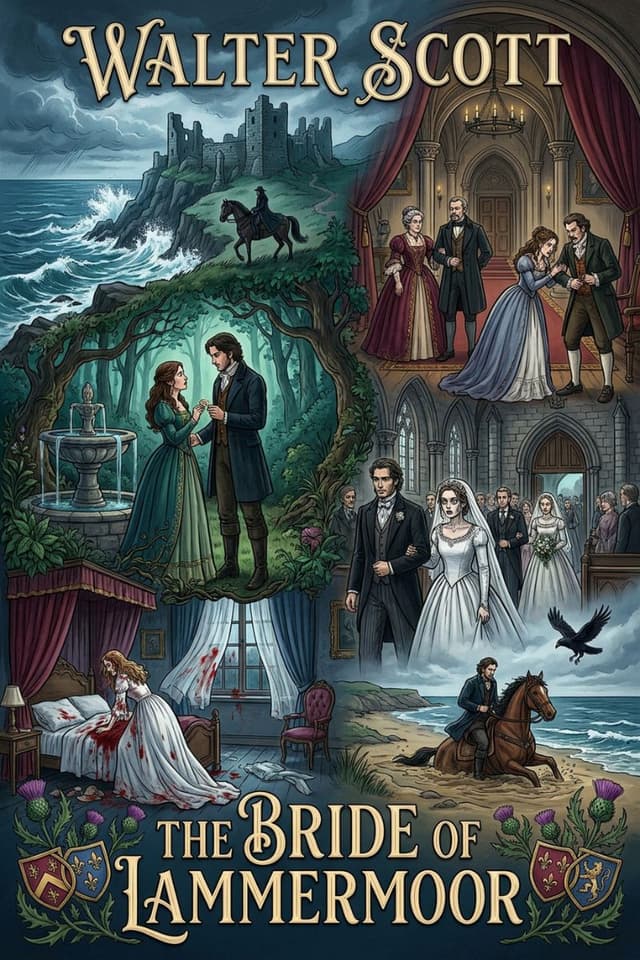
Edgar Ravenswood is a young man with nothing left but pride and a crumbling tower on the Scottish coast. His father has just died, ruined and bitter, stripped of his title and his ancestral estate by the cunning legal maneuvering of Sir William Ashton, the Lord Keeper of Scotland. The Ashtons now live in Ravenswood Castle. Edgar lives in Wolf's Crag, a sea-beaten ruin barely fit for habitation, attended by one fiercely loyal old servant named Caleb Balderstone and sustained by a burning desire for revenge.
At his father's funeral, Edgar defies the local authorities by insisting on an Episcopal service, marking himself as both proud and reckless. The neighborhood watches and wonders what the last of the Ravenswoods will do next.
The Rescue
What he does next is unexpected. While out walking near the estate that was once his, Sir William Ashton and his daughter Lucy are charged by a wild bull. Edgar appears and shoots the animal, saving both their lives. Lucy, sheltered and romantic, is instantly fascinated by this dark, brooding stranger who turns out to be her family's sworn enemy. Sir William, ever the politician, sees an opportunity. With the political winds shifting, he calculates that making peace with Edgar might protect his own position.
Edgar is invited to stay. He means to refuse. He means to hate the Ashtons. But Lucy is gentle and sincere, and he finds himself drawn to her despite everything.
A Secret Engagement
The two fall in love during the brief window when Lady Ashton, the true power in the family, is away in London. Sir William is too weak-willed to oppose the match openly and too shrewd to reject it outright. Edgar and Lucy pledge themselves to each other at a fountain in the grounds, breaking a gold coin between them as a token of their vow. But omens shadow the moment. Old blind Alice, a former Ravenswood servant, has warned them that no good can come of a union between their families. A dead raven falls at Lucy's feet. An ancient prophecy lingers over Wolf's Crag.
They agree to keep the engagement secret until the time is right. The time will never be right.
The Mother Returns
Lady Ashton arrives home, and the atmosphere changes completely. She is a woman of iron will and ferocious ambition, often compared to Lady Macbeth. She has no intention of allowing her daughter to marry the impoverished heir of a ruined family, no matter what promises have been made. She has another match in mind: Frank Hayston of Bucklaw, a wealthy young laird whose fortune would serve the family's interests far better.
Sir William, who had been cautiously willing to tolerate the engagement, collapses under his wife's authority. Edgar is driven from the house. Lucy is effectively imprisoned by her mother's relentless pressure. Letters are intercepted. Allies are cut off. And Lady Ashton brings in an old woman, Ailsie Gourlay, who fills Lucy's weakening mind with dark tales and superstitious terrors about the Ravenswood name.
The Breaking Point
Edgar, meanwhile, has been sent abroad on a political mission, trusting that Lucy will hold firm. But Lucy, isolated, exhausted, and psychologically broken by her mother's campaign, is a very different person from the girl who broke the gold coin at the fountain. The question becomes whether love can survive when one lover is absent and the other is being systematically dismantled.
The marriage to Bucklaw is arranged. The wedding day approaches. And then Edgar returns, and everything that has been building through the novel rushes toward a conclusion that is as violent as it is inevitable.
About the Author: Walter Scott
Early Life
Walter Scott was born in Edinburgh in 1771, the son of a lawyer. As a young child he contracted polio, which left him with a permanent limp. He was sent to recover at his grandparents' farm in the Scottish Borders, where his grandmother and aunt filled his head with ballads, folk tales, and stories of the old border wars. These early years shaped everything that followed. Scott developed a remarkable memory for verse and an obsessive love of Scottish history and legend.
He was educated at Edinburgh University and trained as a lawyer, eventually becoming both Sheriff-Depute of Selkirkshire and Clerk of Session in Edinburgh. But the law was always his day job. His real life was in stories.
The Literary Career
Scott first made his name as a poet. The Lay of the Last Minstrel (1805), Marmion (1808), and The Lady of the Lake (1810) were massive bestsellers that made him the most popular poet in Britain. When Lord Byron began to eclipse him in verse, Scott pivoted to prose and essentially invented the historical novel as we know it.
Waverley (1814) was published anonymously and became a sensation. Over the next thirteen years, Scott produced novel after novel at an astonishing pace: Rob Roy, Ivanhoe, The Heart of Midlothian, The Bride of Lammermoor, and many more. All were published anonymously, credited only to "the Author of Waverley," though his identity was an open secret. He was the most widely read novelist in the world.
Fortune and Ruin
Scott used his enormous earnings to build Abbotsford, a grand country estate in the Borders, stuffing it with antiquarian treasures and living the life of a Scottish laird. But his finances were entangled with his publishers, the Ballantyne brothers, and with the publisher Archibald Constable through a web of speculative credit arrangements.
In 1825, a financial crash brought the whole structure down. Scott was left with crushing debts. Rather than declare bankruptcy, he placed his estate in trust for his creditors and set about writing his way out of debt. The effort was heroic but punishing, and it shortened his life considerably.
Final Years
Scott's wife Charlotte died in 1826. His health deteriorated through the late 1820s, and he suffered a series of strokes beginning in 1831. He attempted a recuperative voyage to the Mediterranean but returned home failing. He died at Abbotsford on September 21, 1832, at the age of sixty-one, surrounded by his family and his beloved books. His debts were eventually paid in full by the continued sales of his novels after his death.
He was buried at Dryburgh Abbey in the Scottish Borders.
Legacy
Scott was the first international literary superstar. He did more than any single writer to shape the romantic image of Scotland and to establish the historical novel as a serious literary form. His influence extended across Europe and America, touching novelists from Balzac to Fenimore Cooper to Tolstoy. Though his reputation faded somewhat in the twentieth century, he remains one of the most important figures in the history of the novel.
Fun Facts About the Book
Written Under the Influence of Opium
Scott composed much of The Bride of Lammermoor while seriously ill with gallstones and jaundice. In March 1819, he suffered a near-fatal attack and had to suspend writing. When he resumed, he dictated the final chapters while numbed with opium to manage the pain. His amanuenses were his publisher John Ballantyne and his friend William Laidlaw. When Scott later read the finished novel, he claimed to have no memory of composing large portions of it, calling the result "monstrous, gross and grotesque." It has been compared to Coleridge composing "Kubla Khan" in a drugged state.
Based on a True Story
The novel is rooted in a real scandal from seventeenth-century Scotland. Janet Dalrymple, daughter of the powerful Viscount Stair, secretly pledged herself to Lord Rutherford. Her mother forced her instead to marry David Dunbar. On the wedding night in 1669, screams were heard from the bridal chamber. Dunbar was found stabbed and bleeding, and Janet had lost her mind. She died shortly afterward without recovering her senses. Dunbar survived his wounds. Scott heard the story from his own mother, Anne Rutherford, who was distantly connected to the family.
Scott's Own Heartbreak
Biographers have long noted parallels between the novel and Scott's own youthful romantic disappointment. In the 1790s, Scott courted a woman named Williamina Belsches for several years, only for her to marry the much wealthier William Forbes. The bitterness of a broken engagement and the pain of watching someone you love choose another path echoes through Edgar and Lucy's story.
Edgar Allan Poe's Favorite Scott Novel
Poe called The Bride of Lammermoor "that purest and most enthralling of fictions." It is easy to see why the American master of the macabre would be drawn to a novel featuring ravens, prophecies, madness, supernatural omens, and a hero swallowed by quicksand.
The Birth of One of Opera's Greatest Works
The novel inspired Gaetano Donizetti's Lucia di Lammermoor (1835), one of the most celebrated operas ever composed. The famous "mad scene," in which the soprano portrays the bride's descent into insanity, remains one of the supreme tests of vocal artistry. Maria Callas's legendary performances of the role in the 1950s helped revive interest in both the opera and the novel. There were actually six different operas based on the novel, including one with a libretto by Hans Christian Andersen, but Donizetti's version eclipsed them all.
Wolf's Crag and Fast Castle
The ruined coastal tower of Wolf's Crag, Edgar's lonely home, has long been identified with Fast Castle, a real fortress perched on a cliff above the sea on the Berwickshire coast. Scott himself said he had never seen it except from the water but approved of the comparison. The dramatic, wind-blasted setting perfectly matches the novel's atmosphere of decay and defiance.
The Darkest Waverley Novel
Among Scott's many novels, The Bride of Lammermoor stands apart for its unrelieved tragic tone. Critic John Buchan noted that unlike Scott's other works, this one offers no hope for the future and no comfortable resolution. The characters are engulfed by a destiny beyond their control. The darkness is leavened only by the comic antics of Caleb Balderstone, whose desperate schemes to keep up appearances provide some of the funniest scenes in all of Scott's fiction.
The Shortest of Scott's Major Novels
Like Austen's Persuasion (published just two years earlier), The Bride of Lammermoor is notably more compressed than its author's typical work. The tighter structure gives it a relentless momentum that some readers find more gripping than Scott's longer, more digressive novels.
Themes
Pride and Ruin
Edgar Ravenswood is defined by his pride in a name that no longer carries power. The Ashtons are defined by their ambition to acquire the status that comes with wealth and political maneuvering. The novel explores what happens when pride has nothing left to sustain it and when ambition has no limits to restrain it.
The Destruction of the Powerless
Lucy Ashton is caught between forces far stronger than herself. Her father's political calculations, her mother's ruthless ambition, Edgar's wounded pride, and the weight of an ancient family feud all converge on a young woman who has no real power to resist any of them. The novel is a devastating portrait of what happens when a gentle person is crushed by the people who claim to love her.
Fate and Prophecy
Omens, prophecies, and supernatural warnings run through the novel like a dark current. Old blind Alice foretells disaster. An ancient prophecy hangs over the Ravenswood family. Ravens, storms, and ghostly apparitions mark every turning point. Scott draws on Scottish ballad traditions and Gothic conventions to create a world where destiny feels inescapable, even as the characters make choices that seal their own fates.
Old World Versus New
The Ravenswoods represent the old feudal Scotland: proud, loyal to the Stuart cause, bound by honor and tradition, and utterly impoverished. The Ashtons represent the rising class of Whig lawyers and politicians who gained power through cunning and legal manipulation rather than birthright. The novel sits at the hinge point of Scottish history, just before or after the 1707 Act of Union, when the old ways were being swept aside by a new political order.
The Failure of Persuasion
Like its near-contemporary Persuasion, this novel is deeply interested in what happens when young lovers are torn apart by the interference of others. But where Austen's novel offers redemption and reunion, Scott's offers something far darker. Lady Ashton's campaign to break Lucy's will is not mere persuasion but psychological warfare, and the novel suggests that some forms of pressure destroy rather than redirect.
Loyalty and Devotion
Against the backdrop of betrayal and manipulation, the novel offers portraits of fierce loyalty. Caleb Balderstone will lie, steal, and commit arson to preserve his master's dignity. Edgar's constancy to Lucy endures across years and distance. The question is whether loyalty alone is enough when every other force in the world is aligned against you.
The Book's Legacy
The Bride of Lammermoor occupies a unique place in Walter Scott's body of work. It is his darkest novel, his most tightly constructed, and for many readers his most emotionally powerful. While Ivanhoe may be more famous and Waverley more historically significant, The Bride of Lammermoor is often considered Scott's masterpiece of pure storytelling.
Its influence on opera alone would secure its place in cultural history. Donizetti's Lucia di Lammermoor remains a cornerstone of the operatic repertoire nearly two centuries after its premiere, and the image of the mad bride in her bloodstained wedding dress has become one of the most iconic scenes in all of Western art.
The novel also helped establish many of the conventions of Gothic and romantic fiction that would dominate the nineteenth century. The brooding hero in his ruined castle, the innocent heroine crushed by forces beyond her control, the ancient curse working itself out across generations: these elements, which Scott drew from Scottish ballad tradition and shaped into prose, became the raw material for countless novels, plays, and films that followed.
Modern readers who come to the novel expecting a dusty period piece often find themselves surprised by its raw emotional power and its unflinching examination of how families destroy the people they claim to protect. The Bride of Lammermoor is not a comfortable read, but it is an unforgettable one.