Novelhalla
The Obstacle Race
Read The Obstacle Race by Ethel M. Dell for free on Novelhalla, and try out our easy-to-read modern edition of this classic book. You can also download the EPUB and read it on any device if you prefer!
The Plot
A Woman, a Dog, and Three Cigarettes Left
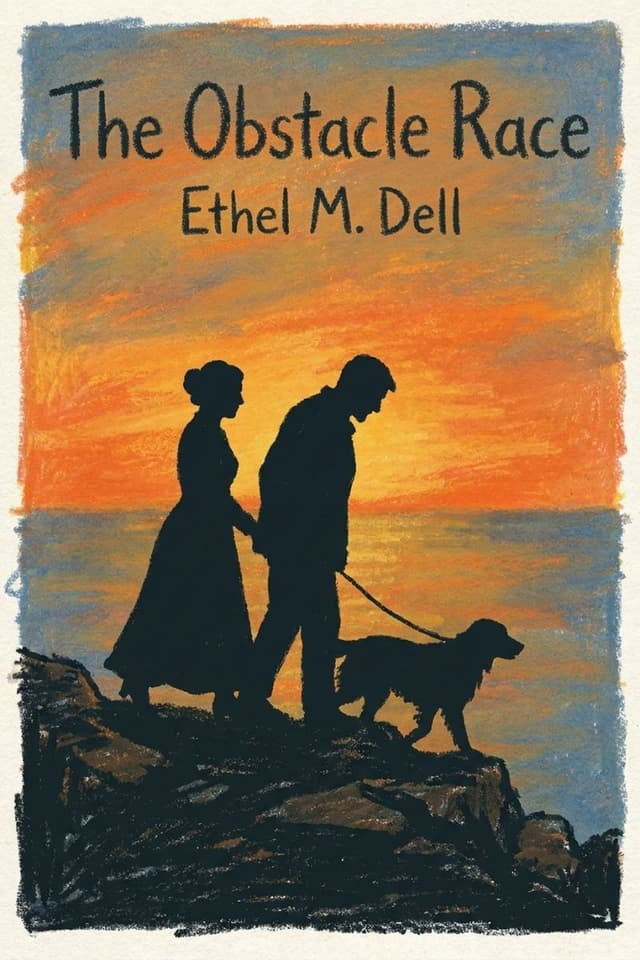
Juliet Moore has walked out on London. Not for a holiday, not for a rest cure, but for good, or so she tells herself. She's taken lodgings above a blacksmith's forge in a fishing village on the English coast, brought her dog Columbus, and worked out that when her last few cigarettes run out she'll have to learn to like whatever the village shop sells.
She has just enough money to live on and no plan beyond breathing. What she's left behind is a social whirl she describes, in one of the book's best moments, as a race with obstacles that only ever get higher. She got out, she says, only just in time.
The village has other ideas about how quiet her new life is going to be.
The Boy Who Threw the Stones
The first person she meets throws a rock at her head. Twice.
He's Robin, somewhere past twenty, badly deformed since a fall from the cliffs as a child, treated by most of the neighbourhood as either a nuisance or a monster. He's rude, he's frightened, he cries easily, and he attaches himself to Juliet with a completeness that would worry anyone with more sense. He tells her about the only two people he loves in the world. One of them is the blacksmith's baby. The other is his brother.
Brother Dick
Dick Green is the village schoolmaster, and he could have been almost anything else. He was reading for the law when Robin was crippled and everyone with an opinion agreed the boy should be shut away somewhere. Dick refused, gave up the career, took the school so he could stay and raise him, and has been at it ever since.
He's also the man who pulls Juliet off a cliff on her second night in the village, holds her on a ledge two hundred feet above the shingle, and tells her not to be silly when she says she can't climb back up. She climbs back up.
There's something in him that doesn't fit the schoolmaster's cottage, and Juliet notices it before she has any right to. So does the squire, who alternately bullies him and can't do without him. So do the miners at High Shale, a rough and increasingly angry crowd nobody else in the parish can handle.
The Great Man and His Wife
Mr. Fielding owns the village, the Court, and most of the opinions in circulation. He's fifty-something, thin-skinned, generous and appalling by turns, and he wants Juliet to take a job: companion to his young wife, who married him for what he had and has spent the years since running herself ragged at a hundred miles an hour to avoid being at home.
Fielding wants Juliet to slow her down. He says so with a bluntness that tells her far more about his marriage than he intends. Mrs. Fielding, for her part, is insolent, unwell, sharp as a tack, and perfectly aware of what her husband is doing.
Juliet takes the measure of both of them, and something in Fielding's face nags at her. She's almost sure she's met him before.
The Thing She Hasn't Said
Here's what makes the book work. Juliet mentions, lightly, that she was brought up as companion to Lady Joanna Farringmore, a society woman whose family happens to own the very mines that overshadow this village. She says she got tired of Lady Jo and left.
The villagers notice her Paris nightdresses. The chauffeur stares at her a beat too long at the churchyard gate. She flinches at questions a companion wouldn't flinch at. She tells Robin that nobody would take the trouble to come looking for her, and it sounds less like a fact than a hope.
Somebody in London is looking. And the schoolmaster who saved her life has a past of his own that he's every bit as careful about, propped up by an obligation to a squire he doesn't much like and a boy he can never leave.
Two people hiding two different things, in a village where a secret keeps about as long as a fish. The question isn't whether it all comes out. It's what's left standing when it does.
About the Author: Ethel M. Dell
The Quietest Bestseller in England
Ethel May Dell was born in August 1881 in south London, the youngest of three children of a clerk in the City. Accounts of the family place her birth in Brixton or Streatham depending on which biographer you follow, which is fitting for a writer who spent her whole career declining to be pinned down.
She was painfully shy, wrote stories to amuse her schoolfriends, and started placing them in popular magazines in her early twenties. Her cousins had a running joke about her fiction: they'd sit with pencils and tally how many times she used the words passion, tremble, pant and thrill. Nobody in the family seems to have predicted what was coming.
Eight Rejections and a Thunderbolt
Her first novel took years and collected rejection after rejection, eight by the usual count, more by some, quite possibly because publishers thought it too hot for a woman to have written. T. Fisher Unwin finally took it for a series showcasing debut authors, and it detonated. It went through roughly thirty printings by 1915. At one point it was reportedly bringing in half of her publisher's income.
She never looked back. Book after book followed, and by the early 1920s she was earning somewhere between twenty and thirty thousand pounds a year, an extraordinary sum for the period. Disturbed by the money, she gave a great deal of it away to her family.
The Woman Nobody Photographed
Dell gave no interviews. Almost no photographs of her exist. She lived quietly in the country, worked with an almost punishing discipline, and by one account would get out of bed in the night to write in the bathroom rather than disturb anyone.
In 1922 she married Lieutenant-Colonel Gerald Tahourdin Savage. She was forty. He resigned his commission, which made her the sole support of the household, and spent the rest of their marriage guarding her privacy with a ferocity that suited her exactly. By all accounts they were happy.
Later Years
She kept writing to the end, producing around thirty novels and eight collections of short stories. The critics never came round, and she never appeared to mind. She died of cancer in September 1939, aged 58, in hospital at Hertford, where her husband had been posted as war closed in.
Fun Facts About the Book
The Title Comes From a Throwaway Line
Juliet coins it herself, early on, trying to explain London to a boy who's never left the village. Fashionable life, she says, is a race full of obstacles that keep getting higher, and she's dropped out. The whole novel then proceeds to put a different set of obstacles in front of her.
It's Structured Like a Race
The book runs in four parts, and the chapter titles are studded with sporting language: a drawn battle, a point of honour, the honours of war. The final chapter is called The Last Fence, which is exactly the sort of thing a hunting-mad Edwardian audience would have grinned at.
The Epigraph Is From Saint Paul
Dell opens with a line from First Corinthians about running so that you may obtain, followed by a short poem of her own asking for the nerve to take the jumps and the grace to applaud a friend who beats you. It's the closest thing she wrote to a personal statement of intent.
There's a Crossover Character
An aristocrat named Saltash turns up in the third part. He's one of Dell's recurring rogues, and the following year he got a whole novel to himself. Readers of the day would have recognized him instantly, which is roughly the 1921 equivalent of a post-credits scene.
And He Got Her Savaged in Print
In 1922, Rebecca West published an essay attacking Dell as the embodiment of the bestseller, and singled out that same aristocrat as her prime exhibit. She called the thing Dell rode to success the Tosh Horse. The phrase followed Dell for decades and did nothing whatsoever to her sales.
It's Set at Home for Once
Dell built her reputation on India and the far corners of the Empire. This one stays put: an English coastal parish, fishing families on one side, lead miners on the other, a squire's house up the hill. The result is closer observation and considerably more social bite than her exotic romances usually allowed.
Written at the Absolute Peak
Cassell brought it out in Britain and Putnam in America in 1921, at the height of her earning power and one year before her marriage. She was, at this moment, one of the most widely read novelists alive and one of the least known personally.
The Dog Is Not Set Dressing
Columbus gets characterization, opinions, comic timing and a running commentary on his mistress's decisions. He's introduced before any human being in the book and he's better company than most of them.
Themes
What One Person Owes Another
Dick's entire adult life is a bill he chose to pay. He gave up a profession, a future, and any realistic prospect of an ordinary life to keep a brother who most people around him regard as a burden best removed. The novel takes that seriously rather than sentimentally, and keeps asking what it costs him and whether anyone has the right to ask him to stop.
The Person Everyone Talks Around
Robin is the moral instrument of the book. The squire wants him institutionalized. The squire's wife calls him things Dell puts on the page without softening. The villagers use him as a joke or a scapegoat. How each character treats him is precisely how the novel judges them, and Juliet's instant kindness is the first thing that marks her out.
Running Away and What It Solves
Juliet believes she's escaped. The book is much less certain. Every quiet corner she finds turns out to be connected by mine ownership, marriage, or gossip to the world she fled. Dell's suggestion is that you can change your address but not your history.
Marriage as a Transaction
The Fieldings are the book's cautionary exhibit: he bought a young wife, she sold herself a comfortable life, and both of them are now paying interest. Juliet says out loud what most novels of the period only implied, that trading your self-respect for security leaves you poorer than you started.
Class, and Who Gets to Be a Gentleman
A schoolmaster who speaks like a gentleman. A chauffeur who doesn't, and is his brother. A squire whose manners are worse than either. A woman whose underwear gives away more about her background than her conversation does. Dell is fascinated by the gap between what people are entitled to and what they actually are.
Strength That Shades Into Force
Dell's heroes take charge, and this one is no exception. Dick saves Juliet's life partly by overriding her, and the novel is frank that his will is the strongest thing about him. Modern readers will feel the tension in that, and it's worth reading with your eyes open. It's also the exact quality that made Dell irresistible to millions of readers and unbearable to the critics.
The Book's Legacy
Dell was one of the biggest-selling novelists of her era and one of the most thoroughly mocked. The literary establishment treated her as a symptom rather than a writer, and her name became a shorthand for everything highbrow critics feared about mass reading. George Orwell put her in the mouth of his hero in a later novel as an example of the rubbish the public buys, which was, of course, free advertising.
The mockery outlived the sales. By the middle of the century she'd faded from the shelves, and unlike some of her contemporaries she never got a scholarly rescue mission or a prestige adaptation to bring her back. Her cousin's word count, the Tosh Horse essay, and the eight rejection letters are better remembered than any of her plots.
Not everyone joined in. The poet Stevie Smith picked Dell's first novel as one of the great bestsellers of the century in a 1958 newspaper feature and praised it without irony. Several of Dell's books were filmed during the silent era, and her fingerprints are all over the century of popular romance that followed: the wounded, dominating hero, the heroine with a secret, the moral reckoning in the last chapter.
This one is a good place to meet her. It has the melodrama her readers came for, but it's grounded in a real English village with real economic tensions running through it, and its emotional centre isn't the romance at all. It's a man and the brother he refused to give up. Read it for the cliff rescue and the hidden identity, and stay for the fact that Dell, the writer nobody would take seriously, wrote one of the more decent portraits of a disabled man in the popular fiction of her day.