Novelhalla
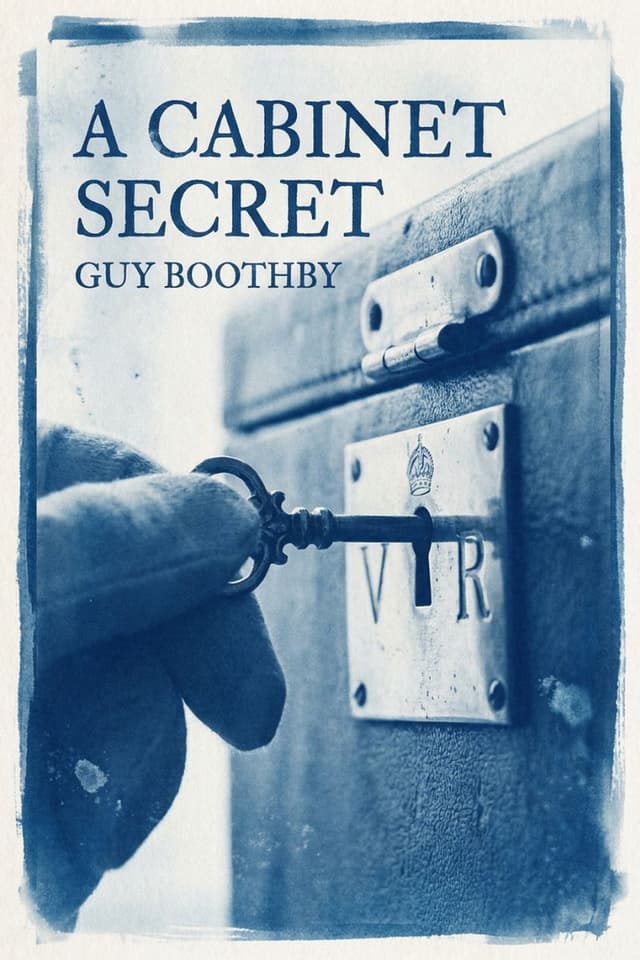
A Cabinet Secret
Read A Cabinet Secret by Guy Boothby for free on Novelhalla, and try out our easy-to-read modern edition of this classic book. You can also download the EPUB and read it on any device if you prefer!
The Plot
A Yacht in Naples Harbour
Two men stand in a filthy garret high above the bay, taking turns at a pair of field glasses, watching every vessel that drops anchor. They aren't admiring the sunset. They're waiting for a white steam yacht carrying a woman they need, and they're running out of time.
The yacht belongs to an English duke who has no idea what he's been ferrying across the Mediterranean. His guest is the Countess de Venetza, beautiful, widowed, traveling with her elderly father, and entirely charming to everyone who meets her. She is also the chosen instrument of a secret Council that meets in Prague and answers to nobody, and the orders the Council has just sent her are these: go to England at once, a house has already been taken for you in a fashionable quarter, money is already waiting at whatever bank you choose.
Britain is about to go to war in South Africa. The Council has worked out that a nation with its army overseas, its generals untested and its friends in Europe unsympathetic is a nation that can be taken apart from the inside. All they need is someone who can get into the drawing rooms where the decisions are made.
The Man on the Verandah
Sir George Manderville is a newly appointed member of the Cabinet, a sensible man, a punctual man, and rather proud of being difficult to fool. He's killing time in the courtyard of his Paris hotel, waiting on a chronically late friend and idly guessing at the nationalities of the guests, when a carriage pulls up and a dark-eyed woman steps out of it.
He can't explain what happens next. He doesn't find her merely beautiful. He finds her frightening. Her eyes follow him to the opera, to supper afterward, back to his rooms, and into a night he spends pacing the carpet trying to argue himself out of a dread he can't name. He blames his nerves. He blames his digestion. He tells himself he'll never see her again.
The next morning she drops a bracelet on the stairs, and he picks it up.
By that evening the Countess and her companions have talked their way into his reserved railway compartment, discovered that he's an old school friend of their duke, and made themselves so agreeable across the Channel that he's inviting them to share his carriage on to London. She mentions, as they part, that she's taken Wiltshire House for the season and would be delighted if he called.
Men Who Do Not Come Home
War is declared. The country steadies itself around the popular general chosen to take command in the field, a punctual, dutiful man who is expected at a private dinner on the eve of his sailing.
He never arrives. He's traced from Windsor to Paddington, into a cab, and then nowhere at all. Scotland Yard's best men find nothing. A crowd gathers at Waterloo to cheer a departure that doesn't happen, and the Cabinet has to decide how long it can keep the truth out of the papers.
His replacement sails within days. The transport carrying him and an entire regiment reaches Madeira, anchors in the bay on a quiet night, and the news reaches London in the middle of a very glittering party at Wiltshire House.
And then a Cabinet minister says goodnight to Manderville on a street corner a hundred yards from his own front door, walks off into the dark, and doesn't reach it.
The Trap
Somebody knows things that only a handful of men in Whitehall know. Somebody is reading the country's plans as fast as the country makes them. Manderville, who sits at the table where those plans are made, starts doing arithmetic he doesn't like, and every sum keeps landing on the same beautiful face.
The trouble is that he's already vouched for her. He's the reason a colleague dropped his guard. He's the one who mentioned the duke's name at exactly the wrong moment on a crowded staircase. Whatever is coming, he helped carry it through the door.
There are men in Europe who have been watching the Countess for years and can tell him exactly what she is. There is a young count in her household who's in love with her and dangerously careless with his opinions. There is a Council somewhere that hasn't finished issuing orders yet. And there's a woman who invited him to call on her, knowing perfectly well he would.
He has no idea yet how far this goes, who else is bought, or what the conspirators are actually building toward. He only knows that the country's nerve is starting to crack, and that he walked into the middle of it with a bracelet in his hand and a polite remark on his lips.
About the Author: Guy Boothby
Colonial Beginnings
Guy Newell Boothby was born in 1867 at Glen Osmond, just outside Adelaide, into one of South Australia's more conspicuous families. His grandfather Benjamin Boothby was a Supreme Court judge whose career ended in spectacular controversy, his father sat in the South Australian Legislative Assembly, and three of his uncles held senior colonial posts. He was sent to England as a small boy for his schooling and didn't come back to Adelaide until he was sixteen.
Back home he took a job as private secretary to the Mayor of Adelaide and started writing for the stage. The results were not encouraging. His plays and libretti went nowhere, and one in particular failed badly enough to send him looking for something else to do.
The Long Way Around
What he did was travel. He went through parts of Asia and then made an overland journey across tropical Australia with a companion, an experience he turned into a travel book in 1894. That same year he published his first novel and moved to England for good, and this time the writing took. Rudyard Kipling, who became a friend and something close to a mentor, had encouraged him to keep going through a long run of rejections.
The Fiction Factory
The first Dr Nikola novel appeared in 1895 and made him famous almost overnight. Nikola is a cat-carrying, hypnotism-wielding master criminal chasing immortality and world domination, a Victorian ancestor of every suave supervillain who came after him, and readers couldn't get enough. Four more Nikola books followed, along with mummy's-curse horror, sea adventure, crime, and a gentleman-thief who beat Raffles into print by two years.
Boothby wrote at a speed that astonished even his publishers, producing well over forty books in roughly a decade. He told an interviewer that he started at half past five in the morning and dictated his novels into a phonograph, from which two secretaries transcribed them. At his peak he was earning a fortune, living comfortably near Bournemouth, keeping a farm and breeding dogs on the side.
An Early Ending
He married Rose Bristowe in 1895 and they had three children. In February 1905 he caught influenza, it turned to pneumonia, and he died at thirty seven. His career had lasted almost exactly ten years.
Critics of the day were divided on him and have stayed divided. The case against is that he wrote too fast to write well. The case for is that almost nobody of his generation could make a reader turn pages the way he could, and that he essentially helped invent the shape of the modern thriller while trying to make a deadline.
Fun Facts About the Book
It Was Published While the War Was Still Going On
The novel came out in November 1900, roughly a year into the Boer War, with the outcome still unsettled and the newspapers still full of it. Boothby wasn't writing historical fiction. He was writing about a crisis his readers were living through that week, which gave the book a charge that's hard to manufacture any other way.
The Author Got Nervous Enough to Write a Preface
Before the story starts, Boothby stops to tell readers that while the war is real, the characters and incidents are invented and resemble no living person. He then adds that he only wanted to show what might have happened if a secret power had decided to take advantage of Britain while she was distracted. It's a disclaimer that manages to sound both apologetic and rather pleased with itself.
Dated a Year Ahead
The first edition went on sale in November 1900 but carries 1901 on the title page, a common publishing trick of the era to keep a book looking new through the following year.
It Was Illustrated
The original edition came with illustrations by A. Wallis Mills, who went on to become one of the most recognizable cartoonists working for Punch. The frontispiece shows a woman leaning over a man who appears to be in no position to object.
Real Places, Invented Men
Boothby set his conspiracy against completely real furniture. Windsor, Paddington, Waterloo, Carlton House Terrace, the Royal Arsenal at Woolwich, the actual geography of Whitehall. The offices are real, the buildings are real, and everyone holding the offices is made up, which is exactly what makes the thing feel plausible.
The Reviewers Split Down the Middle
An Adelaide paper thought Boothby had produced a story that was interesting enough for readers who only wanted sensation, while making clear it considered him well below his own previous standard and not a great novelist by any measure. A Tasmanian reviewer had a much better time, praising the originality of the plot and the rapid-fire way the situations pile onto one another. Both reviews, read side by side, describe the same book pretty accurately.
It Arrived in the Middle of a Traffic Jam
Boothby was producing books so quickly that this one is wedged between a maritime romance published just before it and another novel published just after. He kept that pace up for ten straight years.
The Genre Was About to Explode
Invasion-scare and secret-conspiracy stories were becoming a minor industry in Britain around 1900, feeding a national anxiety about being unprepared and friendless in Europe. Boothby got there early, and the machinery he uses here, the beautiful foreign agent, the shadowy international Council, the cabinet minister in over his head, would still be running a hundred years later.
Themes
Splendid Isolation Looks Different From the Inside
Britain's boast that she stood alone and needed nobody is treated in this book as an advertisement for attack. Manderville stands at a window in the small hours listing his country's allies and coming up with nobody, and the conspirators have run exactly the same calculation and reached exactly the same answer. The pride and the vulnerability turn out to be the same thing.
Good Manners Are a Security Hole
Every breach in this story is opened by politeness. A reserved compartment gets shared because refusing would be rude. A stranger is vouched for because the name of a mutual friend came up. An invitation is accepted because declining would look ungracious. Boothby builds a thriller in which the ruling class's own code of conduct is the weapon used against it, and nobody can defend against it without behaving badly.
Fascination and Dread as the Same Feeling
Manderville's reaction to the Countess isn't infatuation. It's something more uncomfortable, a pull he experiences as fear and keeps trying to explain away as illness or nerves. The book is interested in the point where attraction stops being a pleasure and starts being a symptom, and in a man who prides himself on rationality discovering he has no argument against his own instincts.
Belief Versus Employment
The conspiracy isn't one thing. There's a young man who genuinely believes and talks too much, a professional who takes risks out of habit, a woman who does the work superbly while making it clear she resents the people giving her orders, and a Council nobody ever sees. What holds a secret organization together, and what the individuals inside it actually want, are two very different questions.
The Nation's Nerve as a Target
The attacks in the story aren't aimed only at bodies and buildings. They're aimed at confidence. Boothby keeps cutting away from Whitehall to the crowds, the papers, the rumors, and the men in clubs who know everything and nothing, because the real battlefield is what the public believes about its own strength.
Being Complicit Without Being Guilty
Manderville never betrays anything. He just says a helpful sentence to a colleague on a staircase. The book takes seriously the particular horror of realizing you were useful to the wrong people while doing nothing you could reasonably be blamed for.
The Book's Legacy
Boothby is one of those writers whose reputation went underground without his influence ever going anywhere. George Orwell, who thought carefully about why bad books sometimes outlive good ones, remembered Boothby's work with real affection, and the Dr Nikola novels stayed in print and in circulation long after the literary establishment had stopped taking their author seriously.
This one belongs to the branch of his work that fed directly into the twentieth century spy novel. The elements are all here in a form readers would recognize instantly today: an unseen council pulling strings across borders, an agent placed inside high society, sabotage aimed at the machinery of the state, and a decent man near the center of government who realizes far too late that he's part of the plot. Erskine Childers, John Buchan, Ian Fleming and everyone downstream of them were working the same seam.
Modern readers tend to be struck by how fast it moves. There's no warming up, no throat-clearing, just two men with binoculars and a plan, and then a woman stepping out of a carriage and ruining a Cabinet minister's sleep. The prose has the confidence of a writer who never once worried that his audience might put the book down, mostly because they didn't.
It's also a fascinating artifact of a specific moment of national unease, written in real time by a colonial Australian living in England, about an empire discovering that being enormous and being safe are not the same condition. Read it for the conspiracy and the atmosphere and the extremely competent villainess, and stay for the strange experience of watching someone in 1900 imagine a kind of attack that the following century would make entirely ordinary.