Novelhalla
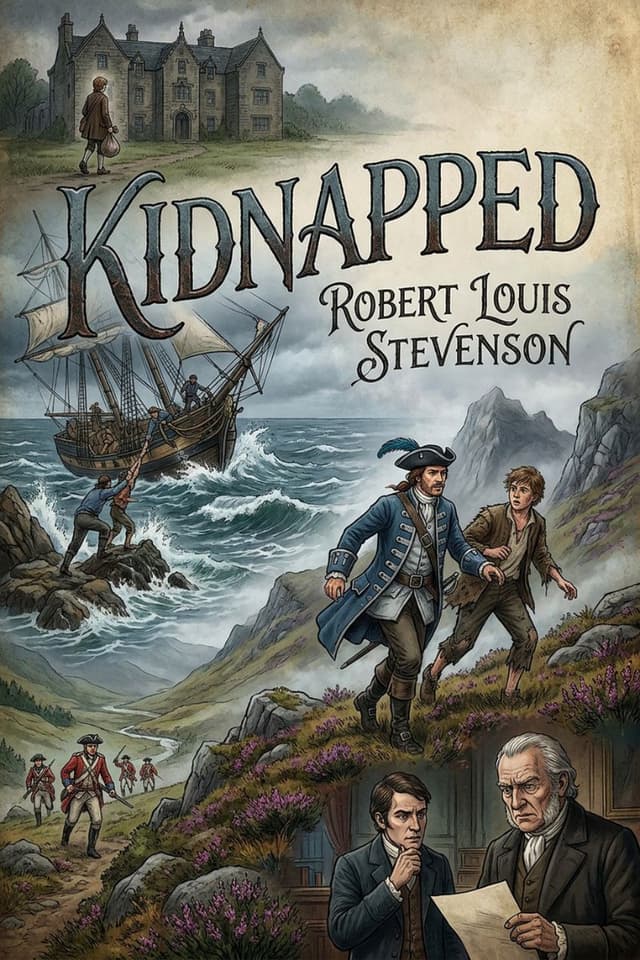
Kidnapped
Read Kidnapped by Robert Louis Stevenson for free on Novelhalla, and try out our easy-to-read modern edition of this classic book. You can also download the EPUB and read it on any device if you prefer!
The Plot
David's Story
David Balfour is seventeen years old, orphaned, and setting out into the world with nothing but a letter from his late father. The year is 1751, and the Jacobite rebellion that tore Scotland apart six years earlier still casts a long shadow over the Highlands.
David's father has directed him to seek out his uncle Ebenezer at the House of Shaws, the ancestral Balfour estate near Edinburgh. David expects to find family and perhaps fortune. What he finds instead is a crumbling mansion, a miserly uncle who lives alone in darkness, and a growing suspicion that something is very wrong.
Ebenezer seems terrified of his nephew's arrival. Before David can uncover the truth about his inheritance, his uncle arranges to have him kidnapped. David is knocked unconscious and wakes aboard the brig Covenant, bound for the American colonies where he will be sold into indentured servitude.
The Meeting
The ship's voyage around the Scottish coast takes a dramatic turn when the Covenant runs down a small boat in the fog. Only one man survives: Alan Breck Stewart, a Jacobite soldier in the service of the exiled Stuart king, carrying money collected from Highland clansmen for the rebel cause.
Alan is everything David is not. He is vain, hot-tempered, fiercely proud of his clan, and utterly devoted to a political cause David considers treasonous. He wears fine French clothes and carries himself like a prince. His face is marked with smallpox scars, and there is a price on his head.
When David overhears the ship's officers plotting to murder Alan and steal his gold, he makes a choice that will change both their lives. He warns Alan, and together they barricade themselves in the ship's roundhouse, fighting off the crew in a desperate battle. By the time the fighting ends, they have become unlikely allies.
The Flight
The Covenant strikes a reef off the coast of Mull, and David is swept ashore alone. He spends days stranded on a tidal island, not realizing he could simply walk to the mainland at low tide. It is the first of many lessons about his own inexperience.
David eventually finds his way across the Highlands, following coded messages Alan has left for him. When they reunite, they witness a murder that will make them both fugitives. Colin Roy Campbell, known as the Red Fox, is shot dead on the road, and David is seen standing over the body.
What follows is an exhausting flight across some of the most rugged terrain in Britain. Alan and David must travel by night, hide by day, and trust their lives to Highland clansmen who risk everything to shelter them. They face starvation, fever, and the constant threat of capture by redcoat soldiers.
About the Author: Robert Louis Stevenson
Early Life
Robert Louis Stevenson was born in Edinburgh in 1850, the only child of a prosperous family of lighthouse engineers. His grandfather, father, and uncles had designed and built lighthouses all along the Scottish coast, and young Louis was expected to follow the family profession.
From childhood, Stevenson was plagued by respiratory illness. He spent much of his early years confined to bed, looked after by his devoted nurse Alison Cunningham, who filled his imagination with tales of Scottish martyrs and adventure stories. His sickroom became a theater of the mind, and he was already writing stories as a boy.
A Writer's Path
Stevenson studied engineering at Edinburgh University to please his father, then switched to law, passing the bar at twenty-five. But he had already decided to be a writer, teaching himself the craft by imitating authors he admired. He never practiced law.
In 1876, while traveling in France, Stevenson met Fanny Osbourne, an American woman eleven years his senior, separated from her husband and raising two children. When she returned to California, Stevenson followed her against the advice of everyone who knew him, crossing the Atlantic in steerage and arriving near death. They married in 1880.
The next years were a restless search for a climate that would ease his lungs. Stevenson and Fanny lived in Switzerland, the south of France, and England, never settling anywhere for long. Despite constant illness that often left him bedridden and unable to speak, he wrote at a furious pace.
The Great Works
Treasure Island appeared in 1883, beginning as a story for his stepson Lloyd and quickly becoming one of the most beloved adventure novels in English. Kidnapped followed in 1886, the same year as The Strange Case of Dr. Jekyll and Mr. Hyde, which made Stevenson internationally famous and financially secure for the first time.
After his father's death in 1887, Stevenson left Britain forever. He sailed the South Seas with his family, finally settling in Samoa in 1890. There he built a house called Vailima, became deeply involved in local politics, and was beloved by the Samoan people, who called him Tusitala, the teller of tales.
Final Years
Stevenson died suddenly on December 3, 1894, at age forty-four. He had been working on what many consider his finest novel, Weir of Hermiston, when a blood vessel burst in his brain. Sixty Samoan men cut a path through the jungle to carry him to the summit of Mount Vaea, where he was buried overlooking the sea.
His tomb bears the lines he wrote for himself: "Home is the sailor, home from sea, / And the hunter home from the hill."
Fun Facts About the Book
The Endless Title
The book's full original title is a marvel of Victorian verbosity: "Kidnapped: Being Memoirs of the Adventures of David Balfour in the Year 1751: How he was Kidnapped and Cast away; his Sufferings in a Desert Isle; his Journey in the Wild Highlands; his acquaintance with Alan Breck Stewart and other notorious Highland Jacobites; with all that he Suffered at the hands of his Uncle, Ebenezer Balfour of Shaws, falsely so-called: Written by Himself and now set forth by Robert Louis Stevenson."
Serial Origins
Like many Victorian novels, Kidnapped first appeared in serial form, running in the boys' magazine Young Folks from May to July 1886. The same magazine had previously published Treasure Island. Neither story was particularly popular with the magazine's young readers, but both became classics when published as books.
Real People, Real Murder
Alan Breck Stewart was a real person, a Jacobite agent who was accused of assassinating Colin Roy Campbell in 1752. The murder, known as the Appin Murder, remains one of Scotland's great unsolved crimes. Alan was never caught, but James Stewart was hanged for the killing despite almost certainly being innocent. In 2001, an 89-year-old descendant of the Stewart clan claimed that family tradition named the true killer as Donald Stewart, and that the secret had been passed down for nearly 250 years.
Stevenson Played with Time
The novel is set in 1751, but the Appin Murder actually occurred in 1752. Stevenson acknowledged he was not much concerned with historical precision, preferring to capture the spirit of the era rather than slavishly follow dates.
A Lawyer's Interest
Stevenson came to the story through his legal training. While researching possible courtroom dramas, he discovered the trial records of James Stewart and was moved by the injustice of the case. The trial, held in a Campbell town before a Campbell judge with a jury packed with Campbells, was effectively a foregone conclusion.
Henry James Was a Fan
The novelist Henry James, Stevenson's close friend, declared Alan Breck Stewart "the most perfect character in English literature." High praise from one of the most demanding critics of the age.
The Bronze Reunion
In 2004, Sean Connery unveiled a bronze statue in Edinburgh depicting Alan Breck Stewart and David Balfour standing together. The statue, by sculptor Alexander Stoddart, stands on Corstorphine Road at the spot where, in the novel, the two friends part ways.
A Planned Sequel
Stevenson always intended to continue David's story. The sequel, Catriona (published in America as David Balfour), appeared in 1893. It follows David's attempts to help James Stewart and his romance with the title character, but most readers agree it lacks the raw energy of Kidnapped.
Stevenson's Middle Name
Stevenson was christened Robert Lewis Balfour Stevenson. He changed the spelling of Lewis to Louis at around eighteen, though he pronounced it in the Scottish manner, rhyming with "Lewis." He gave his hero the surname Balfour as a nod to his own family connections.
Themes
Friendship Across Division
The heart of the novel is the unlikely bond between David and Alan, two men divided by politics, religion, temperament, and culture. David is a Lowland Whig, loyal to King George. Alan is a Highland Jacobite, loyal to the exiled Stuarts. They should be enemies. Instead, their shared dangers forge a friendship that transcends their differences.
Coming of Age
David begins the novel as a naive country boy who does not even know he could walk off a tidal island. He ends it as a young man who has killed enemies, survived the wilderness, and outwitted his treacherous uncle. The flight across the Highlands is also a journey into adulthood.
Highland and Lowland
Stevenson uses David's journey through Scotland to explore the deep cultural divide between Highland and Lowland, between the Gaelic world of clans and chiefs and the English-speaking world of lawyers and merchants. David begins with Lowland prejudices but comes to admire the courage and loyalty of the Highland people, even as he cannot share their politics.
The Nature of Loyalty
The novel asks what we owe to friends, to family, to cause, and to country. Alan is almost suicidally loyal to his clan and his exiled king. David remains loyal to Alan even when it would be safer to abandon him. The Highland people risk their lives to shelter fugitives because of bonds of blood and honor. Against this stands the cold loyalty of the government men, who hunt down rebels for pay.
Justice and Injustice
From Ebenezer's theft of David's inheritance to the rigged trial that will condemn James Stewart, the novel is haunted by the gap between law and justice. The powerful take what they want while the weak suffer. David's final victory is a small restoration of right in a world where wrong often prevails.
The Duality of Human Nature
Stevenson was fascinated by moral complexity, a theme he explored most famously in Dr. Jekyll and Mr. Hyde. In Kidnapped, few characters are simply good or evil. Captain Hoseason is a villain who nonetheless shows moments of decency. The ship's officers are sometimes kind and sometimes brutal. Even Alan, for all his courage and charm, has a reckless vanity that puts them both in danger.
The Book's Legacy
Kidnapped has been adapted for film and television more than a dozen times, beginning with a silent version in 1917. The 1960 Disney film starring Peter Finch as Alan Breck remains popular, and a 2005 BBC miniseries brought the story to a new generation. In 2023, the National Theatre of Scotland staged a musical adaptation that reimagined Alan and David's relationship as a romance.
The novel helped establish the adventure story as a serious literary form. Writers from Joseph Conrad to Jorge Luis Borges have praised Stevenson's craft, and the book remains assigned reading in schools around the world.
More than that, Kidnapped shaped how readers imagine Scotland. The romantic Highlands, the tartan-clad warrior, the stubborn loyalty of the clans, all of these images owe something to Stevenson's vivid storytelling. He wrote at a time when the Highland way of life had been largely destroyed, and he preserved it in amber, flawed and glorified and utterly compelling.
For all its adventure and excitement, the novel's deepest appeal may be the friendship at its center. Alan and David bicker, quarrel, and nearly come to blows, but when it matters most, they stand together. Their parting at the end of the novel, when David feels "so lost and lonesome that I could have found it in my heart to sit down by the dyke, and cry and weep like any baby," speaks to anyone who has ever said goodbye to a friend who made them brave.