Novelhalla
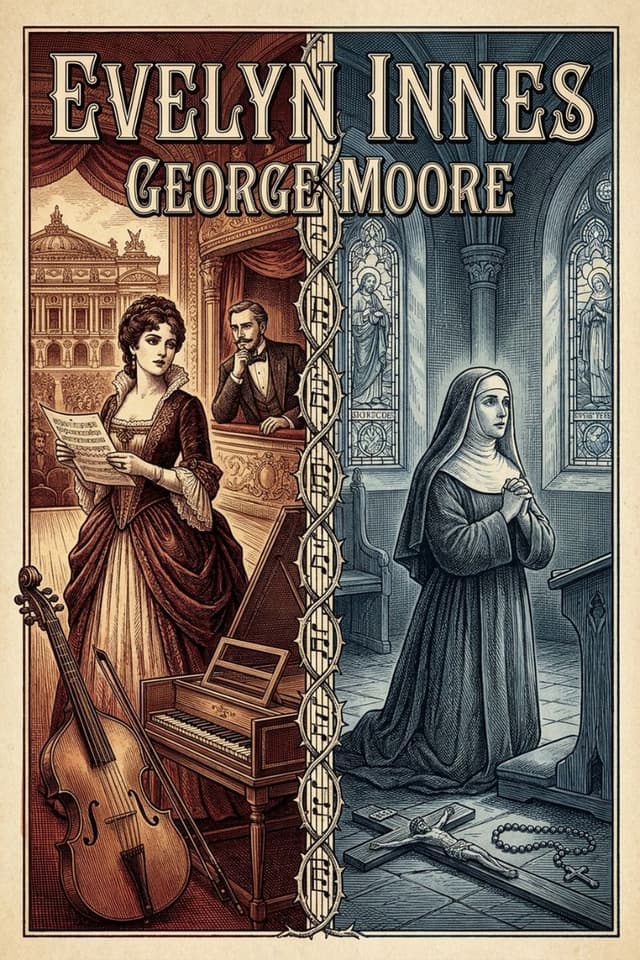
Evelyn Innes
Read Evelyn Innes by George Moore for free on Novelhalla, and try out our easy-to-read modern edition of this classic book. You can also download the EPUB and read it on any device if you prefer!
The Plot
Evelyn's Story
Evelyn Innes is twenty years old, living quietly in Dulwich with her widowed father, when we first meet her. The year is sometime in the 1890s, and the household breathes a rarefied air of devotion and obscurity. Mr. Innes is a passionate champion of early music, a man who repairs Elizabethan virginals and gives small concerts of Renaissance compositions on instruments most people have never heard of. His late wife was an opera singer who lost her voice and died young. Evelyn inherited her mother's vocal gift but has spent her life playing the viola da gamba and singing madrigals rather than pursuing the operatic career that might have been hers.
Into this cloistered world comes Sir Owen Asher, a wealthy baronet in search of novelty. He has grown bored with the usual amusements of his class and has lately become interested in Wagner and early music. He attends one of Mr. Innes's concerts, is charmed by the quaint instruments and the devout atmosphere, and becomes fascinated by Evelyn herself. He sees in her an extraordinary talent being wasted on fifteenth-century pavanes.
Owen offers to take Evelyn to Paris and have her trained as an opera singer. The proposal is really an offer of something more, and Evelyn knows it. She must choose between her father's world of sacred music and modest obscurity and a life of fame, passion, and moral compromise.
The Complications
What follows is a novel of ambition and conscience, of art and religion, of the flesh and the spirit. Evelyn must navigate the world of opera and the demands of love. She encounters men who offer her different visions of what life and art might mean. She finds herself drawn to places and people that seem to promise peace, even as her public triumphs multiply.
The novel traces the inner life of a woman who wants things that may not be compatible: artistic greatness, romantic love, and the approval of her own soul. Moore follows Evelyn through drawing rooms and opera houses, through confessionals and quiet gardens, as she searches for some way to reconcile the contradictions of her nature.
About the Author: George Moore
Early Life
George Augustus Moore was born in 1852 at Moore Hall in County Mayo, Ireland, into a Catholic landowning family with a distinguished history. His great-uncle had been president of the short-lived Republic of Connacht during the 1798 rebellion. His father was a member of Parliament known for defending tenant rights during the Great Famine.
Moore grew up in the big house tradition of Anglo-Irish gentry, though his family was Catholic rather than Protestant. He was educated erratically and showed little early promise. What he wanted was to be a painter, and at twenty-one he left Ireland for Paris to study art.
The Paris Years
In Paris, Moore discovered he had no talent for painting but a great deal for living. He became a fixture of the bohemian world, befriending the Impressionist painters and becoming particularly close to Edouard Manet, who painted his portrait multiple times. He absorbed the atmosphere of the cafes and studios and learned the lessons of French naturalism, particularly the work of Emile Zola.
The maxim Manet gave him, "Be ashamed of nothing but to be ashamed," became Moore's guiding principle. He would spend his career shocking readers with frank treatments of subjects Victorian England preferred to ignore.
The Novelist
Financial troubles forced Moore back to London in 1880, where he remade himself as a novelist. His early books, including A Modern Lover and A Mummer's Wife, introduced French naturalism to English readers and were promptly banned by the circulating libraries. Moore fought back with pamphlets attacking literary censorship.
His masterpiece, Esther Waters (1894), told the story of a servant girl who has a child out of wedlock. It was an immediate success and established Moore as a major literary figure. Evelyn Innes followed in 1898, drawing on Moore's passion for Wagner and his friendship with the early music pioneer Arnold Dolmetsch.
The Irish Years and After
In 1901, Moore returned to Dublin, drawn by the Irish Literary Renaissance and his friendship with W.B. Yeats. He contributed to the founding of the Abbey Theatre and wrote important short stories about Irish life. But his gossipy memoir Hail and Farewell (1911-1914), which skewered his former friends with devastating wit, made him enemies throughout literary Dublin. He famously quipped that Dublin was divided into those who feared being in his book and those who feared being left out.
Moore returned to London in 1911 and spent his remaining years there, writing experimental novels including The Brook Kerith, a retelling of the life of Jesus that imagines Christ surviving the crucifixion. He died in 1933, leaving a fortune of £80,000. His ashes were buried in a Celtic urn on an island in Lough Carra, near the ruins of his family home, which had been burned during the Irish Civil War.
Fun Facts About the Book
The Dolmetsch Connection
The character of Mr. Innes, Evelyn's father, was based on Arnold Dolmetsch, a French-born musician who was pioneering the revival of early music in London. Moore visited Dolmetsch's home in Dulwich in 1894 and was captivated by the concerts of fifteenth-century music played on authentic instruments. The novel lovingly recreates this atmosphere of violas da gamba, virginals, and Renaissance madrigals.
Wagner Everywhere
The novel is saturated with Wagner. Moore was himself an ardent Wagnerite, and the book reflects the passionate debates about Wagner's music and ideas that consumed artistic circles in the 1890s. Readers with an interest in opera and classical music will find much to savor in Moore's detailed treatment of the musical world.
A Book Divided
Moore originally conceived Evelyn Innes and its sequel Sister Teresa as a single novel. He wrote for two years before realizing he had produced five hundred pages and was only halfway through the story. His publisher convinced him to divide the material into two books. Moore always regretted this decision and spent years trying to convince readers that the two novels formed a single work.
Early Stream of Consciousness
Literary scholars have identified Evelyn Innes as containing some of the earliest examples of stream-of-consciousness prose in English literature, predating the experiments of James Joyce and Virginia Woolf. Moore's attempt to capture Evelyn's inner life was groundbreaking for its time.
A Victorian "Early Music" Novel
The novel has been called the first "early music novel" in English, capturing the nascent movement to revive Renaissance and Baroque music on period instruments. The detailed descriptions of viols, lutes, virginals, and harpsichords, and the debates about how early music should be performed, document a cultural moment that would eventually transform classical music.
The Maud Cunard Connection
Some scholars believe Moore drew on his long affair with Lady Maud Cunard, a wealthy American-born socialite and patron of the arts, in creating aspects of the novel. Moore conducted this relationship for decades, and his complex feelings about art, society, and love may have informed his portrait of Evelyn.
Obsessive Revision
Moore was notorious for revising his novels through multiple editions, and Evelyn Innes was no exception. He produced significantly different versions of the book, changing passages, adding scenes, and altering details. Scholars must specify which edition they are discussing when analyzing the novel.
Themes
Art and Religion
The central tension of the novel is between two ways of experiencing transcendence. Moore suggests that the aesthetic experience of great music and the religious experience of worship may not be as different as they appear. Both involve ritual, beauty, and the surrender of the self to something larger. Evelyn is drawn to both, and the novel asks whether they can be reconciled.
The Woman Artist
Evelyn Innes is one of the great portraits of a female artist in Victorian fiction. Moore takes seriously both her ambition and her talent, showing how a woman of genius navigates a world that offers her success only at the cost of respectability. The novel asks what sacrifices art demands and whether women must pay a higher price than men.
Sensuality and Spirituality
Moore refuses to treat sensual pleasure and spiritual longing as simple opposites. Evelyn's religious feelings are themselves sensuous, full of imagery and emotion. Her attractions have spiritual dimensions. The novel explores how the same nature that craves physical passion might also crave something higher.
The Divided Self
Evelyn is torn between different men, different kinds of music, different ways of life. She cannot easily choose because she genuinely wants incompatible things. Moore uses her dilemma to explore how modern people, freed from traditional constraints, must construct their own identities from contradictory materials.
Catholicism and Aestheticism
Writing as a lapsed Catholic himself, Moore treats the Church with a complex mixture of attraction and irony. He is drawn to the beauty of Catholic ritual, the drama of confession and absolution, the glamour of saints and mystics. But he also questions whether faith can survive becoming merely beautiful, merely another aesthetic experience.
The Price of Freedom
Evelyn exercises a freedom that would have been impossible for women of earlier generations. She can pursue her career and make her own choices about love. But Moore shows that freedom brings its own burdens. Without traditional structures to guide her, Evelyn must find her own way, and the search proves demanding.
The Book's Legacy
Evelyn Innes was a popular success when it appeared in 1898, praised for its sophisticated treatment of music and its daring exploration of a woman's inner life. It was followed by the sequel Sister Teresa in 1901, which continues Evelyn's story.
The novels are less read today than Moore's other works, particularly Esther Waters and Hail and Farewell. But they occupy an important place in literary history as early experiments in psychological fiction and as documents of the fin-de-siecle fascination with art, religion, and the soul.
Moore's influence on later writers, particularly James Joyce, has been increasingly recognized. Joyce admired Moore's work and sent a wreath to his funeral. The psychological techniques in Evelyn Innes anticipate methods that would become central to modernist fiction.
For readers interested in the cultural history of the 1890s, the novel offers a vivid portrait of a world caught between Victorian certainties and modern anxieties. The opera houses and drawing rooms, the debates about Wagner and early music and the nature of art itself, all come alive in Moore's detailed prose.
Most of all, Evelyn Innes remains a compelling portrait of a woman trying to reconcile ambition with conscience, talent with tradition, desire with duty. Her struggle feels remarkably contemporary, which may be why the novel, long out of fashion, deserves rediscovery.