Novelhalla
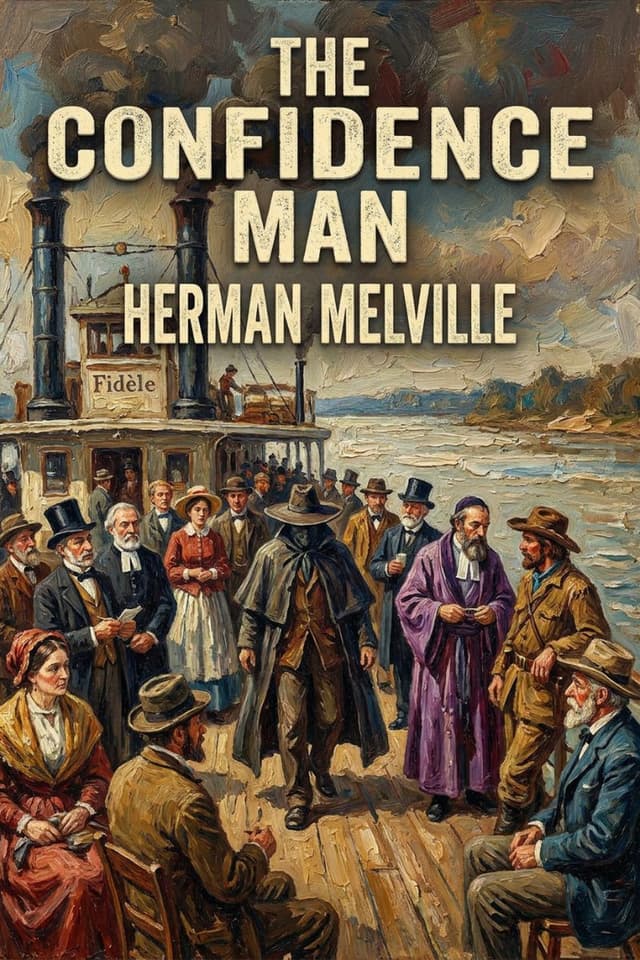
The Confidence Man
Read The Confidence Man by Herman Melville for free on Novelhalla, and try out our easy-to-read modern edition of this classic book. You can also download the EPUB and read it on any device if you prefer!
The Plot
April Fools
It's April 1st. A steamboat called the Fidèle is pulling away from the docks in St. Louis, headed south down the Mississippi toward New Orleans. The decks are packed with every kind of American you can imagine: merchants, backwoodsmen, fortune seekers, heiress hunters, truth seekers, and hunters after all those hunters. It's a floating cross-section of a nation on the make.
As the boat departs, a strange man in cream-colored clothes appears at the waterside. He's mute. No luggage, no friends, no one to meet him. He boards the ship and begins writing messages on a small slate, holding them up for the crowd: Charity believeth all things. Charity endureth all things. The passengers stare at him like he's from another planet.
Meanwhile, just a few feet away, the ship's barber hangs a sign over his door: NO TRUST.
Between those two messages, the entire voyage will unfold.
The Masquerade Begins
Almost immediately, a crippled Black beggar appears on deck, catching coins tossed at him by amused passengers. He calls himself Black Guinea, and he's entertaining enough that people throw money. But a man with a wooden leg isn't charmed. He accuses the beggar of being a fraud, a white man in disguise, a fake cripple running a scam.
The crowd can't decide. Is he real? Is he performing? Does it matter, if they were happy to throw coins a minute ago?
Before anyone can settle the question, Black Guinea rattles off a list of passengers who can vouch for him. A man in a gray coat. A gentleman with a weed in his hat. A man in a yellow vest. The crowd disperses to find these supposed references, and the game is on.
A Series of Encounters
What follows is a parade of strangers, each one arriving on deck with perfect timing and a silver tongue. A man in mourning named John Ringman appears, weeping over a private sorrow, and before you know it he's talked a young college student into considering shares in a mining company. A man in gray collects donations for a Seminole Widow and Orphan Asylum that may or may not exist. A ruddy-cheeked businessman sells stock in the Black Rapids Coal Company with the easy confidence of someone who genuinely believes in the product. An herb doctor peddles miracle cures to the sick and the desperate.
Each of these figures works a different angle. One plays on sympathy. Another on greed. Another on faith. Another on the fear of being seen as uncharitable. They are relentless, charming, and deeply persuasive. They seem to know exactly what each person needs to hear.
And here's the thing that keeps nagging at you: they might all be the same person.
The Question That Won't Go Away
The encounters keep multiplying. A man with a brass plate advertises an employment agency that promises only the most trustworthy servants. He is so obviously running a scheme that it should be transparent, but his marks are too tangled up in their own desire to believe. After all, who doesn't want to trust the person standing in front of them?
The passengers aren't stupid. Several of them push back hard. A Missouri bachelor flatly refuses to trust anyone and has a grim philosophy about human nature to match. A wooden-legged cynic mocks every appeal to goodwill. A bitter old miser clutches his money and snarls at charity. These skeptics are sharp, angry, and often right about the cons being run on them.
But being right doesn't seem to help. The confidence man, whoever or whatever he is, adapts. He shifts shape. He changes tactics. He finds the crack in every wall.
The Cosmopolitan
In the second half of the voyage, a new figure dominates the ship. He calls himself Frank Goodman, and he is magnificent. Dressed in a wildly colorful outfit that borrows from a dozen cultures, he announces himself as a "cosmopolitan," a citizen of the world, a lover of all humanity. He is warm, generous, endlessly talkative, and absolutely impossible to pin down.
Goodman moves through the ship engaging passengers in long, winding philosophical conversations about trust, charity, and what people owe each other. He debates a misanthrope over wine. He matches wits with a man named Charlie Noble who may himself be running a con. He tangles with a barber who refuses to extend credit.
Is Goodman the confidence man's final and most polished disguise? Or is he something else entirely, a genuine seeker of human connection moving through a world of liars? The novel will not tell you. It will make you desperately want to know, and then it will refuse.
Into the Darkness
Night falls on the Fidèle. The lamps are going out. Goodman finds himself in the ship's cabin with an old man reading the Bible by lamplight. They talk about faith and confidence and whether people can be trusted. A boy appears selling traveler's locks and money belts, and there's something unsettling about the whole transaction, a sense that the machinery of trust and suspicion has been grinding all day and has finally worn everyone down to something raw.
The last lamp is extinguished. Someone leads someone else into the darkness. And the novel ends with a single, haunting promise that hangs in the air like smoke.
About the Author: Herman Melville
A Privileged Beginning
Herman Melville was born in 1819 in New York City to a family with serious American pedigree. One grandfather participated in the Boston Tea Party. The other was a Revolutionary War hero. His father, Allan Melvill, was an importer of French goods who projected success right up until his business collapsed in 1830. The family fled to Albany. Two years later, Allan was dead, likely from pneumonia compounded by overwork and stress, leaving his wife and eight children with almost nothing.
Herman was twelve. He went to work as a bank clerk.
The Education of the Sea
After stints as a teacher, a farmhand, and a failed applicant for a job on the Erie Canal, Melville did what broke and restless young men did in the 1840s: he went to sea. He sailed to Liverpool as a cabin boy at nineteen. At twenty-one, he shipped out on the whaling vessel Acushnet, bound for the South Pacific.
What happened next reads like fiction. Melville deserted the ship in the Marquesas Islands and spent weeks living among the Typee people, a group rumored to practice cannibalism. He escaped on an Australian whaler, participated in a mutiny in Tahiti, worked as a harpooner, clerked in a store in Honolulu, and finally enlisted in the U.S. Navy before sailing home in 1844.
He was twenty-five years old, and he had enough material for a lifetime.
The Rise and Fall
Melville turned his adventures into books, and the public loved them. Typee (1846) and Omoo (1847) were hits. He married Elizabeth Shaw, daughter of the Chief Justice of Massachusetts, and settled into life as a professional author. Then he got ambitious.
Moby-Dick (1851) was meant to be his masterpiece. It is. But it sold about 3,000 copies in his lifetime and baffled most critics. Pierre (1852), a dark psychological novel, was savaged. His short fiction, including "Bartleby, the Scrivener" and "Benito Cereno," appeared in magazines to modest attention. By 1856, Melville was broke, in poor health, and watching his literary career disintegrate.
He wrote The Confidence-Man during this period. It would be his last published novel.
The Long Silence
After the novel's failure in 1857, Melville tried lecturing, then took a job as a customs inspector on the New York docks, a position he held for nearly twenty years. He wrote poetry, some of it excellent, almost none of it read. He published two final volumes of verse in private editions of twenty-five copies each.
When Melville died in 1891, the New York Times misspelled his name in the obituary. He had been forgotten so thoroughly that the world had to rediscover him in the 1920s, when a new generation of critics recognized what had been there all along: one of the most daring and original minds in American literature.
Fun Facts About the Book
Published on April Fools' Day
The novel was published on April 1, 1857, the same date as its setting. This was almost certainly deliberate. Melville's father's family came from Scotland, where April Fools' Day tradition involved sending gullible people on pointless journeys. Which is, in a sense, exactly what the novel does to its readers.
Inspired by Real Con Men
In the early 1850s, New York newspapers were full of stories about a man who tricked strangers into giving him money by simply asking them to demonstrate their confidence in him. He'd approach someone, claim to be an acquaintance, and then brazenly ask, "Are you really disposed to put any confidence in me?" The term "confidence man" entered the American vocabulary from these news reports, and Melville ran with it.
The Emerson Roast
Several characters in the novel appear to be satirical portraits of real people. The most widely discussed target is Ralph Waldo Emerson, whose philosophy of optimism and self-reliance Melville seems to have found dangerously naive. Thoreau and P.T. Barnum also appear to get the treatment. Melville was settling some philosophical scores.
Melville's Last Novel
The Confidence-Man was the last novel Melville published in his lifetime. He wouldn't return to prose fiction for nearly thirty years, when he began the unfinished novella Billy Budd shortly before his death. The novel's final line seems to acknowledge this uncertainty about the future: "Something further may follow of this Masquerade." Nothing did. At least not from Melville.
A 343-Copy Debut
The novel sold catastrophically. One biographical estimate puts first-year sales at around 343 copies. Contemporary reviewers were baffled. One admitted an inability to understand the book at all but conceded the philosophy was "sharp, comprehensive, suggestive, and abundantly entertaining." Another complained that the book could be read backwards without any loss of sense. These were not meant as compliments, but in hindsight, they're remarkably accurate descriptions of what makes the novel special.
The Ship's Name
The steamboat is called the Fidèle, which is French for "faithful." On a ship full of liars, cheats, and people desperate to be deceived, the name is pure Melville: a joke that cuts to the bone.
Themes
Trust and Its Discontents
The word "confidence" appears in nearly every chapter, and the novel turns it over like a coin, examining both sides until neither looks real. What does it mean to trust someone? What does it cost not to? The characters who refuse to trust anyone are miserable. The characters who trust freely are exploited. Melville offers no comfortable middle ground.
The American Hustle
The Fidèle is America in miniature: a vessel full of people heading somewhere promising while trying to get ahead of each other along the way. Stock schemes, fake charities, miracle cures, employment scams. Melville wrote this in the 1850s. It could have been written yesterday. The novel sees something rotten and deeply American in the machinery of confidence, the way an entire economy runs on people's willingness to believe in things that might not be real.
Identity as Performance
Who is the confidence man? One person in many disguises? Many people running similar cons? The devil himself? A misguided saint? The novel refuses to answer, and that refusal is the point. In a world where everyone is performing a version of themselves, the line between identity and disguise disappears. You can't unmask someone when there might be nothing beneath the mask.
The Problem of Charity
The novel takes the Christian virtue of charity and stress-tests it to destruction. If you're commanded to believe the best of people, what happens when someone exploits that belief? If you refuse to be charitable because you might be deceived, have you already lost something more important than money? Melville seems genuinely tormented by the question.
Cynicism vs. Naivety
The novel is populated by two kinds of fools: those who trust too easily and those who trust nothing at all. The cynics in the book are often correct about the cons being run on them, but their correctness makes them no happier and no wiser. Melville seems to suggest that pure cynicism is just as much a trap as pure faith, and possibly a lonelier one.
The Book's Legacy
For decades after its publication, The Confidence-Man was considered Melville's worst book, a confusing mess written by a man whose talent had burned out. It wasn't until the mid-twentieth century that critics began to realize what Melville had actually done. He'd written a postmodern novel a hundred years before postmodernism existed.
The Dalkey Archive Press called it "America's first postmodern novel: game-like, darkly comic, and completely inventive." The novelist Rodrigo Fresán described it as "Pynchon before Pynchon." Its hall-of-mirrors structure, its refusal to resolve, its deep suspicion of narrative reliability, all of these things that baffled 1857 readers are exactly what make it feel uncannily alive now.
In 2017, the novelist Philip Roth called it the essential book for understanding a particular strain of American life, the culture of the con, the art of the deal, the way confidence itself becomes a commodity. The novel has found its moment again and again, surfacing whenever the gap between what Americans say and what Americans do becomes impossible to ignore.
It has no major film adaptation. It has no prestige TV series. It doesn't need one. The Confidence-Man is the kind of book that lives in the bloodstream of other books, influencing writers from Thomas Pynchon to Cormac McCarthy to anyone who has tried to write about America as a grand, ongoing, darkly funny swindle.