Novelhalla
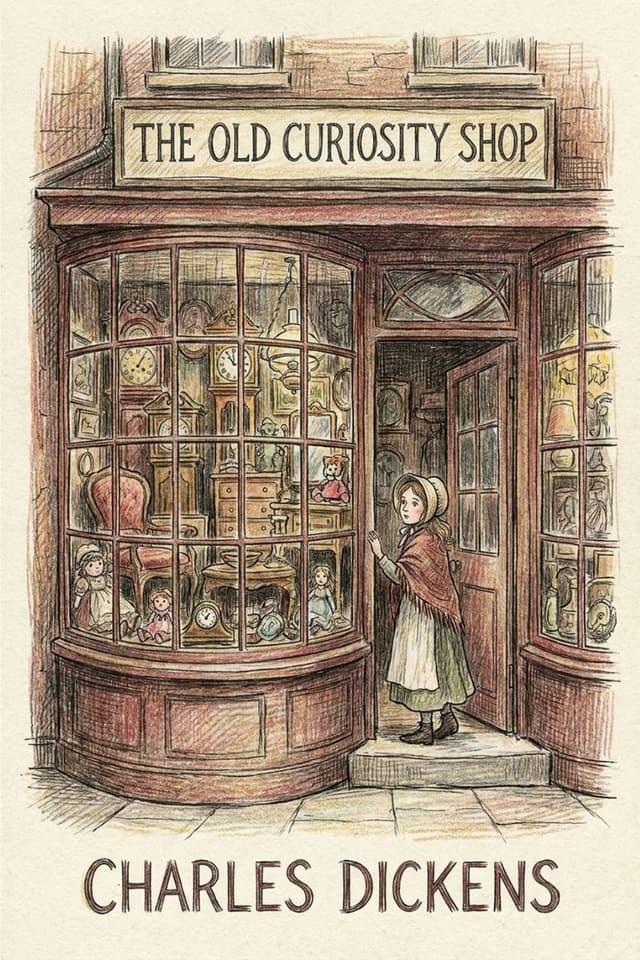
The Old Curiosity Shop
Read The Old Curiosity Shop by Charles Dickens for free on Novelhalla, and try out our easy-to-read modern edition of this classic book. You can also download the EPUB and read it on any device if you prefer!
The Plot
The Shop
In a cramped, dusty corner of London sits a strange little shop crammed with ancient relics, suits of armor, rusty weapons, and curiosities from forgotten eras. This is home to thirteen-year-old Nell Trent and her elderly grandfather. She loves him. He loves her. And he is destroying them both.
Every night, the old man slips out of the shop after Nell falls asleep. She lies awake listening to the door close, terrified of where he goes and what he does. She doesn't know the full truth yet, but she can feel it: something is very wrong.
Her grandfather gambles. Not casually, not for fun. He gambles with a desperate, feverish obsession, convinced that one big win will secure Nell's future and lift her out of poverty forever. Instead, he is borrowing money he cannot repay from the worst possible person.
The Dwarf
Daniel Quilp is a moneylender. He is also, in every meaningful sense, a monster. Small, twisted, and grotesque in appearance, Quilp is a man who takes visible pleasure in cruelty. He terrorizes his wife. He bites and scratches. He drinks boiling liquor without flinching and smokes cigars that would choke anyone else, grinning the entire time. He is malice in human form, and he is circling Nell and her grandfather like something out of a nightmare.
Quilp has been lending the old man money for his gambling habit, and now the debts have come due. But Quilp doesn't just want repayment. He wants the shop. He wants control. And there's something about Nell herself that catches his attention in a way that makes your skin crawl.
When the old man's debts finally swallow everything, Quilp seizes the shop and everything in it. Nell and her grandfather are thrown into the street with nothing.
The Road
Rather than fall into Quilp's hands, Nell convinces her grandfather to flee London entirely. And so begins one of the most harrowing journeys in all of Dickens: a young girl and a broken old man, walking through the English countryside with no money, no plan, and no one to help them.
They fall in with traveling performers, Punch and Judy men named Codlin and Short, who seem friendly but have motives of their own. They encounter Mrs. Jarley and her traveling waxwork exhibition, who gives Nell honest work and a brief taste of stability. They pass through industrial towns choked with smoke and poverty, places where the furnaces glow all night and the workers look like ghosts.
Through all of it, Nell is the one holding things together. She finds food. She finds shelter. She manages her grandfather's moods and confusion. She is thirteen years old and she is carrying an adult on her back, and the weight of it is slowly, quietly, wearing her down.
The Grandfather's Secret
The worst part isn't the poverty or the exhaustion. It's what happens when her grandfather's addiction resurfaces on the road. He meets gamblers. The old fever returns. And in one devastating scene, he does something so desperate and so betraying that Nell realizes she cannot trust the person she loves most in the world. She is not just caring for him. She is protecting herself from him.
And still she stays. Still she walks. Still she leads him forward.
Back in London
Meanwhile, the story splits. Back in the city, a cast of characters orbit around the vanished pair. Kit Nubbles, the loyal young servant who adored Nell, is desperate to find her. A mysterious "Single Gentleman" arrives and begins searching with an urgency that suggests he knows more than he's letting on. And Quilp, furious that his prey has escaped, begins scheming with the oily lawyer Sampson Brass and his terrifying sister Sally to destroy Kit and anyone else who might help Nell.
Then there's Dick Swiveller, a cheerful, impractical young man who quotes poetry at every opportunity and stumbles into Brass's employ. Dick seems like comic relief at first. He is so much more than that. His friendship with a half-starved little servant girl the Brasses keep locked in their kitchen, a girl he names "the Marchioness," becomes one of the most unexpectedly tender relationships in all of Dickens.
The Question
Nell and her grandfather eventually find refuge in a quiet village, taken in by kind people who give them peace at last. But peace comes late. The journey has cost Nell more than anyone around her realizes, and those searching for her are running out of time.
The race to find Nell before it's too late is one of the most genuinely suspenseful sequences Dickens ever wrote. Victorian readers stormed the docks in New York, shouting at sailors on incoming ships to find out what happened to her.
Whether they arrive in time depends on how much a thirteen-year-old girl's body can endure when her spirit has been carrying everyone else for far too long.
About the Author: Charles Dickens
A Childhood of Shadows
Charles Dickens was born on February 7, 1812, in Portsmouth, the second of eight children. His early years were happy enough, filled with books and imagination, but financial disaster struck when he was twelve. His father was imprisoned for debt, and young Charles was pulled out of school and sent to work in a blacking factory, pasting labels on pots of shoe polish in miserable conditions.
The experience lasted only a few months, but it scarred him for life. He never spoke of it publicly, and the shame and anger of that time fueled nearly everything he wrote. The abandoned child, the cruel institution, the adults who fail to protect the young: these aren't just themes in Dickens. They're autobiography.
Rise to Fame
After a stint as a law clerk and then a journalist, Dickens published his first novel, The Pickwick Papers, in 1836 at age twenty-four. It was a sensation. Within a few years, he was the most famous writer in England, publishing Oliver Twist, Nicholas Nickleby, and The Old Curiosity Shop in rapid succession, all in serial form that kept readers waiting breathlessly for each new installment.
He married Catherine Hogarth in 1836. They had ten children together, though the marriage would eventually collapse amid scandal and separation.
The Great Works
Through the 1840s and 1850s, Dickens produced an astonishing body of work: A Christmas Carol, David Copperfield, Bleak House, A Tale of Two Cities, Great Expectations. Each book tackled the social ills of Victorian England with a mixture of outrage, humor, and deep compassion that no other writer could match. He also edited magazines, gave public readings that drew enormous crowds, and threw himself into charitable causes.
Final Years
Dickens drove himself relentlessly in his later years, undertaking exhausting reading tours in Britain and America that damaged his health. He separated from his wife in 1858 and began a relationship with actress Ellen Ternan, which he kept largely secret. He suffered a stroke on June 8, 1870, at his home at Gad's Hill Place in Kent, and died the following day at age fifty-eight. He left his final novel, The Mystery of Edwin Drood, unfinished. He was buried in Poets' Corner at Westminster Abbey.
Fun Facts About the Book
The Novel That Caused a Frenzy
When The Old Curiosity Shop was being published in weekly installments, the suspense over Nell's fate became a cultural phenomenon. American readers famously crowded the piers in New York harbor, calling out to arriving ships from England to learn what had happened to her. It was the Victorian equivalent of a season finale cliffhanger, and the entire English-speaking world was watching.
Dickens's Grief Made Real
Dickens poured his grief over the death of his beloved sister-in-law, Mary Hogarth, into the character of Little Nell. Mary had died suddenly in 1837 at just seventeen years old, collapsing after a night at the theater and dying in Dickens's arms the following afternoon. He took a ring from her finger and wore it for the rest of his life. Writing Nell's story three years later, he told a friend that "old wounds bleed afresh."
Oscar Wilde's Famous Burn
Not everyone was moved by the novel's emotional intensity. Oscar Wilde reportedly quipped that "one must have a heart of stone to read the death of Little Nell without laughing." The comment has become one of the most famous pieces of literary criticism in English, and it captures the divide between those who find the novel deeply moving and those who find it overwrought.
The Real Shop
A building at 13-14 Portsmouth Street in Holborn, London, claims to be the inspiration for Dickens's curiosity shop. The building genuinely dates back to the sixteenth century, but it was actually named "The Old Curiosity Shop" after the novel was published, capitalizing on the book's fame. It still stands today, having survived the Blitz during World War II.
Dickens's First Child Protagonist
The Old Curiosity Shop was Dickens's first novel to place a child at the very center of the story. Oliver Twist featured a child protagonist, but Nell's journey is more sustained and intimate. The success of Nell's story established Dickens as the great champion of vulnerable children in literature, a role he would continue to play throughout his career.
A Train Thrown Out the Window
Irish politician Daniel O'Connell was reportedly so upset while reading the novel on a train that he threw his copy out the window in anguish. Whether the story is entirely true or not, it captures just how intensely Victorian readers responded to Nell's plight.
Queen Victoria Approved
Queen Victoria herself read The Old Curiosity Shop in 1841 and recorded in her journal that she found it "very interesting and cleverly written." Royal approval only added to the novel's already enormous popularity.
The Marchioness
One of the novel's great hidden treasures is the character known only as "the Marchioness," a half-starved servant girl kept in near-slavery by the villainous Brass siblings. Her friendship with the irrepressible Dick Swiveller is one of the most charming and quietly revolutionary subplots Dickens ever wrote, a story of two unlikely outcasts who save each other.
Themes
The Exploitation of Innocence
Nell is surrounded by adults who either exploit her or fail her. Her grandfather uses her as justification for his gambling. Quilp sees her as property to be seized. Even well-meaning strangers often can't protect her. The novel is a sustained cry of outrage at a world that chews up its most vulnerable members and calls it business.
Addiction and Self-Destruction
Nell's grandfather isn't a villain. That's what makes him so painful to read. He genuinely loves Nell, but his gambling addiction overrides everything, his love, his judgment, his decency. Dickens portrays addiction not as a moral failing but as a kind of possession, something that transforms a good person into someone capable of betraying the one person they care about most.
The Corruption of the City
London in this novel is a place of predators and shadows. The countryside, while not without its own dangers, offers glimpses of peace and genuine human kindness. Dickens draws a stark line between urban corruption and rural refuge, though he's honest enough to show that the road itself can be as punishing as anything the city inflicts.
Children Carrying Adult Burdens
Nell doesn't get to be a child. She is the caretaker, the decision-maker, the emotional anchor for a man decades her senior. Dickens understood this particular cruelty from his own childhood in the blacking factory, and he writes it with a specificity that cuts deep. The tragedy isn't just what happens to Nell. It's everything she was never allowed to have.
Good and Evil as Forces of Nature
Quilp isn't just a bad man. He's almost elemental, a force of pure malevolence that exists to destroy innocence wherever he finds it. Nell, by contrast, radiates goodness so pure it sometimes feels otherworldly. Dickens sets these two forces on a collision course and asks whether goodness alone is enough to survive in a world this hostile.
Loyalty and Unlikely Salvation
Some of the novel's most powerful moments come from characters you wouldn't expect. Kit's unwavering devotion. Dick Swiveller's transformation from feckless clown to genuine hero. The Marchioness's quiet courage. Dickens suggests that salvation, when it comes, often arrives from the margins, from people the world has overlooked.
The Book's Legacy
The Old Curiosity Shop was a phenomenon in its time, one of the most widely read and emotionally impactful novels of the nineteenth century. The public response to its serialization was unlike anything literature had seen before, with readers across two continents desperately invested in the fate of a fictional thirteen-year-old girl.
Its reputation has shifted over the centuries. Victorian readers wept openly. Later critics, led by Wilde's famous jab, dismissed its sentimentality. But modern readers are finding their way back to the novel, recognizing in Nell's story a surprisingly unflinching portrait of childhood vulnerability, addiction, and systemic cruelty that feels remarkably contemporary.
Quilp remains one of Dickens's most unforgettable creations, a villain so vivid and so gleefully repulsive that he practically leaps off the page. And the subplot of Dick Swiveller and the Marchioness is increasingly celebrated as one of the finest things Dickens ever wrote, a story within a story that deserves its own spotlight.
The novel has been adapted for film, television, and stage multiple times, including a 1975 musical and a 2007 BBC production starring Derek Jacobi and Toby Jones. The building in London that claims to be the original shop remains a tourist attraction to this day.
More than anything, The Old Curiosity Shop endures because its central question never stops being relevant: what happens to the innocent when the people who should protect them can't even protect themselves?