Novelhalla
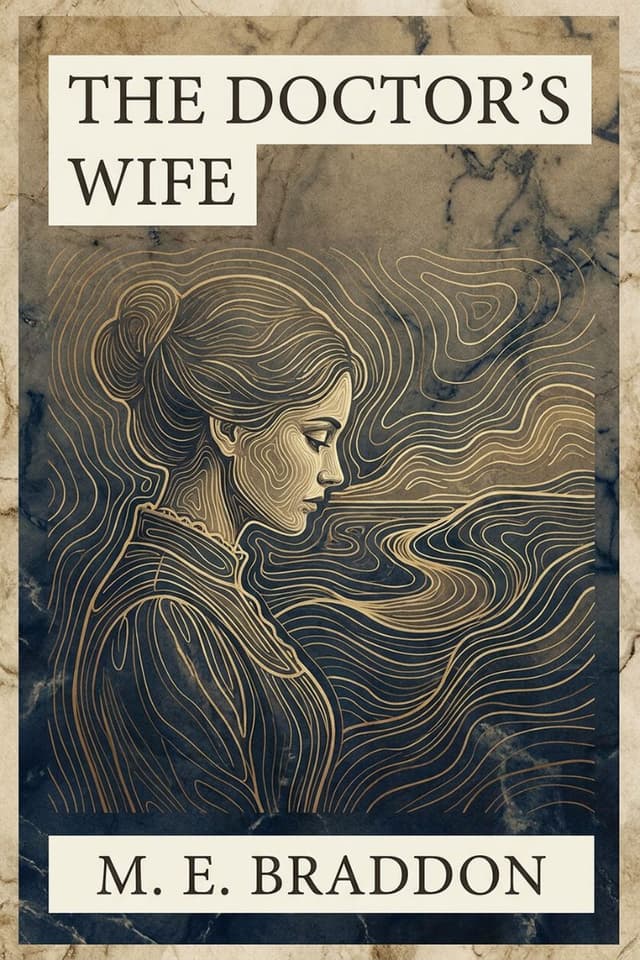
The Doctor's Wife
Read The Doctor's Wife by M. E. Braddon for free on Novelhalla, and try out our easy-to-read modern edition of this classic book. You can also download the EPUB and read it on any device if you prefer!
The Plot
A Girl Made of Books
Isabel Sleaford lives inside her own head. She's young, beautiful in an unusual, dreamy kind of way, and completely addicted to novels. Dickens, Thackeray, Scott, Byron, Shelley. She devours them all, and somewhere along the way she stops being able to tell the difference between the stories she reads and the life she wants to live. She doesn't just enjoy fiction. She inhabits it. Every morning she wakes up hoping today will be the day her real story begins.
Her actual life is considerably less thrilling. She works as a governess in her father's chaotic household in Camberwell. Her stepmother is sharp and overworked. Her half-brothers are wild. Her father, a man who calls himself a barrister, is mysterious and unsettling in ways Isabel doesn't fully understand. One day the family vanishes from their home in the middle of the night, debts unpaid, and Isabel is left to figure out what comes next.
The Good Doctor
What comes next is George Gilbert. He's a young country doctor from a small town called Graybridge-on-the-Wayverne, and he is exactly as exciting as that sounds. George is decent, honest, hardworking, and utterly incapable of understanding a single thing about the woman he falls in love with. He meets Isabel through his friend Sigismund Smith, a cheerful hack writer who churns out penny dreadfuls and talks about murder plots the way other people talk about the weather.
George sees Isabel's strange dark beauty and decides she's the one. Isabel sees George and thinks... well, she thinks he might be a stepping stone to something better. Not cruelly. She's not calculating. She's just so lost in her fantasy world that she genuinely believes marrying a doctor might lead to the kind of grand, poetic life she's been reading about. It does not.
Mordred Priory
Married life in Graybridge is quiet. Devastatingly quiet. George goes on his rounds. Isabel sits alone in their cottage and reads. She wanders the lanes. She waits for something to happen. And then one day, in the countryside near an old oak tree, she sees him.
Roland Lansdell is the wealthy young owner of Mordred Priory. He's handsome, worldly, well-read, poetic, and restless in the way that only rich men with too much time and too many feelings can be. He's everything George isn't. He quotes the same poets Isabel loves. He understands the things she feels. He looks at her and actually sees her.
Roland has traveled the world, grown bored with it, and come home with a kind of elegant emptiness that makes him reckless. When he meets Isabel, something shifts. She's not like the sophisticated women he's known. She's genuine in her longing, innocent in her intensity. He's drawn to her precisely because she takes everything so seriously.
The Dangerous Middle
What follows is not what you might expect. This isn't a story about a passionate affair. It's something more complicated and, in some ways, more painful. Isabel and Roland circle each other through the social landscape of the English countryside. They meet under trees, at picnics, at local gatherings. They talk about books. They share the kind of emotional intimacy that is technically innocent and absolutely devastating.
Isabel doesn't think she's doing anything wrong. She gives George her duty and obedience, and she gives Roland the part of her soul that George has never even noticed exists. In her mind, these are two separate things. She is bewildered when the world begins to see it differently.
Roland, meanwhile, is at war with himself. He knows what this looks like. He knows what it could become. He's ashamed of the position he's putting them both in, even as he can't seem to stop seeking her out.
Lady Gwendoline Doiley, Roland's cousin, watches all of this with growing alarm. She has her own reasons for caring what Roland does and who he cares about, and she is not inclined to be gentle about it.
Secrets and Shadows
And then there's the matter of Isabel's father. The man who disappeared from Camberwell all those years ago hasn't disappeared entirely. There is a figure lurking at the edges of this story, a man with a grudge and a dangerous connection to someone Isabel cares about. A connection she should see but somehow doesn't.
The novel builds slowly, almost hypnotically, through its first movements, and then the final act arrives like a carriage coming around a blind corner. Secrets surface. Threats become real. The gap between the stories Isabel has always believed in and the world she actually lives in closes with terrifying speed.
Whether Isabel will be destroyed by that collision or transformed by it is the question the whole book has been building toward.
About the Author: M. E. Braddon
The Early Years
Mary Elizabeth Braddon was born in 1835 in Soho, London. Her father was a solicitor, her mother was Irish, and the marriage fell apart when Mary was about five years old after her father's infidelities came to light. Her mother Fanny left him and raised Mary alone, an almost unheard-of act for a woman in Victorian England. It shaped everything that came after.
Mary was an avid reader and began writing stories as a child. A gift of a writing desk from her godfather at age six may have sealed her fate. She was privately educated and showed early talent, but the family's finances were always precarious.
The Actress
At seventeen, Braddon did something shocking. She went on the stage. Acting was not considered a respectable career for a young woman, so she performed under the name "Mary Seyton" to protect what remained of the family's reputation. She spent about eight years in the theater, touring provincial circuits, working her way up from crowd scenes to leading roles, supporting herself and her mother on her earnings.
She was competent enough to make a living, but she never quite broke through in London. By 1860, she had decided her real talent lay elsewhere.
The Sensation Queen
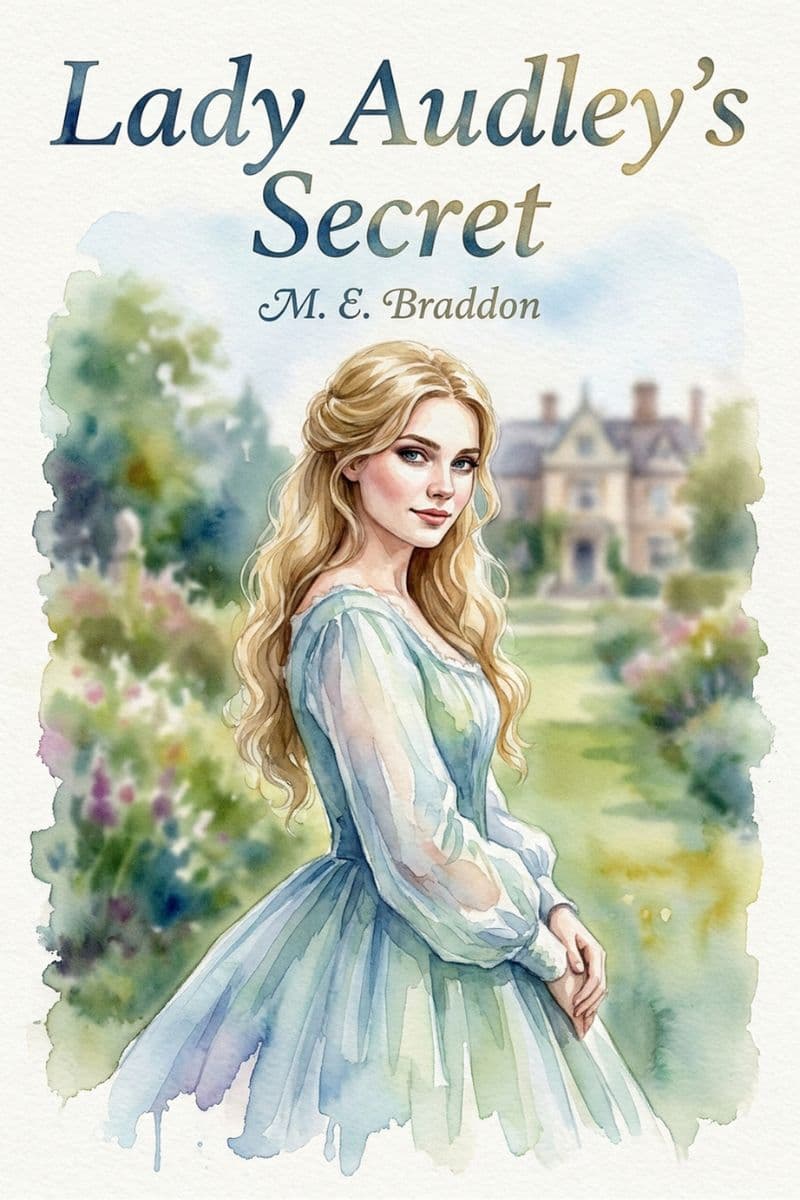
Braddon's first published novel appeared in 1860, and by 1862 she had written the book that would make her famous: Lady Audley's Secret. It was a sensation in every sense. The story of a beautiful woman with a horrifying secret became one of the bestselling novels of the Victorian era and essentially defined the "sensation novel" as a genre. Readers were scandalized and addicted in equal measure.
She wrote at a pace that seems almost impossible today. In the 1860s alone, she produced roughly twenty novels, sometimes three a year, all while raising a large and complicated family.
The Unconventional Life
Braddon's personal life was as sensational as her fiction. In 1861, she began living with the publisher John Maxwell, whose wife was confined to a mental institution. They couldn't legally marry, so they simply lived as husband and wife, scandalizing Victorian society. Braddon raised Maxwell's five children from his first marriage and bore him six more. They finally married in 1874 when Maxwell's first wife died.
She also founded and edited Belgravia magazine, which published fiction, poetry, and essays. She was not just a novelist but a literary entrepreneur.
Later Years and Legacy
Braddon continued writing into old age, producing over eighty novels across her career. Her later work moved away from pure sensation toward more psychologically complex fiction, earning her the respect of writers like Henry James and Robert Louis Stevenson. She died in 1915 at the age of seventy-nine, still writing.
For much of the twentieth century, Braddon was dismissed as a mere entertainer. More recently, scholars have recognized her as a sharp social critic, a pioneer of the thriller genre, and a woman who used fiction to expose the dark underbelly of respectable Victorian life.
Fun Facts About the Book
A Deliberate Rewrite of Madame Bovary
Braddon openly acknowledged that The Doctor's Wife was inspired by Flaubert's Madame Bovary. She called Flaubert's novel a work of "hideous immorality," which was probably at least partly strategic, since publicly condemning the French novel gave her an excuse to borrow its premise. Both books feature a dreamy, novel-addicted woman trapped in a marriage to a dull country doctor. But Braddon took the story in a very different direction, and the differences say as much about the two cultures as the similarities do.
"This Is Not a Sensation Novel"
At one point in the text, Braddon's narrator announces: "This is not a sensation novel. I write here what I know to be the truth." It's a wonderfully cheeky moment, given that the book contains secret identities, criminal fathers, blackmail, and violence. Braddon was simultaneously trying to prove she could write serious literary fiction and unable to resist the thriller instincts that made her famous. The tension between those two impulses is part of what makes the book so interesting.
The Built-In Self-Parody
One of the novel's best characters is Sigismund Smith, a cheerful young writer of penny dreadfuls who is almost certainly a parody of Braddon herself. He writes cheap serialized adventure stories, talks obsessively about plotting murders for his fiction, and provides most of the book's humor. Having a sensation author as a character in a novel that keeps insisting it isn't a sensation novel is exactly the kind of joke Braddon loved.
Serialized in Temple Bar
The novel was first published as a monthly serial in Temple Bar magazine throughout 1864, then released as a three-volume novel. Braddon herself edited Temple Bar for a time, making her both the author and, effectively, the publisher of her own work. She understood the business of fiction as well as anyone in Victorian England.
The Protestant Bovary
Scholars have noted that Braddon made one crucial change from Flaubert's original: Isabel does not commit adultery. Her emotional attachment to Roland is intense and consuming, but it remains unconsummated. Braddon later said this was due to Protestantism and a platonic concept of love. Whether that's the real reason or a concession to what English readers could tolerate in 1864 is an open question.
A Book Drunk on Books
The novel is packed with literary references. Nearly every page contains allusions to Dickens, Byron, Shelley, Tennyson, and dozens of other writers. Isabel doesn't just read books; she filters her entire experience of reality through them. Modern editions often include extensive notes to explain references that Victorian readers would have caught immediately.
Themes
The Danger of Living in Stories
Isabel's central problem is that she has confused fiction with life. She expects her existence to have the shape and intensity of a novel, and when it doesn't, she can't cope. Braddon is fascinated by what happens when someone builds their entire identity out of books and then has to confront a world that refuses to cooperate.
Marriage as a Trap
Isabel marries George without loving him, hoping marriage itself will provide the adventure she craves. Instead, it becomes a cage. George is not a bad husband. He's kind, faithful, and completely oblivious. The horror of Isabel's situation is that there's no villain to blame. Just two people who should never have married each other, locked together by law and custom.
The Inner Life of Women
The novel is deeply concerned with what happens inside Isabel's head, a space her husband never thinks to enter. Braddon makes the case that a woman's intellectual and emotional life matters, even when the world around her treats it as irrelevant. Isabel's longing isn't trivial. It's the central fact of her existence, and the people who dismiss it are the ones who fail her.
Class and Worth
George earns his living through honest work. Roland inherited his wealth and his estate. The novel plays these two men against each other not just as romantic rivals but as representatives of different ideas about what gives a person value. Neither comes off entirely well.
The Gap Between Desire and Reality
Everything Isabel wants is slightly out of reach, slightly impossible, slightly imaginary. Braddon is interested in that gap, the space between what we dream about and what we actually get, and whether the dreaming itself is the disease or the only thing keeping us alive.
The Book's Legacy
The Doctor's Wife occupies a strange and interesting place in literary history. It's both a sensation novel and a deliberate attempt to transcend the genre. It's a rewriting of Madame Bovary that takes its source material and turns it into something distinctly English and distinctly Braddon's own.
For decades, the book was overshadowed by Lady Audley's Secret, but readers who discover it often find it the more rewarding of the two. Where Lady Audley's is all plot and shock, The Doctor's Wife is quieter, stranger, and more emotionally complex. It's a novel about a woman who is trapped not by a scheming villain but by her own imagination and by a society that has no room for what she needs.
Braddon's exploration of a woman consumed by fiction feels remarkably modern. In an age of social media and curated lives, the idea of someone who can't stop comparing their reality to an impossible ideal hits differently than it did in 1864. Isabel Gilbert might be the first great fictional portrait of someone who is, in the most literal sense, terminally online, just with books instead of screens.