Novelhalla
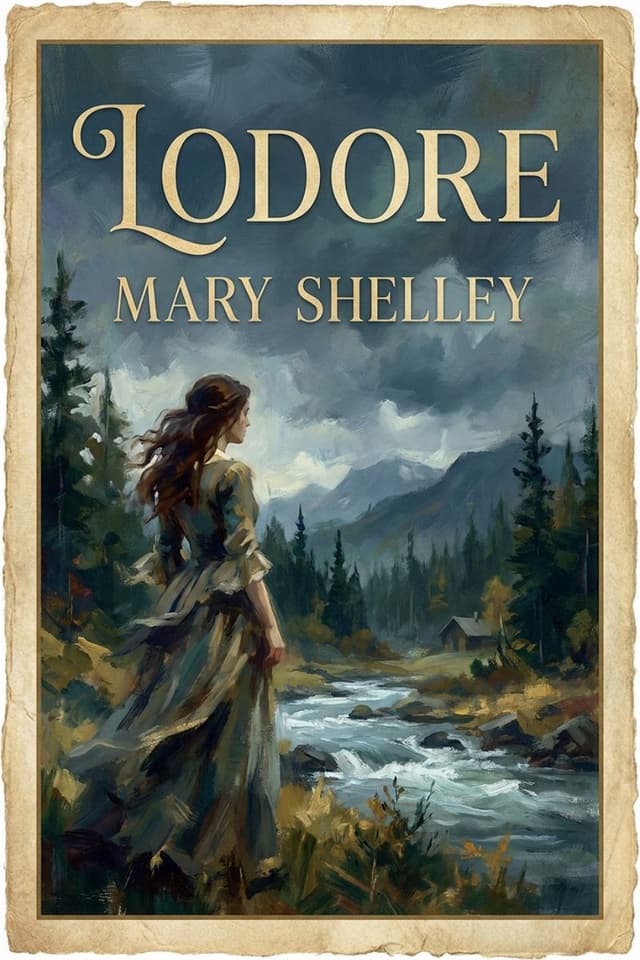
Lodore
Read Lodore by Mary Wollstonecraft Shelley for free on Novelhalla, and try out our easy-to-read modern edition of this classic book. You can also download the EPUB and read it on any device if you prefer!
The original is written in three volumes. This page only has our Modern version, the "Read Original" button here will fail to load. If you'd like to read the classics please visit Gutenberg.org to download them.
The Plot
A Family Shattered
The novel opens in the quiet village of Longfield in Essex, where Elizabeth Fitzhenry lives a modest and solitary life. She is waiting, as she has waited for years, for some word of her brother, Lord Lodore, who vanished from England long ago under circumstances no one in Longfield fully understands. The village knows only fragments: that he married a breathtaking young woman, that something went wrong, and that he disappeared.
The story then reaches back to explain how the family fell apart. Lord Lodore is a man of noble instincts and deep passions, but also of pride, restlessness, and poor judgment. His marriage to the very young and very beautiful Cornelia seems brilliant on the surface. But Cornelia has been raised by her mother, the calculating Lady Santerre, to value appearances, social standing, and control above all else. She is not cold by nature, but she has been shaped into something ornamental and guarded. She does not know how to love openly, and Lodore does not know how to be patient.
Jealousy, meddling, and wounded pride do their work. The marriage fractures beyond repair, and Lodore makes a drastic decision: he takes their infant daughter, Ethel, and leaves England entirely, retreating to the wilderness of Illinois in America. Cornelia remains behind with her mother. Mother and daughter are separated, and the separation will last for years.
A Daughter Raised in the Wild
In the forests along the Illinois River, Lodore raises Ethel in near-total isolation. He educates her himself, molding her according to his own ideals of what a woman should be: gentle, devoted, dependent, entirely oriented toward the care and comfort of others. It is an education born of love but also of control. Ethel grows up innocent, affectionate, and deeply attached to her father, but she has no experience of the world, no practical skills, and no sense of herself as an independent person.
When Lodore finally resolves to bring Ethel back to England, the journey home is cut short by violence. A duel, tangled in old grievances and wounded pride, leaves Ethel suddenly and completely alone. She is still a teenager. She has no money, no mother, and an upbringing that has prepared her beautifully for a world that does not exist.
Three Women, Three Educations
What follows is the real heart of the novel. Ethel returns to England and must find her way in a society she does not understand. She falls deeply in love with Edward Villiers, a young man of good family and generous heart who has, unfortunately, almost no money. Their devotion to each other is genuine and touching, but devotion does not pay creditors, and the threat of financial ruin presses closer with every chapter.
Meanwhile, Cornelia, Lady Lodore, moves through fashionable society, outwardly polished but inwardly hollow. She has a daughter she has never reached for. The question of whether pride or feeling will win out in her is one of the novel's most compelling threads.
And then there is Fanny Derham, Ethel's closest friend and the novel's most remarkable figure. Where Ethel was educated to be dependent and Cornelia was trained to be decorative, Fanny has been taught to think for herself. She is intelligent, principled, and unafraid. She does not need anyone's protection. She represents the road not taken, the kind of woman either of them might have become with a different upbringing.
The novel traces these three women as they navigate love, money, estrangement, and the long shadow of a dead man's choices, building toward a question that matters far more than any plot twist: can a family broken by pride and bad education ever be made whole again?
About the Author: Mary Wollstonecraft Shelley
A Radical Inheritance
Mary Shelley was born Mary Wollstonecraft Godwin on August 30, 1797, in London, and her parentage alone would have made her remarkable. Her mother was Mary Wollstonecraft, the author of A Vindication of the Rights of Woman and one of the founding voices of modern feminism. Her father was William Godwin, a political philosopher, novelist, and one of the leading radical thinkers of his age. Mary never knew her mother. Wollstonecraft died of puerperal fever eleven days after giving birth to her. The loss haunted Mary for her entire life and echoes through nearly everything she wrote. She grew up reading her mother's books and visiting her grave in the churchyard of St Pancras, where she would sit and read and, eventually, meet the man who would change her life.
Godwin remarried in 1801. His new wife, Mary Jane Clairmont, brought two children of her own into the household, and the relationship between Mary and her stepmother was tense from the start. Mary's education was informal but rich. She had access to her father's enormous library, and the household received a steady stream of distinguished visitors, among them Samuel Taylor Coleridge, who once recited "The Rime of the Ancient Mariner" while young Mary hid under the parlor sofa to listen.
Elopement and Tragedy
In 1814, when she was sixteen, Mary fell in love with Percy Bysshe Shelley, a twenty-one-year-old poet, radical, and devoted disciple of her father. Percy was already married. Mary eloped with him anyway, accompanied by her stepsister Claire Clairmont, and her father refused to speak to her for over two years.
The years that followed were extraordinary and devastating. Mary and Percy traveled restlessly through Europe, always short of money, always surrounded by brilliant company. Their circle included Lord Byron, Leigh Hunt, and a constellation of writers, artists, and thinkers. But the losses were relentless. Mary's first child, a baby girl, died at just a few days old. A son, William, died of malaria in Rome at the age of three. Another daughter, Clara, died in Venice at barely a year old. Only their fourth child, Percy Florence, survived to adulthood.
In the summer of 1816, during a stay near Lake Geneva with Byron and others, Byron proposed that everyone write a ghost story. Mary, eighteen years old, produced the tale that became Frankenstein, published anonymously in 1818 to immediate success. She was not yet twenty.
Widowhood and Writing
Percy Shelley drowned in a sailing accident in the Gulf of Spezia on July 8, 1822. He was twenty-nine. Mary was twenty-four, a widow with a toddler son and very little money. She kept his heart, wrapped in silk, in her writing desk for the rest of her life.
She returned to England and devoted herself to two tasks: supporting herself and Percy Florence through her writing, and preserving and promoting Percy's literary legacy. She edited his Posthumous Poems (1824), his Poetical Works (1839), and his prose, adding notes that remain essential to Shelley scholarship today.
Her own literary output was substantial. After Frankenstein came six more novels: Valperga (1823), a historical romance set in medieval Italy; The Last Man (1826), a visionary novel about the extinction of humanity by plague that is now recognized as an early masterpiece of science fiction; The Fortunes of Perkin Warbeck (1830); Lodore (1835); and Falkner (1837). She also wrote short stories, travel books, biographical essays for Lardner's Cabinet Cyclopaedia, and reviews.
Mary Shelley died on February 1, 1851, in London, likely from a brain tumor or a series of strokes. She was fifty-three. She was buried at St Peter's Church in Bournemouth. Her son and daughter-in-law later had the remains of both her parents exhumed from St Pancras and reburied beside her, reuniting in death the family that had never been whole in life.
Fun Facts About the Book
The Other Title
Lodore was also published under the title The Beautiful Widow, a name that shifts the emphasis from the domineering patriarch to the women left to navigate his wreckage. Both titles were used during Shelley's lifetime, depending on the edition and the market.
Hidden Autobiography
Readers and critics have long recognized that Lodore is one of Shelley's most autobiographical novels. The financial desperation of Ethel and Edward Villiers closely mirrors the struggles Mary and Percy Shelley endured during their early years together, when creditors hounded them relentlessly. One scholar described the novel as Shelley's attempt to split her late husband into two characters: the noble, courageous Lord Lodore on one hand, and the nervous, introverted Francis Derham on the other. Biographer Charlotte Gordon called it Shelley's "most radical book to date."
Her Mother's Unfinished Conversation
The character of Fanny Derham has been widely interpreted as Shelley's tribute to both her parents. Fanny embodies the educational ideals championed by Mary Wollstonecraft and the political philosophy of William Godwin. Scholar Lisa Vargo has described the entire novel as an "imagined conversation" between Shelley and her mother on the subject of how daughters should be raised, a conversation that Wollstonecraft's early death made impossible in life.
A First for Shelley
Lodore marked a significant departure in tone from Shelley's earlier novels. Frankenstein, The Last Man, and her other works are steeped in tragedy and desolation. With Lodore, she attempted something different. Whether she fully pulled it off is a matter of readerly debate, but the shift itself reveals a writer willing to take risks even in her sixth novel.
Critical Success
Contemporary reviewers received Lodore warmly. Fraser's Magazine praised its "depth and sweep of thought." The Literary Gazette called Shelley "one of the most original of our modern writers." It was her most commercially successful novel since Frankenstein, and it proved that she was far more than a one-book author.
An American Wilderness
The Illinois frontier scenes in the novel's early chapters are among the most unusual passages in English domestic fiction of the 1830s. The story moves from the drawing rooms of London society to the forests along the Illinois River and even to Niagara Falls, giving the novel a geographic sweep that was quite surprising for a book often compared to Jane Austen.
A Silver Fork in Disguise
At first glance, Lodore appears to be a "silver fork" novel, the popular Regency-era genre about life in fashionable society. But Shelley's version subverts the form from within. Beneath the polished surfaces and social maneuvering lies a fierce critique of how patriarchal culture educates women into helplessness and then punishes them for being helpless.
Themes
The Education of Women
This is the novel's great subject. Shelley places three women at its center, each shaped by a radically different upbringing, and watches what happens. Ethel, educated by her father to be dependent and decorative, nearly drowns in the real world. Cornelia, raised by her mother to value appearances above feeling, becomes hollow and miserable. Fanny, taught to think and act for herself, thrives. The novel is essentially an argument, dramatized through lived experience, for the kind of egalitarian education that both Mary Wollstonecraft and William Godwin championed.
The Damage Fathers Do
Lodore loves his daughter, but his love is possessive and controlling. He raises her not as a full human being but as his ideal of femininity, training her to be exactly the kind of wife he wished he had married. The result is a young woman who is sweet, loyal, and almost completely helpless. Shelley is unflinching in showing how even well-intentioned paternal authority can cripple the people it claims to protect.
Marriage, Money, and Survival
The novel's middle sections are a sustained, unsentimental examination of what happens when love meets poverty. Ethel and Edward adore each other, but adoration does not prevent humiliation, debt, and the threat of prison. Shelley writes about money with the hard-won clarity of someone who spent years dodging creditors herself. She understood, as few novelists of her era did, that financial vulnerability is not merely inconvenient but existential, particularly for women who have been given no tools to manage it.
Mothers and Daughters
The estrangement between Cornelia and Ethel runs through the entire novel like a wound that will not close. Shelley, who lost her own mother eleven days after birth, returned again and again in her fiction to the theme of absent, damaged, or failed maternal bonds. In Lodore, she explores that theme with more directness and emotional investment than anywhere else in her work.
Independence vs. Dependence
Fanny Derham stands as the novel's living argument for female independence. She does not need a husband to define her. She does not collapse when the world turns hostile. She has been taught to think, to act, and to endure. Set against Ethel's learned helplessness and Cornelia's social armor, Fanny's quiet self-possession is the most radical thing in the book.
The Long Shadow of the Dead
Lord Lodore dies early in the novel, but his influence saturates everything that follows. His decisions about Ethel's education, his role in the estrangement from Cornelia, and his model of patriarchal authority continue to shape events long after his death. Shelley understood, from her own life, how the dead can go on governing the living.
The Book's Legacy
When it was published in 1835, Lodore was the most successful novel Mary Shelley had written since Frankenstein. Reviewers praised it, readers bought it, and for a brief moment it seemed to establish her as a major voice in the literary landscape of the 1830s. But the novel's reputation faded quickly. By the end of the nineteenth century, critics dismissed it as old-fashioned, and for most of the twentieth century it was read, when it was read at all, mainly by scholars mining it for autobiographical clues about the Shelleys' circle.
That has changed. The feminist literary scholarship of the 1970s and after brought renewed attention to all of Mary Shelley's work, and Lodore has been a particular beneficiary. Modern readers and critics have recognized it as one of her most politically engaged novels, a book that uses the conventions of domestic fiction to mount a serious argument about gender, education, and power. Lisa Vargo's 1997 Broadview edition, with its extensive introduction and contextual materials, did much to make the novel accessible to a new generation.
Lodore is not Frankenstein. It has no monster, no arctic ice, no laboratory horror. It is a quieter book, and a more intimate one. But in some ways it is bolder. Shelley put aside the Gothic and the apocalyptic and trained her intelligence directly on the world she lived in: the drawing rooms and debtor's prisons, the failed marriages and flawed educations, the women who were shaped by men's ideals and then left to survive the consequences. It is the work of a writer who had lost nearly everyone she loved and still believed that education could liberate, and that women deserved better than the world had so far offered them.
For readers who think of Mary Shelley as the author of one famous novel, Lodore is a revelation. It shows the full range of her mind: the social critic, the feminist thinker, the grieving daughter and mother, the woman who knew what it meant to be broke, heartbroken, and brilliant all at once.