Novelhalla
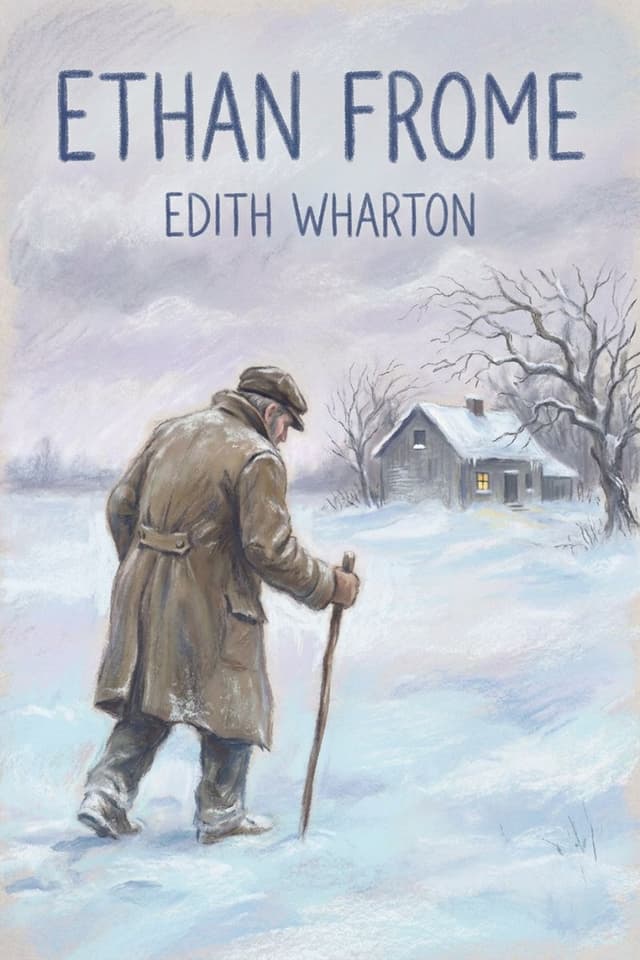
Ethan Frome
Read Ethan Frome by Edith Wharton for free on Novelhalla, and try out our easy-to-read modern edition of this classic book. You can also download the EPUB and read it on any device if you prefer!
The Plot
The Ruin of Ethan Frome
A stranger arrives in Starkfield, Massachusetts for a winter work assignment and notices a man at the post office. He's tall, or he was once. Now he's bent, scarred, and dragging one leg behind him. His name is Ethan Frome. The locals say he's been like that since "the smash-up" twenty-four years ago, but nobody wants to talk about what happened. Eventually a blizzard forces the stranger to spend the night at Frome's farmhouse, and what he sees there tells him everything he needs to know.
The story goes back.
A Life Interrupted
Twenty-four years earlier, Ethan Frome is twenty-eight and already a man whose dreams have been amputated one by one. He wanted to be an engineer. He went to college. He got a taste of a bigger, brighter world. Then his father died. Then his mother got sick. He came home to run the failing farm and sawmill in a frozen corner of Massachusetts where nothing grows and nobody leaves.
His cousin Zeena came to help nurse his mother. After his mother died, the silence of the farmhouse was so unbearable that Ethan married Zeena mostly to have another human voice in the house. It was a mistake he understood almost immediately.
Within a year, Zeena transformed. She became consumed by illness, real or imagined, ordering patent medicines by mail, visiting doctors in distant towns, cataloguing her symptoms with the devotion other people give to hobbies. She is cold, sharp-eyed, and relentlessly dissatisfied. The farmhouse feels less like a home than a sickroom with a permanent patient.
Ethan is trapped. He can't sell the farm. He can't afford to leave. He can barely afford to stay.
Mattie
Then Mattie Silver arrives, and the air in the house changes.
She's Zeena's cousin, young and orphaned and penniless, sent to help with the housework in exchange for room and board. She's not particularly good at housework. She burns things and forgets things and can't quite get the hang of the kitchen. None of that matters. What matters is that she laughs. She notices the sunset. She looks at Ethan like he's a person and not a piece of furniture.
Ethan falls in love with her slowly and then all at once. They never say it. They barely touch. But walking home together through the snow at night, sitting by the fire when Zeena is asleep, sharing a glance over the supper table, they build an entire unspoken world between them. The tension is exquisite and agonizing, because both of them know that nothing about their situation allows for what they feel.
One Evening
Zeena leaves overnight to see a new doctor in a neighboring town. For the first time, Ethan and Mattie are alone in the house together. They have supper. They sit by the fire. Mattie has set out Zeena's prized red glass pickle dish, the one kept on the highest shelf and never used, to make the evening feel special.
The cat knocks the dish off the table. It shatters.
It's a tiny disaster, but it lands like a prophecy. Ethan pieces the broken dish back together and hides it on the shelf, hoping Zeena won't notice. Everything fragile in this house is about to break, and gluing the pieces back together won't save any of it.
The Reckoning
Zeena comes home with news that changes everything. The new doctor says she's sicker than anyone realized. She's hiring a professional girl to replace Mattie. Mattie has to go. Tomorrow.
Ethan panics. He tries to think of ways to stop it. He considers running away with Mattie. He drafts a letter to Zeena. He imagines borrowing money, starting over somewhere else. But every plan collapses under the weight of poverty, obligation, and the simple, crushing fact that he has nothing to offer and nowhere to go.
He is asked to drive Mattie to the train station. Their last ride together. The road passes the long hill above the village, the one with the big elm tree at the bottom. And somewhere between goodbye and oblivion, a desperate idea takes shape.
What happens on that hill is the heart of this story. It's the moment where love and despair and twenty-four years of silence all converge. And the stranger who walked into the Frome farmhouse during a blizzard is about to find out what it cost.
About the Author: Edith Wharton
Born to Privilege
Edith Newbold Jones was born in 1862 into one of New York's oldest aristocratic families. The phrase "keeping up with the Joneses" is widely believed to have originated with her relatives. She grew up surrounded by wealth, private tutors, and European travel. She was expected to marry well, host parties, and absolutely not become a writer.
Her mother, Lucretia, was particularly opposed to the idea of her daughter pursuing anything so vulgar as a literary career. Edith wrote anyway, secretly at first, publishing poems in magazines as a teenager.
Marriage and Misery
In 1885, at twenty-three and approaching what her society considered dangerously old-maid territory, Edith married Edward "Teddy" Wharton, a pleasant, outdoorsy Boston gentleman thirteen years her senior. They were intellectually and sexually incompatible almost from the start. The marriage was apparently never a physically intimate one, and Edith suffered a series of nervous breakdowns in the 1890s.
She coped by writing. Her first published book was actually about interior design, but fiction quickly became her focus. In 1901, she designed and built The Mount, a grand estate in Lenox, Massachusetts, where she hosted literary society and wrote her finest work. Her friendship with Henry James, who became her close friend and sharpest critic, deepened during these years.
The Breakthrough
The House of Mirth, published in 1905, was both a critical triumph and a bestseller. It established Wharton as one of America's most important novelists. Meanwhile, Teddy's mental health deteriorated. He suffered from manic depression, embezzled from Edith's trust fund to support a mistress, and was eventually institutionalized. Edith began an affair with journalist Morton Fullerton, finding the intellectual and emotional connection her marriage had never provided.
The Whartons divorced in 1913. Edith moved permanently to France and never really came back.
War, Writing, and Legacy
When World War I broke out, Wharton threw herself into humanitarian work with extraordinary energy, establishing charities, refugee hostels, and schools. She visited the front lines as a journalist. France awarded her the Legion of Honor.
She kept writing through all of it. The Age of Innocence, published in 1920, won the Pulitzer Prize in 1921, making Wharton the first woman ever to receive the award. She was also nominated for the Nobel Prize in Literature three times. She published more than fifty books in her lifetime, including novels, novellas, short stories, travel writing, and criticism. She died in 1937 at her home in France, at seventy-five, still working.
Fun Facts About the Book
It Started as a French Homework Assignment
Wharton originally wrote the story of Ethan Frome as a composition exercise while studying French in Paris. The tale sat unfinished for years before she picked it back up and transformed it into an English-language novella. The homework assignment that became a masterpiece.
Based on a Real Sledding Accident
In 1904, while living in Lenox, Wharton learned about a real sledding accident on Courthouse Hill. A group of young people crashed into a lamppost. One girl was killed. Wharton became friends with one of the survivors, Kate Spencer, who worked with her at the Lenox Library. The real accident's details are grimmer than fiction, with five people involved instead of two.
Wharton Didn't Call It a Novel
Wharton was always careful to refer to Ethan Frome as a "reminiscence" rather than a novel. At around 30,000 words, it's technically a novella, but more than that, she seemed to want to frame it as something overheard, pieced together, half-imagined. The frame structure of the narration reinforces this. We're told this story by someone who is guessing at most of it.
A Departure from Her World
Nearly all of Wharton's other major fiction takes place among the wealthy elite of New York society. Ethan Frome is set among impoverished rural farmers in the Massachusetts hills. She drew on her decade living in Lenox to create Starkfield, but the class world of the book is entirely different from anything else she wrote. It's as if she needed to leave her own milieu to write the purest version of the trapped-by-duty story that haunted her.
The Name Says Everything
The fictional town is called Starkfield. Stark field. Wharton was not being subtle about the emotional landscape she was creating. The name mirrors the barren, frozen, unforgiving world her characters inhabit, both physically and spiritually.
A Bestseller and a Controversy
Ethan Frome was a commercial success when it appeared in 1911, but it divided critics. Some praised its haunting power and restraint. Others, notably Lionel Trilling, dismissed it as lacking moral significance. The debate hasn't fully settled. What nobody argues about is its emotional impact. The ending is one of the most devastating in American literature, and the kind of thing that stays with you for days.
Themes
Entrapment
Every character in this story is stuck. Ethan is stuck on the farm, in his marriage, in poverty, in Starkfield. Zeena is stuck with illness and isolation. Mattie is stuck with no money, no family, and no options. The landscape itself, frozen and impassable for months, is a physical manifestation of the emotional prison they all inhabit. Wharton builds the walls slowly and then shows you there's no door.
Duty vs. Desire
Ethan wants Mattie. He wants a different life. He wants to be the person he was becoming before obligation dragged him home. But he can't abandon a sick wife. He can't leave without money. He can't act on his feelings without destroying what little stability anyone around him has. The novel asks whether doing the right thing can slowly kill you, and doesn't offer a comforting answer.
Silence and Repression
Almost nothing in this book is said aloud. Ethan and Mattie communicate through glances, small gestures, the way they sit near each other. Ethan's inner life is rich and desperate, but he can barely articulate any of it. Wharton uses this gap between feeling and expression to generate almost unbearable tension. The things these people can't say to each other are the things that will destroy them.
The Crushing Weight of Poverty
This isn't just a love story. It's a story about what happens when you have no money and no options. Ethan can't leave because he can't sell the farm. He can't take Mattie away because he has nothing to take her to. Every escape route requires resources he doesn't have. Wharton, who came from extraordinary wealth, writes about poverty with sharp, clear-eyed compassion.
The Landscape as Character
The New England winter isn't just a backdrop. It's a force. The cold isolates people from each other. The snow makes travel dangerous. The frozen earth mirrors frozen lives. Wharton uses the setting so effectively that Starkfield feels less like a place and more like a condition.
The Book's Legacy
Ethan Frome is one of the most widely read American novellas, a staple of high school and college syllabi, and one of those books that people remember with a shudder decades after reading it. Its ending is regularly cited as one of the most shocking and devastating in American fiction.
The 1993 film adaptation starred Liam Neeson as Ethan, Joan Allen as Zeena, and Patricia Arquette as Mattie. A ballet adaptation, Snowblind, premiered with the San Francisco Ballet in 2018.
The book's influence extends beyond direct adaptations. Its portrait of rural isolation, thwarted desire, and the slow violence of a life without options resonates through American literature and film. Any story about people trapped by circumstance and geography, from Brokeback Mountain to Winter's Bone, owes something to what Wharton accomplished in these spare, devastating pages.
At barely over a hundred pages, Ethan Frome packs the emotional wallop of books three times its length. Wharton strips away everything except what matters: love, duty, cold, and the terrible arithmetic of a life with no way out. It's the kind of book you can read in an afternoon and think about for the rest of your life.