Novelhalla
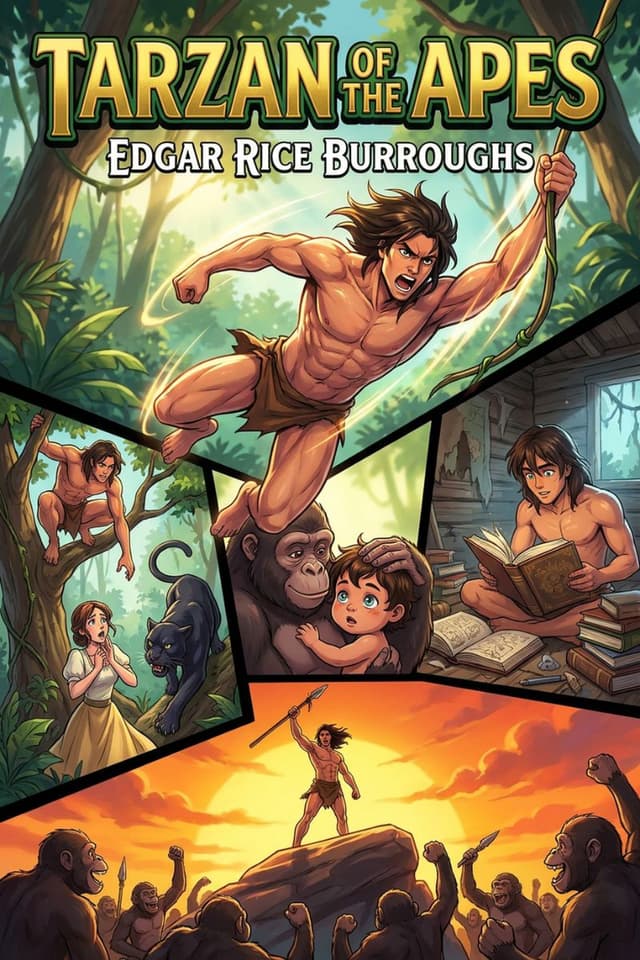
Tarzan of the Apes
Read Tarzan of the Apes by Edgar Rice Burroughs for free on Novelhalla, and try out our easy-to-read modern edition of this classic book. You can also download the EPUB and read it on any device if you prefer!
The Plot
Marooned
A young English nobleman, John Clayton, Lord Greystoke, and his pregnant wife Alice are sailing for the west coast of Africa when the crew of their ship mutinies. The mutineers, in a rare act of mercy, do not kill the Claytons. Instead, they maroon them on a remote, uncharted stretch of African coastline with a few supplies and no hope of rescue.
Clayton is resourceful. He builds a small cabin. He fights off wild animals. He does everything a man of his era and station can do to protect his wife in a wilderness that wants to kill them both. Alice gives birth to a son. But the jungle is relentless, and one by one, the things that connect the Claytons to civilization begin to fall away.
Within a year, both parents are dead. The baby is alone in a cabin on the edge of the world.
The Ape-Child
He does not stay alone for long. A band of great apes discovers the cabin. A female named Kala, who has just lost her own infant, hears the human baby crying and does something extraordinary. She takes him. She claims him as her own.
The boy grows up as a member of the ape tribe. They call him Tarzan, which in their language means "White Skin." He is smaller than the others, slower to develop, and painfully aware that he looks nothing like his family. Where they are massive and dark-furred, he is pale and hairless. He thinks he is ugly. He thinks he is weak.
He is wrong on the second count.
Becoming Tarzan
As he grows, Tarzan begins to discover what he is. He is faster in the trees than anyone realizes. He is clever in ways the apes are not. He teaches himself to swim when a predator chases him into water. He fashions ropes and learns to use them. And one day, exploring the jungle, he finds the cabin where he was born.
Inside are books. Picture books, primers, an alphabet chart. Tarzan has never seen written language before. He does not know what these strange marks mean. But something in him responds to them, and over the course of years, entirely on his own, he teaches himself to read and write English. He cannot speak it. He has no idea how the sounds work. But he can read. And through reading, he begins to understand that he is not an ape at all. He is something called a M-A-N.
He also finds a hunting knife. That knife changes everything.
King of the Jungle
Armed with his blade, his ropes, and an intelligence that none of the jungle's other inhabitants can match, Tarzan rises. He battles gorillas. He kills a lioness and takes her skin as his first clothing. He faces down Kerchak, the brutal leader of his ape tribe, and fights enemies that would terrify any man alive.
But Tarzan is not any man. He has the strength of a creature raised wild and the mind of a human being who has taught himself civilization from picture books. He becomes something the jungle has never seen before, a predator who can think, a thinker who can fight, a creature balanced on the razor edge between two worlds.
And then the two worlds collide.
The Strangers
A ship arrives. A party of people is stranded on the same stretch of coast where Tarzan's parents died decades before. Among them is an older professor, his companions, and his daughter. Her name is Jane Porter. She is the first white woman Tarzan has ever seen.
Tarzan watches these strange, clumsy, fascinating people from the trees. They cannot hunt. They cannot climb. They are helpless against the dangers that surround them every minute. He begins to protect them in secret, leaving food, driving off predators, a ghost in the canopy who never shows his face.
But the jungle is not content to let these visitors stumble along in peace. Something is coming for Jane. Something terrible. And when it does, Tarzan will have to step out of the shadows and reveal himself.
The Choice
What happens when a man who has never spoken a word of any human language meets the woman who makes him want to try? What happens when the Lord of the Jungle discovers he might also be the heir to an English title? And what happens when the world of drawing rooms and inheritance and civilization comes crashing into a life built in the treetops?
Tarzan has spent his entire existence mastering the jungle. Nothing in it can defeat him. But the human world has rules he has never learned, feelings he has never felt, and a question he is completely unprepared to answer: which world does he belong to?
About the Author: Edgar Rice Burroughs
Early Life
Edgar Rice Burroughs was born in Chicago in 1875, the youngest surviving son of a successful businessman and Civil War veteran. He was sent to a series of schools, including the prestigious Phillips Academy in Massachusetts (from which he was expelled) and Michigan Military Academy, where he graduated in 1895 and briefly stayed on as a teacher.
He failed the entrance exam for West Point and enlisted instead in the Seventh U.S. Cavalry, requesting the worst post in America. He got it. He was stationed at Fort Grant, Arizona, where he contracted dysentery and received an honorable discharge. He was twenty years old and had already failed at his first two career paths.
The Years of Failure
What followed was a staggering parade of unsuccessful ventures. Burroughs tried ranching in Idaho, running a stationery store, working as a railroad policeman, mining for gold in Oregon, selling pencil sharpeners door to door, and managing offices for businesses that kept collapsing under him. He worked at Sears, Roebuck and Company and impressed his bosses, but left because he wanted to be his own man. He tried that. It did not work either.
By 1911, he was thirty-six years old with a wife and three children, no stable career, and the creeping realization that he might be sliding out of the middle class entirely.
The Unlikely Writer
Here is where the story turns. Burroughs was placing ads in pulp fiction magazines for one of his failing businesses. He started reading the stories in those magazines and had a thought that would change his life: he could write something at least as bad as this, and apparently people got paid for it.
He wrote a science fiction story about a man transported to Mars. The editor of All-Story magazine bought it immediately for $400. Burroughs's second attempt, a historical novel, was rejected. His third was a story about an English baby raised by apes in the African jungle. Tarzan of the Apes appeared in All-Story in October 1912 and was an immediate sensation. Burroughs received $700 for it, which was more money than most of his previous careers had provided.
He wrote eight novels in the following twelve months. He never looked back.
Success and Empire
Tarzan of the Apes was published as a novel in 1914 after being rejected by nearly every major publisher in the country. It became a bestseller. Burroughs went on to write twenty-three Tarzan sequels, ten Mars novels, and dozens of other adventure and science fiction books. He was one of the most popular writers in the world.
In 1919, he bought a ranch near Hollywood that he named Tarzana. A town grew up around it and officially took the name. In 1923, he became one of the first authors to incorporate himself, founding Edgar Rice Burroughs, Inc. He licensed Tarzan for films, comic strips, radio programs, and merchandise on a scale that anticipated modern franchise entertainment by decades.
Later Years
Burroughs divorced his first wife in 1934 and married the former wife of his friend, a marriage that also ended in divorce. During World War II, at age sixty-six, he became the oldest American war correspondent, covering the Pacific theater and witnessing the Japanese attack on Pearl Harbor alongside his eldest son.
He spent his final years in Encino, California, suffering from heart problems. He died on March 19, 1950, at age seventy-four, having published nearly eighty novels. At the time of his death, he was believed to have earned more from film adaptations than any other author in history.
Fun Facts About the Book
Written on a Dare to Himself
Burroughs did not set out to write great literature. He set out to write something publishable while working at a failing business. His famous motivation was looking at the pulp fiction he was advertising in and thinking he could do at least that well. He described his early stories as experiments to see what he could get away with. The result was one of the most iconic characters in the history of fiction.
Rejected by Every Major Publisher
After its enormous success as a magazine serial, Tarzan of the Apes was turned down by virtually every major book publisher in the country before A.C. McClurg and Company in Chicago finally accepted it in 1914. It became a bestseller almost overnight. McClurg went on to publish twenty-nine Burroughs titles.
The All-Story Magazine
Tarzan's first appearance was in the October 1912 issue of The All-Story, a popular pulp fiction magazine. The entire novel was published in a single issue. The response from readers was immediate and overwhelming. Letter after letter poured in to the editor demanding more Tarzan stories.
Burroughs Had Never Been to Africa
Burroughs wrote one of the most famous jungle adventure stories ever published without having set foot in Africa. His knowledge of the continent came entirely from reading. The jungle in Tarzan of the Apes is less a realistic portrayal of equatorial Africa than a mythic landscape, a dangerous paradise built from imagination, library books, and pure storytelling instinct.
The Romulus and Remus Connection
When asked about his inspiration, Burroughs consistently pointed not to Rudyard Kipling's The Jungle Book (published in 1894) but to the Roman legend of Romulus and Remus, twin brothers raised by a she-wolf who went on to found Rome. Kipling himself acknowledged the connection between the two works, noting wryly that Burroughs had taken the concept and thoroughly made it his own.
Tarzan Speaks Ape, Reads English
One of the novel's most unusual details is that Tarzan teaches himself to read and write English from picture books and primers found in his dead parents' cabin, without ever hearing a word of the language spoken aloud. He can compose written notes in English but cannot pronounce a single word of it. He eventually learns to speak French before he ever speaks English.
The Name
"Tarzan" means "White Skin" in the invented language of the apes. Burroughs created an entire vocabulary for the ape tribe, with specific words for different animals, actions, and concepts. Some of these invented terms, like "Mangani" for the great apes and "Tantor" for elephant, appear throughout the long series of sequels.
A Franchise Before Franchises Existed
Burroughs was decades ahead of his time in understanding how to turn a fictional character into a commercial empire. He licensed Tarzan for films starting in 1918, launched a comic strip in 1929, created a radio serial, and merchandised the character aggressively. In 1923, he incorporated himself as a business, something virtually no author had done before. Modern franchise entertainment owes a significant debt to the model Burroughs pioneered.
Themes
Nature vs. Civilization
The novel's central tension is the pull between the wild and the civilized. Tarzan is born an English aristocrat and raised as a jungle animal. Which identity is real? Is civilization something you learn, or something you are? Burroughs keeps pushing the question without offering a comfortable answer, because Tarzan is magnificent in both worlds and fully at home in neither.
The Self-Made Man
Tarzan teaches himself everything. He learns to read without a teacher. He learns to fight without a trainer. He figures out tools, weapons, strategy, and survival entirely through observation and will. There is something deeply American about this fantasy, the idea that the right person, given nothing but raw ability and determination, can master anything.
Identity and Belonging
Tarzan spends his childhood believing he is an ugly, inferior ape. The discovery that he is actually human reshapes everything he understands about himself. But becoming human opens a new set of questions. Which humans? Which culture? Which world? The novel is a story about someone who keeps discovering new layers of who he might be and never quite settling the question.
The Power of Literacy
In a novel full of physical combat and jungle survival, the most transformative moment is quiet. A boy picks up a book. He stares at strange marks on a page. And over years of patient, solitary effort, he cracks the code. Literacy is the thing that separates Tarzan from everything else in the jungle. It is the bridge between his two worlds, and Burroughs treats it as an almost magical power.
The Book's Legacy
Tarzan of the Apes created one of the most recognizable fictional characters on the planet. Within six years of the novel's publication, Tarzan had appeared in his first film (1918, starring Elmo Lincoln), and the character has never left screens since. Over two hundred Tarzan films have been produced, from the iconic Johnny Weissmuller series of the 1930s and 40s to Disney's animated version in 1999 to The Legend of Tarzan in 2016.
The character has appeared in comic strips (starting with Hal Foster's newspaper strip in 1929), radio serials, television shows, Broadway musicals, and countless merchandise lines. Burroughs's California ranch became the town of Tarzana, and the character's name entered dozens of languages as a shorthand for wild, physical freedom.
Burroughs wrote twenty-three sequels, and the books have sold over thirty million copies in more than fifty languages. The character has been played by Olympic athletes, bodybuilders, and Hollywood leading men. His yodeling jungle call, invented for the 1932 film by MGM's sound department, is one of the most instantly recognizable sounds in cinema history.
The novel itself is a product of its time, and modern readers will find elements that reflect the racial attitudes of early twentieth-century America in ways that are uncomfortable and worth acknowledging. But the core of the story, a child lost between two worlds, trying to figure out who he is, has an emotional power that transcends its era. That is why Tarzan endures. Not because of the vine-swinging or the chest-beating, but because somewhere underneath all the adventure is a question everyone recognizes: where do I belong?