Novelhalla
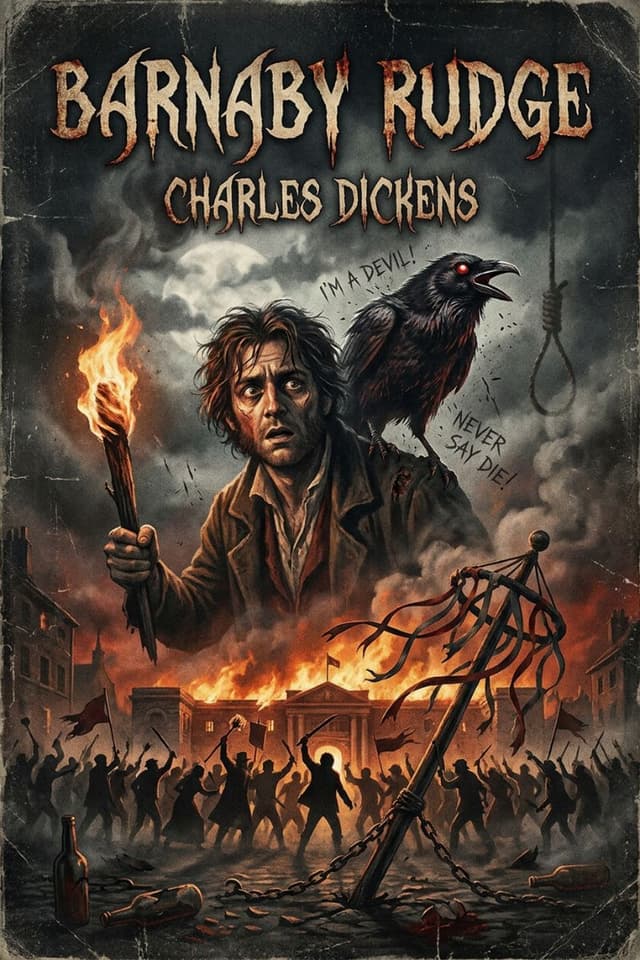
Barnaby Rudge
Read Barnaby Rudge by Charles Dickens for free on Novelhalla, and try out our easy-to-read modern edition of this classic book. You can also download the EPUB and read it on any device if you prefer!
The Plot
The Murder at the Warren
The story opens on a stormy night in March 1775, at the Maypole Inn in the village of Chigwell, twelve miles northeast of London. The innkeeper John Willet and his cronies sit around the fire telling a stranger about a local tragedy: twenty-two years ago, on this very date, Reuben Haredale, the wealthy owner of a nearby estate called the Warren, was found murdered in his home. His steward, a man named Rudge, was discovered dead in a pond on the grounds, apparently another victim. The gardener vanished and was never found. The case was never solved.
The stranger slips away into the storm, but he is not done with the people of Chigwell. He rides to London and tracks down a woman named Mary Rudge, the widow of the dead steward, and her grown son Barnaby. He demands money from her, and she is terrified of him.
Barnaby Rudge is a young man with an intellectual disability, born on the very night of the Haredale murder. He is gentle, exuberant, oddly dressed, and accompanied everywhere by his pet raven, Grip, a chattering, mischievous bird who is considerably sharper than his master. Barnaby and Grip are well known and generally well liked throughout the neighborhood.
Love and Scheming
Woven through the mystery is a love story. Edward Chester, a young Protestant gentleman, is in love with Emma Haredale, the Catholic niece of the murdered man's brother Geoffrey. The match is forbidden on both sides. Edward's father, Sir John Chester, is a smooth, calculating, self-serving man who wants his son to marry money. Geoffrey Haredale, Emma's guardian, despises Chester and his family. The two fathers, who loathe each other in every other respect, agree on one thing: the young lovers must be kept apart.
Meanwhile, Gabriel Varden, a kindly locksmith from Clerkenwell, moves between these worlds as a voice of honest decency. His household is a comedy of domestic warfare. His wife is a self-pitying religious enthusiast, manipulated by their treacherous maid Miggs. His apprentice Simon Tappertit is a vain, strutting little man who fancies himself a revolutionary leader and nurses a ridiculous infatuation with Varden's pretty daughter Dolly.
Dolly Varden herself is a coquette, flirtatious and charming, who strings along the lovesick Joe Willet, son of the Maypole's bullying innkeeper, until Joe can take no more of his father's tyranny and her indifference and leaves to join the army fighting in America.
The Coming Storm
The mysterious stranger continues to haunt and terrorize Mary Rudge, and she flees London with Barnaby to escape him, vanishing into the countryside. The story then leaps forward five years to 1780, and the novel's tone shifts dramatically.
Three horsemen stop at the Maypole Inn on their way to London. One of them is Lord George Gordon, the eccentric, charismatic president of the Protestant Association, who is whipping up fury against the Catholic Relief Act of 1778. The act had eased some of the legal restrictions on Catholics, and Gordon means to see it repealed.
The forces gathering around Gordon draw in characters from every strand of the story. Hugh, the Maypole's wild and brutish hostler, joins the cause out of sheer appetite for chaos. Simon Tappertit sees the movement as his chance for power. Ned Dennis, the public hangman, signs on with enthusiasm. And Barnaby, innocent and easily led, is swept up in the excitement of flags and marching without understanding what any of it means. His mother is powerless to stop him.
The Riots
What follows is Dickens at his most powerful. The Gordon Riots erupt across London. A petition to Parliament becomes a siege. Catholic churches and homes are torched. Prisons are stormed and burned. The mob attacks Newgate itself, and the sky over London glows with fire. The rioters loot a distillery and drink themselves into a frenzy among the flames.
Dickens portrays the riots as both terrifying and pitiable, a force of destruction fueled by genuine grievance, cynical manipulation, and blind stupidity in roughly equal measure. The mob is not a faceless mass but a collection of individuals, each with their own reasons for being there, few of them having anything to do with religion.
In the chaos, the personal stories collide with history. Emma Haredale and Dolly Varden are abducted. The Warren is burned to the ground. Barnaby is arrested and thrown into Newgate. And the secrets of the Haredale murder, buried for a quarter century, are finally dragged into the light.
About the Author: Charles Dickens
Early Life
Charles Dickens was born on February 7, 1812, in Landport, near Portsmouth, where his father John was a clerk in the Navy Pay Office. The family moved frequently during his childhood. When Charles was twelve, his father was imprisoned for debt in the Marshalsea Prison, and the boy was sent to work in a blacking warehouse, pasting labels on bottles of shoe polish. The experience lasted only a few months, but it scarred him for life and became the emotional engine behind much of his fiction.
Rise to Fame
After a brief education at Wellington House Academy and work as a solicitor's clerk and parliamentary reporter, Dickens began publishing sketches and stories in London periodicals. His first novel, The Pickwick Papers, appeared in serial form in 1836 and made him famous almost overnight. By the time he wrote Barnaby Rudge in 1841, he was twenty-nine years old and already the most popular novelist in England, with Pickwick, Oliver Twist, Nicholas Nickleby, and The Old Curiosity Shop behind him.
The Working Life
Dickens was a man of staggering energy. He wrote fourteen completed novels, edited weekly magazines, gave public readings that packed theaters on both sides of the Atlantic, campaigned for social reform, managed amateur theatrical productions, and walked miles through London at night when he could not sleep. He married Catherine Hogarth in 1836 and had ten children with her before their separation in 1858, a painful public affair that he handled badly.
Final Years
The public reading tours of his later years were enormously popular but physically devastating. Dickens drove himself relentlessly despite declining health. He suffered a stroke on June 8, 1870, while at dinner at his home, Gad's Hill Place in Kent, and died the following day at the age of fifty-eight. He was buried in Poets' Corner at Westminster Abbey, against his own wishes for a modest funeral.
Legacy
Dickens is widely regarded as the greatest novelist of the Victorian era and one of the most important writers in the English language. Characters like Scrooge, Fagin, Miss Havisham, and Mr. Micawber have entered the common imagination so thoroughly that people who have never read a word of Dickens know who they are. His novels remain in print, perpetually adapted, and perpetually read.
Fun Facts About the Book
The Novel That Wouldn't Be Born
Barnaby Rudge was supposed to be Dickens's first novel. He conceived the plot in 1836, when he was only twenty-four, and signed a contract to write it. But disputes with publishers, competing projects, and years of delays pushed the book back again and again. It finally appeared in 1841 as his fifth published novel. By that point, Dickens had been planning and abandoning it for five years.
Dickens's Own Raven
The character of Grip was based on Dickens's real pet raven, also named Grip. The bird lived with the Dickens family at their home on Devonshire Terrace in London. She had an extensive vocabulary, a talent for biting the children's ankles, and a habit of dominating the family's large dog. Dickens adored her and wrote to a friend that he intended to make a character out of her because she was "immeasurably more knowing" than the simple-minded Barnaby. Grip died in 1841, possibly from eating lead paint chips, and Dickens had her stuffed and mounted in a glass case. He kept the taxidermied bird in his study for the rest of his life.
The Raven That Inspired "The Raven"
Edgar Allan Poe reviewed Barnaby Rudge as it was being serialized and was fascinated by the character of Grip. In his review, Poe praised the raven but argued that Dickens had not used the bird to its full potential. A few years later, Poe published his poem "The Raven," and literary scholars have long noted the connection. The similarities are hard to miss. In chapter five of Barnaby Rudge, Grip makes a noise and a character asks what it was, to which another replies that it is someone knocking softly at the shutter. Poe's raven famously arrives by "gently rapping, rapping at my chamber door." The stuffed Grip can still be seen today in the Rare Book Department of the Free Library of Philadelphia.
The Dolly Varden Craze
One of the novel's most unexpected legacies had nothing to do with ravens or riots. Dolly Varden, the locksmith's flirtatious daughter, was described by Dickens in such vivid detail, right down to her cherry-colored mantle and little straw hat, that she became a fashion icon. After a painting of Dolly that Dickens had commissioned sold at auction following his death in 1870, a craze erupted. Victorian women adopted the "Dolly Varden" look, a style of brightly patterned floral dress with a polonaise overskirt inspired by the 1770s fashions Dolly would have worn. The name was also given to a hat, a type of fabric, a species of trout, a cake, and even a variety of horse.
Poe the Mystery Critic
In his review of the early installments, Poe predicted the solution to the novel's murder mystery before Dickens had published the ending. Poe laid out his theory of the killer's identity based on narrative clues in the early chapters, and he turned out to be correct. Whether this was a triumph of Poe's analytical mind or a sign that the mystery was too transparent is still debated.
The Real Maypole Inn
Dickens based the Maypole Inn on the King's Head in Chigwell, Essex, a real coaching inn dating to the sixteenth century. He loved Chigwell and once described it in a letter as "the greatest place in the world" with "such a delicious old inn opposite the churchyard." The King's Head still stands today, though it is now a Turkish restaurant rather than a pub.
Walter Scott's Shadow
Dickens wrote Barnaby Rudge in conscious imitation of Sir Walter Scott's historical novels, particularly The Heart of Midlothian, which also centered on a famous prison break. Dickens privately wanted to prove he could outdo Scott on his own ground. Whether he succeeded is a matter of taste, but his depiction of the storming of Newgate is regarded as one of the great set pieces in Victorian fiction.
A Warning to His Own Time
Though set in 1780, the novel was aimed squarely at the political anxieties of 1841. Dickens was writing during the rise of the Chartist movement, when mass working-class agitation for political reform was raising fears of revolution across England. The Gordon Riots, which had haunted British memory for sixty years, served as Dickens's historical analogy for what might happen if legitimate grievances were left to fester and exploited by demagogues.
Rarely Adapted
Barnaby Rudge is one of the least adapted of all Dickens's novels. A silent film was made in 1915, and the BBC produced a television version in 1960, but it has never received the lavish film or serial treatment given to Oliver Twist, David Copperfield, or Great Expectations. It remains, in the words of the Dickens biographer Peter Ackroyd, "one of Dickens's most neglected, but most rewarding, novels."
Themes
Fathers and Sons
Nearly every relationship between a father and son in the novel is poisoned. John Willet bullies Joe into submission. Sir John Chester manipulates and abandons Edward. Barnaby's father is a figure of terror who lurks in the shadows. Hugh never knew his father at all. Dickens, who never recovered from his own father's failures, returns again and again to the damage done when fathers fail their children.
The Mob and the Individual
The Gordon Riots allow Dickens to explore how individuals are absorbed into a crowd and lose themselves. Barnaby is swept into the riots without understanding them. Hugh joins for the thrill of destruction. Tappertit joins for vanity. Dennis joins to protect his professional interests. Dickens shows the mob as a force that dissolves individual conscience, where otherwise ordinary people commit acts they would never contemplate alone.
Innocence Exploited
Barnaby is the novel's clearest example, but the theme runs wider. The rioters are described as a mass of people manipulated by leaders who do not share their risks. Lord Gordon is sincere but deluded. Gashford is cynical. The people who burn and die in the streets are, for the most part, the poor and desperate, used as tools by those who will abandon them when the consequences arrive.
Locked Doors and Broken Gates
The novel is full of images of confinement and release. Newgate Prison looms over the story. Gabriel Varden makes his living building locks. The rioters break open prisons and set their inmates free. But freedom without direction becomes chaos. Dickens suggests that the destruction of old structures, however corrupt, does not by itself create justice.
Religious Intolerance
The Gordon Riots were nominally about religion, but Dickens shows that genuine religious conviction played almost no part in the violence. The rioters are motivated by fear, resentment, boredom, greed, and the sheer intoxication of power. The Catholic characters in the novel, particularly Geoffrey Haredale, are among its most honorable figures. Dickens makes clear that bigotry dressed up as faith is still bigotry.
Class and Merit
As in all of Dickens, the true measure of a person has nothing to do with birth. Gabriel Varden the locksmith is worth a hundred Sir John Chesters. Joe Willet, the bullied innkeeper's son, proves himself braver and more honorable than any gentleman in the story. The novel's villains are not the poor but the powerful who exploit them.
The Book's Legacy
Barnaby Rudge is not the Dickens novel most people read first, or second, or even fifth. It sits in the shadow of the great novels that came before and after it, overshadowed by the comedy of Pickwick, the social fury of Oliver Twist, the personal depth of David Copperfield, and the architectural grandeur of Bleak House.
But those who find their way to it discover something remarkable. The riot scenes are among the most vivid and harrowing passages Dickens ever wrote. His depiction of the storming of Newgate, the burning of the Warren, and the drunken destruction of a Holborn distillery has a cinematic power that feels startlingly modern. When Dickens wrote to his friend John Forster during composition, "I have just burnt into Newgate, and am going in the next number to tear the prisoners out by the hair of their heads," you can feel the wild energy that drives those chapters.
The novel also gave the world Grip the raven, a character who leapt off the page and into literary history, inspiring what may be the most famous poem in American literature. The stuffed body of Dickens's own Grip, the real bird behind the fictional one, still sits in its glass case in Philadelphia, linking two of the nineteenth century's greatest writers through the unlikely medium of a talkative, ankle-biting bird.
It is Dickens's first attempt at the historical novel, a form he would return to only once more with A Tale of Two Cities. If that later book is the more polished work, Barnaby Rudge has a wild, Gothic energy that the more disciplined Tale of Two Cities does not attempt. It is a novel about how quickly civilization can unravel, how easily ordinary people can be turned into a mob, and how the innocent are always the first to suffer when the world catches fire.